

Top 10 Business Applications of Smart Contracts in 2025
Smart contracts are no longer a niche concept for crypto enthusiasts; they've evolved into powerful tools driving tangible business automation and efficiency. These self-executing contracts, with the terms of the agreement directly written into code, operate on a blockchain, making transactions traceable, transparent, and irreversible. They eliminate the need for intermediaries, drastically reduce administrative overhead, and build trust in environments where it is traditionally scarce.
For any business handling complex payments, multi-party agreements, or conditional transactions, understanding the practical applications of smart contracts is now essential for maintaining a competitive edge. From automating global supply chain payments to creating fraud-proof loyalty programs, their impact is transforming core operational workflows. Successfully deploying these contracts requires precision and a deep understanding of both blockchain technology and business logic. To effectively implement these innovative solutions and unlock their full potential, businesses often rely on expert fintech software development services.
This article moves beyond theory to explore 10 powerful, real-world examples that showcase not just the 'what,' but the strategic 'how.' We will break down each use case, providing actionable insights into deploying these solutions to unlock new levels of security, speed, and cost savings in your own operations. You will learn how to implement automated payment settlements, manage decentralized escrow, streamline royalty distribution, and more, with clear takeaways for each application.
1. Automated Payment Settlement and Invoice Management
One of the most powerful applications of smart contracts is revolutionizing traditional payment and invoicing workflows. Smart contracts automate payment settlements by executing transactions automatically once predefined conditions are met. This self-executing nature eliminates the need for manual invoice processing, reduces administrative overhead, and drastically shortens payment cycles.
Imagine a contract that holds funds in escrow and releases them only when a shipping API confirms a product has been delivered. This "if-then" logic is the core of automated settlement, replacing intermediaries and manual approvals with cryptographic certainty. The contract acts as a trustless third party, verifying conditions on-chain and instantly transferring funds.
Strategic Breakdown
- E-commerce Platforms: A platform can use a smart contract to auto-settle vendor payments the moment a customer's order is marked as "fulfilled" in their system. This improves vendor relationships by ensuring prompt, reliable payments.
- Freelance Marketplaces: For gig economy platforms, a smart contract can release payment to a freelancer as soon as a client digitally approves the submitted milestone or deliverable, preventing common payment disputes and delays.
- SaaS and Subscriptions: Subscription-based businesses can automate recurring billing. The smart contract can check if a service was active for the billing period and then execute the payment, streamlining revenue collection.
Actionable Takeaways
Implementing this requires careful planning to ensure the contract's triggers are reliable and secure.
- Use Oracles for External Data: Since blockchains cannot access external data directly, use a trusted oracle service to feed real-world information (like delivery status or task completion) to the smart contract.
- Implement Multi-Signature Controls: For high-value transactions, require multiple stakeholders to digitally sign off before a payment is executed. This adds a layer of security against unauthorized or erroneous settlements.
- Integrate with Payment APIs: To streamline the process, use a crypto payment gateway like BlockBee. Its API can generate unique deposit addresses for each transaction, making it easier to track and manage automated payment flows within your existing system.
By automating accounts payable, businesses can significantly reduce operational costs and build stronger relationships with suppliers and partners. For a deeper dive into this topic, you can explore how to implement automated accounts payable solutions.
2. Supply Chain Payment Authentication and Verification
Another transformative application of smart contracts is enhancing the integrity of supply chain finance. Smart contracts can authenticate and verify the completion of specific supply chain activities before automatically releasing payments. This ensures that funds are only transferred once goods and services meet predefined standards, creating a transparent, tamper-proof payment system.
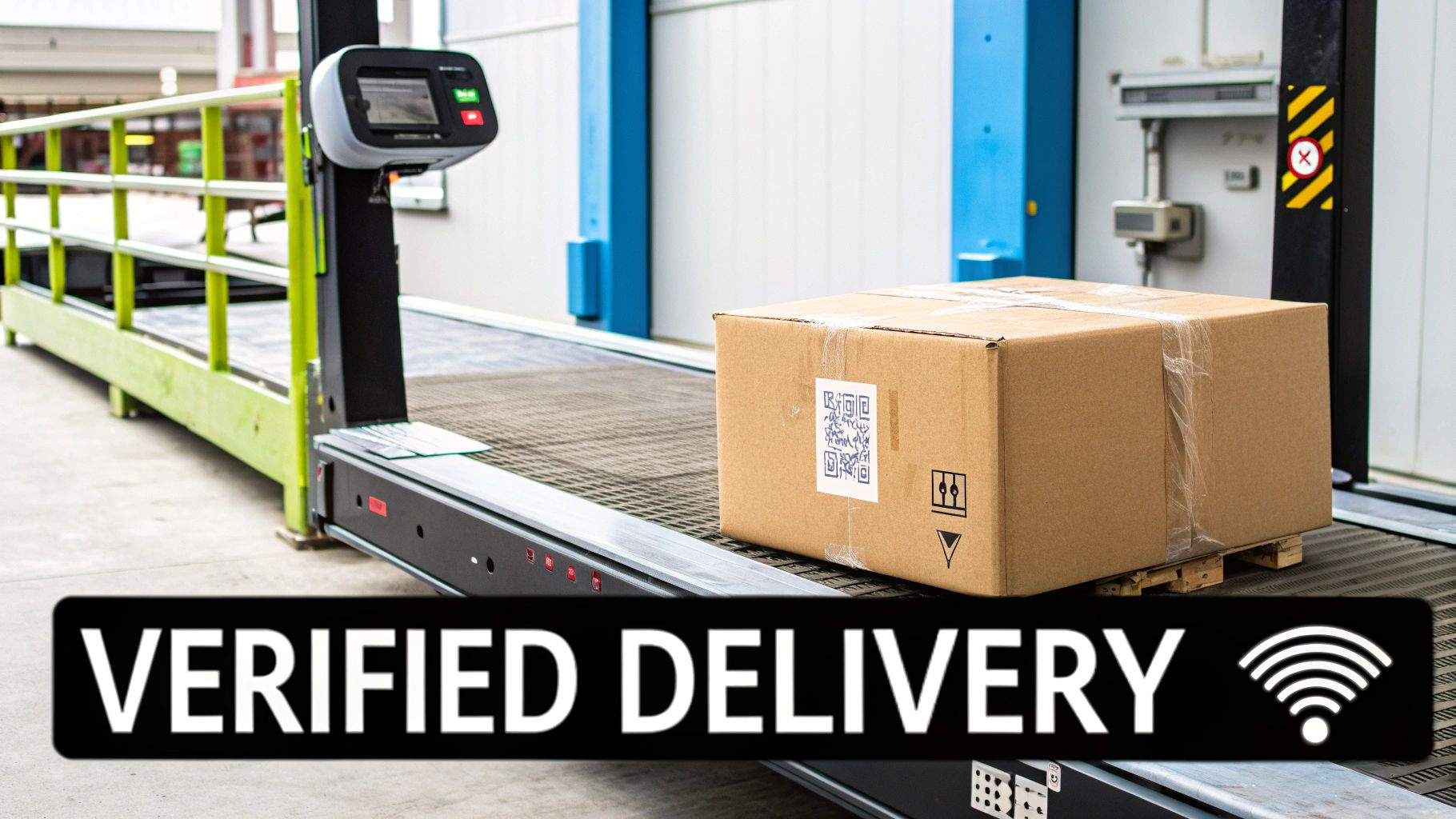
This model moves beyond simple delivery confirmations to include complex verifications like quality inspections, temperature monitoring, or customs clearance. A smart contract can be programmed to hold payment in escrow and only execute the transaction when all stipulated supply chain requirements are cryptographically confirmed, eliminating disputes and fraud.
Strategic Breakdown
- Import/Export Logistics: An international trade business can use a smart contract to release payment to an exporter only when a blockchain-based oracle confirms the goods have successfully cleared customs at the destination port.
- Pharmaceuticals and Cold Chains: For temperature-sensitive goods like medicine, a smart contract can connect to IoT sensors. Payment is automatically processed upon delivery, provided the sensors verify the shipment remained within the required temperature range throughout its journey.
- Agricultural Trade: A food distributor can automate payments to farmers. The smart contract releases funds once an independent inspector uploads a digital certificate confirming the harvest meets specific quality and safety standards.
Actionable Takeaways
Successful implementation hinges on reliable data feeds and clear, codified contract terms.
- Integrate with Oracle Networks: Use trusted oracle services like Chainlink to feed verifiable, real-world data (e.g., GPS location, customs status, IoT sensor readings) into the smart contract.
- Document Verification Requirements: Clearly define and code all conditions for payment release directly into the smart contract. This includes quality metrics, delivery timelines, and compliance checks, leaving no room for ambiguity.
- Support Global Suppliers: For international supply chains, utilize a multi-currency payment solution. BlockBee supports over 70 cryptocurrencies, enabling you to settle payments with diverse global suppliers in their preferred digital asset, simplifying cross-border transactions.
3. Subscription and Recurring Payment Automation
One of the most practical applications of smart contracts is automating subscription management and recurring payments. Smart contracts can execute scheduled payments on a recurring basis, pulling funds from a customer's wallet once predefined conditions are met. This self-executing model removes the need for traditional payment processors, reduces transaction failures, and minimizes administrative overhead for subscription-based businesses.
Imagine a smart contract that automatically checks a user's subscription status on a specific date each month. If the subscription is active, it executes the payment transfer. This "if-then" logic ensures consistent revenue collection and provides a seamless, "set-it-and-forget-it" experience for customers, replacing manual billing cycles with cryptographic reliability.
Strategic Breakdown
- SaaS Platforms: A software-as-a-service provider can deploy a smart contract to auto-bill users in cryptocurrency each month. The contract verifies continued service access and executes the payment, creating a decentralized and highly reliable revenue stream.
- Streaming Services: A decentralized streaming platform could use smart contracts to charge subscribers per episode viewed or on a standard monthly basis. The contract pulls funds only when content is accessed or the billing cycle renews.
- Membership and Fitness Apps: A fitness app can automatically debit members weekly for continued access to premium content or classes. This ensures prompt payment and eliminates the friction of manual renewals.
Actionable Takeaways
Implementing this requires a robust system for managing subscription states and handling potential payment issues.
- Define Programmable Payment Flows: Use a platform with programmable payment flows to define different subscription tiers, billing cycles, and payment conditions directly within the contract's logic.
- Implement Payment Failure Logic: Program the smart contract to send automated notifications if a payment fails due to insufficient funds. Incorporate a grace period to give customers time to top up their wallets before suspending service.
- Provide a Management Dashboard: Create a simple user interface where customers can view their subscription status, payment history, and manage or cancel their plan. This transparency builds trust and reduces support queries.
By automating recurring billing, businesses can secure predictable revenue and enhance customer retention. To further explore this topic, you can learn more about the best recurring billing software.
4. Decentralized Escrow and Multi-Party Transactions
Smart contracts excel at acting as trustless, automated escrow agents, fundamentally changing how multi-party transactions are secured. Instead of relying on a costly third-party service to hold funds, a smart contract locks assets and automatically releases them only when all predefined obligations are cryptographically verified. This removes the need for a trusted intermediary, slashes transaction costs, and creates a transparent, immutable record of the agreement.
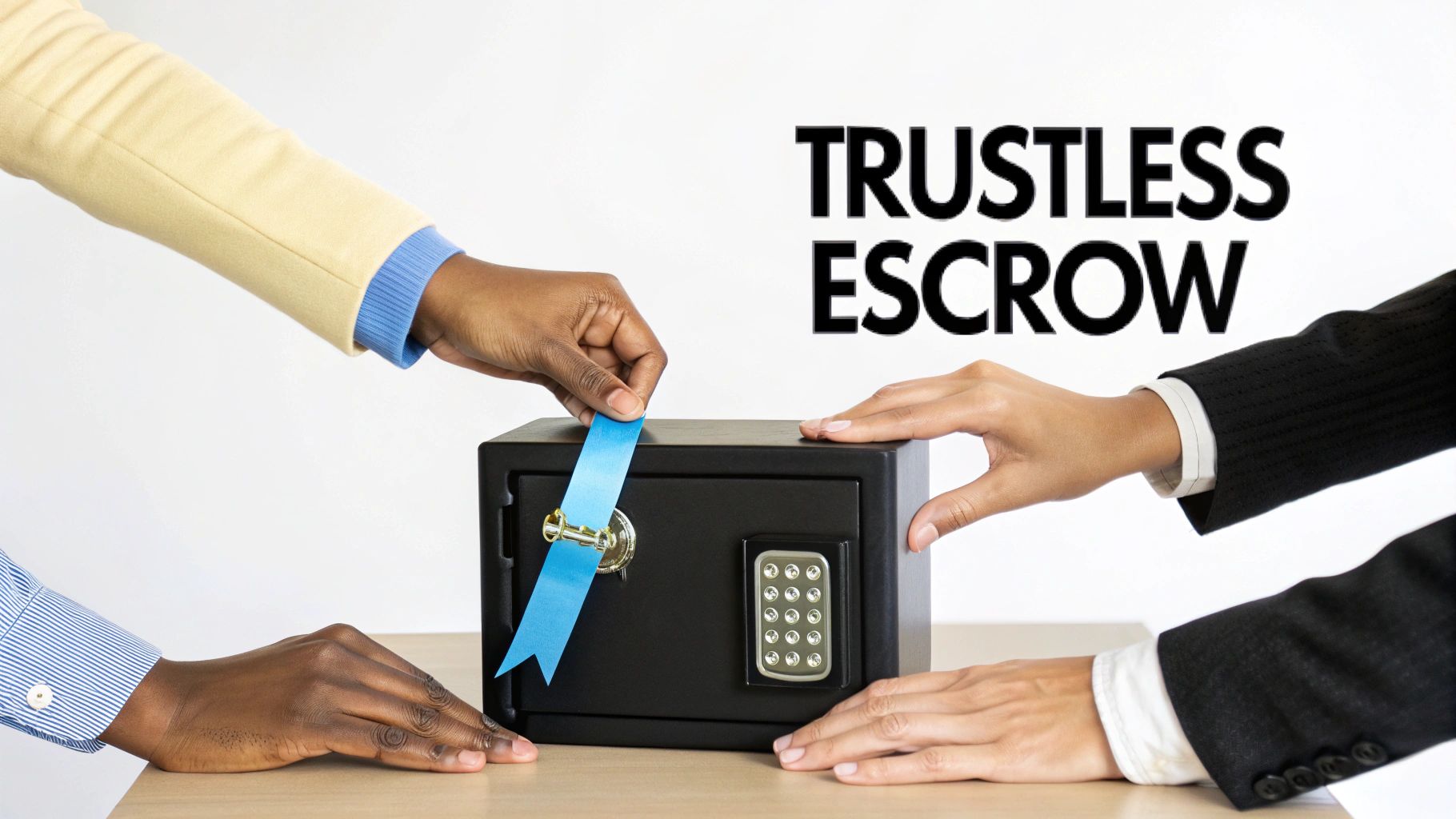
This automated process provides a powerful digital alternative to traditional financial mechanisms. By codifying the terms of an agreement, smart contracts can facilitate secure escrow payments, ensuring funds are held impartially until conditions are met. This is one of the most practical applications of smart contracts for building trust in peer-to-peer and B2B commerce.
Strategic Breakdown
- Freelance and Gig Platforms: A smart contract can hold a client's payment upon project initiation and automatically release it to the freelancer once the work is marked as complete and approved on-platform. This prevents payment disputes and builds trust.
- E-commerce Dispute Resolution: For high-value goods, a contract can hold the buyer's funds, releasing them to the seller only after the buyer confirms receipt or a specified return period expires. This protects both parties from fraud.
- B2B Supply Chain Milestones: In a complex B2B transaction, a contract can release partial payments as various quality assurance checkpoints are met and verified, ensuring vendors are paid promptly for completed work.
Actionable Takeaways
Deploying a decentralized escrow requires crystal-clear logic and robust security measures to be effective.
- Define All Conditions Explicitly: Before deployment, ensure every condition, trigger, and potential outcome, including dispute resolution paths, is clearly defined in the contract's code. Ambiguity is the enemy of automation.
- Implement an Arbitration Mechanism: For situations where conditions are disputed, build a fallback mechanism that allows a designated, trusted arbitrator to resolve the conflict and trigger the correct fund release.
- Use Reusable Addresses for Simplicity: Simplify the process of funding the escrow by using a solution like BlockBee, which can generate static, reusable deposit addresses for each agreement. This makes it easier for participants to send funds and for the system to track them.
By using smart contracts for escrow, businesses can create a more secure, efficient, and transparent environment for complex transactions.
5. Royalty Distribution and Revenue Sharing Automation
One of the most transformative applications of smart contracts lies in automating complex royalty distribution and revenue sharing. Smart contracts can instantly and transparently split incoming funds among multiple stakeholders according to predefined rules and percentages. This self-enforcing capability eliminates the friction, delays, and disputes common in creative industries and collaborative business models.

Imagine a music streaming platform where a smart contract receives a fan's payment. It instantly distributes a portion to the artist, the producer, the record label, and any other rights holders without manual accounting. The contract serves as an autonomous and incorruptible accountant, ensuring every contributor is paid their fair share in real-time, building trust and efficiency into the ecosystem.
Strategic Breakdown
- Music and Content Platforms: A smart contract can automate royalty splits for every song streamed or digital art piece sold. This guarantees that artists, collaborators, and platforms receive their exact percentages immediately upon payment.
- Software and Open-Source Projects: Repositories can use smart contracts to distribute royalties or donations to developers based on their code contributions, fostering a more incentivized and transparent open-source community.
- Digital Marketplaces: E-commerce or affiliate platforms can program a contract to automatically split revenue between the vendor, the affiliate who drove the sale, and the platform itself, streamlining complex commission structures.
Actionable Takeaways
Implementing automated revenue sharing requires a robust and transparent framework to manage distributions effectively.
- Design Clear and Testable Splits: Define royalty percentages directly in the contract's code and rigorously test all scenarios before deployment to ensure accuracy. The logic must be flawless to prevent payment errors.
- Plan for Future Adjustments: Build a governance mechanism into the smart contract, such as a multi-signature voting system, that allows stakeholders to update royalty splits if agreements change over time.
- Streamline Mass Payouts: Integrate a service like BlockBee’s Mass Payouts feature to execute the distributions. Once the smart contract calculates the splits, the API can efficiently send payments to dozens or hundreds of different wallets in a single, cost-effective transaction.
By automating royalty and revenue sharing, businesses can eliminate administrative bottlenecks, reduce costs, and provide unprecedented transparency to all partners and contributors.
6. Conditional Loyalty Programs and Reward Distribution
Another compelling application of smart contracts is the modernization of customer loyalty programs. Smart contracts automate the management and distribution of rewards by executing actions based on verifiable on-chain or off-chain customer behaviors. They can track purchases, referrals, or social engagement and instantly distribute loyalty tokens or crypto rewards once predefined conditions are fulfilled.
This approach creates a transparent and tamper-proof loyalty system where the rules are encoded and publicly verifiable. Instead of relying on a centralized database to manage points, the smart contract acts as an autonomous and impartial administrator, ensuring customers receive their rewards instantly and without dispute. This builds trust and enhances customer engagement through a more dynamic and interactive reward mechanism.
Strategic Breakdown
- E-commerce Rewards: A retail platform can use a smart contract to automatically issue a percentage of a purchase back to the customer as a stablecoin reward or a custom loyalty token the moment a payment is confirmed.
- Automated Referral Programs: A smart contract can track referral links and automatically distribute a commission in cryptocurrency to a user's wallet as soon as their referred friend makes their first purchase, eliminating manual payout processing.
- Engagement-Based Incentives: Media or community platforms can reward users with tokens for specific actions, like daily logins, content contributions, or social shares. The contract autonomously verifies these actions and distributes the rewards accordingly.
Actionable Takeaways
Building a smart contract-based loyalty program requires a focus on user experience and reward stability.
- Use Stablecoins for Rewards: To avoid price volatility concerns for customers, distribute rewards in stablecoins like USDT or USDC. This makes the reward value predictable and more attractive.
- Ensure Clear On-Chain Rules: The logic for reward calculation and distribution should be transparent and clearly defined within the smart contract's code. This transparency is a key selling point for a blockchain-based loyalty system.
- Integrate a Seamless Checkout: To link purchases directly to reward triggers, use a payment gateway like BlockBee. Its API can confirm a successful crypto payment, which then serves as the trigger for the smart contract to execute the reward distribution to the customer's wallet.
7. Automated Compliance and Regulatory Reporting
One of the most critical applications of smart contracts lies in automating complex compliance and regulatory reporting requirements. Smart contracts can embed legal and regulatory rules directly into their code, creating a self-enforcing system that prevents non-compliant transactions before they even happen. This drastically reduces the risk of human error and the high costs associated with manual compliance checks.
By encoding rules such as transaction limits, jurisdictional restrictions, or KYC/AML (Know Your Customer/Anti-Money Laundering) triggers, a smart contract acts as an automated compliance officer. It programmatically verifies that all conditions are met before executing a payment, creating an immutable and transparent audit trail on the blockchain for regulators.
Strategic Breakdown
- Financial Institutions: Banks and FinTech firms can use smart contracts to enforce daily withdrawal limits or flag transactions exceeding a certain threshold for automatic reporting, ensuring adherence to anti-money laundering regulations.
- Cross-Border Payments: A payment platform can deploy a smart contract that automatically blocks transactions to addresses or regions on a sanctions list, preventing violations and ensuring global compliance.
- Decentralized Finance (DeFi): DeFi protocols can integrate smart contracts that restrict access to users from prohibited jurisdictions or require specific identity verification tokens to participate, embedding compliance into the core protocol.
Actionable Takeaways
Automating compliance requires a robust connection between on-chain logic and off-chain regulatory data.
- Integrate with Compliance Oracles: Use trusted oracle services or APIs from firms like Chainalysis or TRM Labs to feed real-time, verified data (like sanctions lists or risk scores) into your smart contract.
- Design for Upgradability: Regulations change. Design your contracts with secure mechanisms for updates, allowing you to adjust compliance logic without redeploying the entire system and disrupting operations.
- Maintain Detailed Logs: Ensure your smart contract logs every compliance check, including both successful executions and rejected attempts. This creates a transparent, auditable record that is invaluable during regulatory reviews.
By automating compliance, organizations can build more secure, transparent, and efficient financial systems while significantly lowering their regulatory risk profile.
8. Dynamic Pricing and Margin Protection Contracts
One of the most practical applications of smart contracts is creating dynamic pricing models that protect business margins against market volatility. Smart contracts can automatically adjust the price of goods or services in real time by pulling data from external sources. This ensures pricing remains fair and competitive while safeguarding profitability from sudden market fluctuations or unpredictable blockchain transaction fees.
This self-adjusting mechanism is crucial in the volatile crypto space. A smart contract can query multiple price oracles to find a current, fair market exchange rate for a cryptocurrency at the moment of a transaction. It then locks in that price for the customer, preventing losses that could occur from price swings between checkout and payment confirmation.
Strategic Breakdown
- Crypto Payment Processing: A payment gateway can use a smart contract to fetch real-time exchange rates from several oracles. It then presents a locked-in price to the customer for a short period, guaranteeing the merchant receives the exact fiat value they expect, regardless of market movements.
- E-commerce Platforms: An online store accepting crypto can use a smart contract to dynamically adjust prices based on network congestion. During high-traffic periods with high gas fees, the contract could slightly increase prices to cover the additional cost, protecting margins.
- Commodity Trading: In digital asset trading, a smart contract can execute an order only when a specific, dynamically determined strike price is met. This automates trading strategies based on real-time market conditions without manual intervention.
Actionable Takeaways
Implementing dynamic pricing requires a robust and transparent setup to maintain customer trust and operational stability.
- Use Multiple Oracles: Rely on a decentralized network of price oracles or at least three independent sources to fetch market data. This prevents a single point of failure and protects against price manipulation from a compromised data source.
- Establish Clear Price Locks: Clearly communicate to the customer that the price is locked for a specific duration (e.g., 15 minutes) at checkout. This transparency prevents confusion and builds confidence in your payment process.
- Leverage Multi-Currency Support: To optimize pricing, integrate a solution like BlockBee, which supports over 70 cryptocurrencies. This allows the smart contract to find the most cost-effective payment route based on real-time network fees and liquidity.
9. Automated Vendor Onboarding and KYC Verification
Another powerful application of smart contracts is the automation of vendor onboarding and Know Your Customer (KYC) verification. Smart contracts can orchestrate complex, multi-stage verification workflows, ensuring vendors meet all compliance and operational requirements before they are integrated into a system or granted payment capabilities. This self-executing process minimizes manual intervention, reduces onboarding friction, and enforces compliance standards with cryptographic precision.
The contract functions as an automated compliance officer. It can be programmed to interact with external identity verification services, check credential databases, and validate business licenses. Once all predefined conditions are successfully met and verified on-chain, the contract can automatically grant the vendor official status, enabling their participation in the network or activating their payment account.
Strategic Breakdown
- Marketplace Platforms: An e-commerce marketplace can use a smart contract to verify a new seller's identity, business registration, and bank details through API calls to trusted services. The seller's account is only activated once the contract confirms all checks have passed.
- B2B Supply Chains: A manufacturing network can automate the onboarding of new suppliers. The smart contract could verify industry certifications, insurance coverage, and financial stability before adding the supplier to an approved vendor list and enabling B2B transactions.
- Fintech and Payment Networks: A fintech platform can automate partner verification by using a smart contract to confirm regulatory licenses and security compliance. Once verified, the contract can instantly activate the partner’s payment channels and transaction capabilities.
Actionable Takeaways
A well-designed automated onboarding process enhances both security and operational efficiency.
- Integrate with Trusted Oracles: Since KYC requires off-chain data, use reputable oracle services to securely feed identity verification results, credential statuses, and other real-world data to the smart contract.
- Prioritize Data Privacy: For handling sensitive personal or business information, explore using privacy-preserving technologies like zero-knowledge proofs. This allows the contract to verify a fact (e.g., "vendor is over 18") without exposing the underlying data.
- Automate Payout Activation: Once a vendor is successfully verified by the smart contract, integrate a service like BlockBee to automatically enable mass payout capabilities. This creates a seamless flow from verification to payment readiness without manual steps.
By automating these crucial front-end processes, organizations can accelerate growth, reduce administrative burdens, and ensure a secure and compliant ecosystem. To understand more about the importance of these verification steps, you can read about KYC in crypto.
10. Batch Processing and Mass Payment Execution
Among the most practical applications of smart contracts is the ability to execute mass payments efficiently. Smart contracts can bundle hundreds or even thousands of individual transactions into a single, atomic operation. This batch processing dramatically reduces transaction fees and administrative complexity associated with mass payout scenarios like payroll, affiliate commissions, or customer refunds.
Instead of initiating separate transactions for each recipient, a business can deploy a smart contract that distributes funds to a predefined list of addresses in one go. This process is not only cost-effective but also enhances transparency, as the entire batch operation is recorded as a single, easily auditable transaction on the blockchain. The contract executes the payouts automatically, ensuring all recipients are paid simultaneously and correctly.
Strategic Breakdown
- Enterprises and Payroll: A global company can use a smart contract to execute monthly salary payouts to its remote workforce. The contract pulls from a list of employee addresses and corresponding amounts, ensuring timely and transparent payroll across different geographies.
- Affiliate and Creator Networks: Platforms that manage large networks of affiliates or creators can automate commission distribution. The smart contract executes payouts to thousands of partners at the end of each payment cycle, eliminating manual processing and delays.
- E-commerce and Refunds: An online retailer can process a batch of customer refunds for returned goods. By bundling these payments, the business saves on network fees and ensures customers receive their funds promptly, improving satisfaction.
Actionable Takeaways
Implementing mass payouts requires a robust and secure framework to handle large-scale fund distribution.
- Leverage Mass Payout APIs: To simplify execution across multiple cryptocurrencies, use a specialized tool like BlockBee's Mass Payouts feature. This allows you to manage and execute bulk payments to thousands of addresses via a single API call, abstracting away the underlying blockchain complexities.
- Implement Pre-Execution Validation: Before triggering the smart contract, run a validation check on all recipient addresses and payment amounts. This proactive step helps prevent failed transactions within the batch, which can complicate reconciliation.
- Chunk Large Batches: For exceptionally large payout lists (e.g., tens of thousands of recipients), consider breaking them into smaller, more manageable chunks. This can help avoid hitting blockchain transaction size or gas limits and makes monitoring easier.
10 Smart Contract Applications Compared
| Title | Implementation Complexity 🔄 | Resource Requirements 💡 | Expected Outcomes ⭐ 📊 | Ideal Use Cases | Key Advantages ⚡ |
|---|---|---|---|---|---|
| Automated Payment Settlement and Invoice Management | Medium — smart contracts, multi-sig, oracle hooks 🔄 | Moderate — dev effort, audits, BlockBee integration 💡 | High — near-instant settlements, fewer errors, clear audit trail ⭐📊 | Vendor payouts, freelance marketplaces, SaaS billing | Instant settlements, lower overhead, immutable records ⚡ |
| Supply Chain Payment Authentication and Verification | High — IoT/oracle integration, multi-party rules 🔄 | High — IoT devices, reliable oracles, stakeholder onboarding 💡 | High — provenance, fraud reduction, dispute minimization ⭐📊 | Import/export, agriculture, pharma cold-chain, manufacturing | Tamper-proof conditional releases, increased transparency ⚡ |
| Subscription and Recurring Payment Automation | Low–Medium — scheduling, retry logic, state management 🔄 | Moderate — scheduling services, customer dashboards, refund handling 💡 | High — predictable revenue, reduced manual ops, timely receipts ⭐📊 | SaaS, streaming, fitness apps, tiered subscription services | Predictable cashflow, automated retries, seamless UX ⚡ |
| Decentralized Escrow and Multi-Party Transactions | High — multi-sig, arbitration/voting mechanisms 🔄 | High — thorough audits, dispute frameworks, careful contract design 💡 | High — trustless escrow, lower custodian costs, transparent records ⭐📊 | Freelance marketplaces, real estate, complex B2B deals | Removes intermediaries, milestone-based releases, cost savings ⚡ |
| Royalty Distribution and Revenue Sharing Automation | Medium — split logic, performance triggers, many recipients 🔄 | Moderate — mass-payout integration, accurate payment routing 💡 | High — instant fair payouts, fewer disputes, transparent accounting ⭐📊 | Music platforms, digital marketplaces, creator revenue sharing | Real-time splits, scalable distributions, dispute reduction ⚡ |
| Conditional Loyalty Programs and Reward Distribution | Medium — behavior tracking, tier logic, time locks 🔄 | Moderate — wallet infra, UI, token management; consider adoption 💡 | Medium–High — improved engagement, auditable rewards ⭐📊 | E-commerce rewards, referrals, membership programs | Instant verifiable rewards, reduced fraud, tiered incentives ⚡ |
| Automated Compliance and Regulatory Reporting | High — KYC/AML flows, sanctions screening, dynamic rules 🔄 | High — compliance APIs, legal review, robust logging 💡 | High — automated enforcement, immutable audit trails, lower risk ⭐📊 | Banks, cross-border payments, fintech platforms | Enforced compliance, faster approved processing, auditability ⚡ |
| Dynamic Pricing and Margin Protection Contracts | High — multi-oracle feeds, slippage and fee logic 🔄 | High — oracle redundancy, monitoring, customer communication 💡 | Medium–High — protected margins, adaptive pricing, transparent decisions ⭐📊 | Crypto payment processors, e-commerce price locks, traders | Margin protection, adaptive fees, real‑time price adjustments ⚡ |
| Automated Vendor Onboarding and KYC Verification | Medium–High — multi-stage workflows, privacy controls 🔄 | High — identity APIs, background checks, escalation paths 💡 | High — faster onboarding, consistent vetting, auditable records ⭐📊 | Marketplaces, B2B networks, payment partners | Faster activation, consistent vetting, reduced fraud risk ⚡ |
| Batch Processing and Mass Payment Execution | Medium — batching logic, gas limits, failure handling 🔄 | Moderate — mass-payout tooling, validation, chunking strategies 💡 | High — lower per‑payment costs, faster bulk settlements, auditability ⭐📊 | Payroll, refunds, affiliate/partner payouts, vendor settlements | Cost savings, atomic bulk execution, simplified reconciliation ⚡ |
Putting Smart Contracts to Work: Your Next Steps Toward Automation
Throughout this exploration of the diverse applications of smart contracts, a clear and consistent theme has emerged: the transformative shift from manual, trust-based processes to automated, trustless execution. We’ve moved beyond theory, examining practical, real-world use cases that are reshaping industries. From streamlining supply chain payments and automating royalty distributions to revolutionizing subscription models and securing multi-party escrow, smart contracts are no longer a futuristic concept but a present-day strategic tool.
The core value proposition is compelling and universally applicable. By encoding business logic directly onto a blockchain, organizations can drastically reduce administrative overhead, eliminate costly intermediaries, and accelerate transaction settlement times from days to mere seconds. This isn't just an incremental improvement; it's a fundamental re-architecting of how value is exchanged and managed.
Synthesizing the Strategic Vision
The ten applications we've detailed, including automated invoicing, conditional loyalty programs, and compliant mass payouts, all share a common DNA. They replace ambiguity with certainty, manual oversight with algorithmic precision, and centralized points of failure with decentralized resilience. The most critical takeaway is that this technology provides a framework for building self-enforcing, transparent, and highly efficient operational workflows.
Key Insight: Smart contracts are not just a payment technology; they are a business process automation engine. Their true power is unlocked when you view them as a way to automate complex, conditional agreements that were previously too costly or cumbersome to manage at scale.
This perspective is crucial. For e-commerce merchants, it means dynamic pricing that protects margins automatically. For SaaS businesses, it means a more reliable and flexible recurring revenue system. For global enterprises, it signifies a secure and auditable method for executing mass payments to vendors, partners, and creators worldwide.
Your Actionable Roadmap to Implementation
The journey into leveraging smart contract technology can seem daunting, but it can be distilled into a clear, strategic process. The goal is not to overhaul your entire operation overnight but to identify and execute a high-impact pilot project that demonstrates tangible value.
Follow these steps to begin your implementation:
- Identify the Core Friction Point: Review your current operations. Where do you experience the most significant delays, disputes, or manual processing costs? Is it in invoice reconciliation, royalty calculations, or managing multi-party transactions? Pinpoint the single biggest pain point that smart contract logic could solve.
- Define the "If-Then" Logic: Clearly map out the conditions and outcomes for your chosen process. For example: IF a product is verified as delivered on the supply chain, THEN release payment from escrow. IF a subscription renewal date is reached, THEN automatically debit the customer's wallet. This simple logic forms the foundation of your smart contract.
- Select the Right Foundational Tools: Integrating blockchain functionality doesn't have to mean building from scratch. This is where leveraging a robust crypto payment infrastructure becomes essential. A platform that provides a non-custodial payment gateway, a versatile API for mass payouts, and broad support for various cryptocurrencies handles the complex blockchain mechanics, allowing you to focus on the business logic itself.
By starting with a well-defined problem and utilizing a powerful API-driven platform, you de-risk the implementation and accelerate your time-to-value. The mastery of these applications of smart contracts will increasingly become a key competitive differentiator, enabling businesses to operate with greater speed, security, and efficiency in an increasingly digital and decentralized global economy. The time to move from exploration to execution is now.
Ready to bring the power of automated, secure crypto payments to your business? BlockBee provides the essential infrastructure, including a non-custodial API and a Mass Payouts feature, to seamlessly integrate the smart contract applications discussed. Explore our developer-friendly tools and start building more efficient payment workflows today at BlockBee.
Review Us