
What is web3 wallet? A Clear, Simple Guide
Think of a Web3 wallet as your personal key to the new, decentralized internet. It’s more than just a place to hold your crypto; it’s your digital identity and a secure vault for everything you own online, giving you true ownership and control over your data.
Your Digital Backpack for the New Internet
Imagine you're exploring a new digital world. Instead of creating a new username and password for every single site, you have one secure "backpack" that holds your ID, your money, and your access passes. That's exactly what a Web3 wallet does. It's the one tool you need to unlock everything the decentralized web has to offer.
With the old way of doing things, companies like Google or Meta are in charge of your account and your data. A Web3 wallet flips that script completely and puts you in the driver's seat. You hold the keys, you own your assets, and you decide who gets to see your information. This move toward self-sovereignty is what Web3 is all about. To get a deeper technical look, check out our guide on how crypto wallets work.
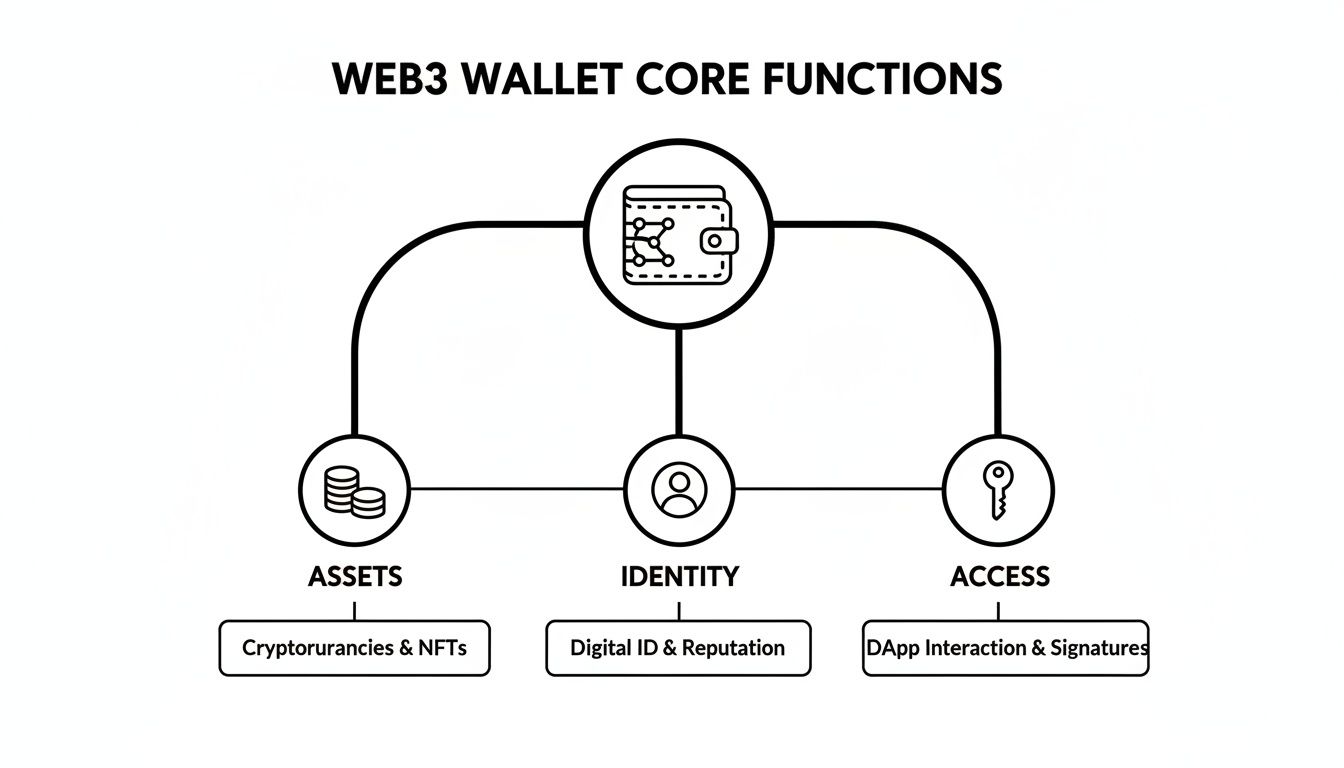
To truly grasp why these wallets are so important, it helps to break down what they actually do. The table below simplifies their main jobs.
Core Functions of a Web3 Wallet at a Glance
| Function | Simple Explanation | Real-World Example |
|---|---|---|
| Asset Management | A secure place to send, receive, and store digital money and items. | Buying an NFT from a marketplace and seeing it appear in your wallet's collection. |
| Identity Verification | Your wallet address acts as your anonymous ID, proving you own something. | Voting on a community proposal in a DAO by connecting your wallet to prove you're a token holder. |
| Application Access | A universal login for decentralized apps (dApps) without needing a password. | Connecting your wallet to a decentralized game to access your in-game items and character. |
These core functions are what make a Web3 wallet the central hub for all your decentralized activities.
The explosive growth in this space speaks for itself. The Web3 wallet market is on track to hit $19 billion this year alone. Even more telling, it’s expected to grow at 31.9% annually, rocketing past $100 billion by 2032. This isn't just a niche trend; it's a fundamental shift in how we'll interact with the internet. You can find more on these incredible Web3 wallet growth statistics to see just how fast things are moving.
A Web3 wallet fundamentally changes the user-platform relationship. Instead of being a product whose data is monetized, the user becomes a sovereign owner, interacting with platforms on their own terms. It’s a passport, not just a password.
Understanding Custodial vs Non-Custodial Wallets
When you’re stepping into the world of Web3 wallets, the most important decision you'll make comes down to a simple, crucial question: who holds the keys? This single choice determines whether you use a custodial or non-custodial wallet, and it completely redefines how you interact with your digital assets.
Think of it like this: is your money in a bank vault or in a personal safe buried in your backyard?
Custodial Wallets: The "Bank Vault" Approach
A custodial wallet is a lot like a traditional bank account. A third party—typically a crypto exchange where you buy and sell—holds and manages your private keys for you.
This approach is definitely convenient. If you forget your password, you can usually go through a simple recovery process, just like with any other online service. For newcomers, this familiarity can be a huge plus, as it lowers the barrier to entry and feels less intimidating. If you've ever purchased crypto on a big exchange and just left it sitting there, you were using a custodial wallet.
But that convenience comes at a cost: trust. You are trusting that company to keep your assets safe. If they get hacked, go bankrupt, or decide to freeze your account for any reason, your funds could be stuck or lost entirely. You're playing in their sandbox, by their rules.
The old saying in crypto is, "Not your keys, not your coins." This phrase was practically invented for custodial wallets. You have an IOU for your crypto, but you don't truly own it until you control the keys.
Non-Custodial Wallets: Your Personal Digital Safe
A non-custodial wallet, on the other hand, is your personal safe. You, and only you, have full, exclusive control over your private keys. This is the very essence of Web3—true ownership and self-sovereignty.
With this model, no one can freeze your funds or block your transactions. It's your money, full stop.
This complete control, however, comes with a healthy dose of personal responsibility. You are the one and only guardian of your "seed phrase"—a unique 12 or 24-word phrase that acts as the master key to your entire wallet. If you lose that phrase, there’s no customer support line to call. Your assets are gone for good.
For a deeper dive into this, you can read our guide on the finer points of non-custodial crypto wallets.
As you can see in the diagram below, your wallet is the command center for your digital assets, your identity, and your access to Web3 applications. This is why holding your own keys is so powerful.
To make the differences even clearer, let's break them down side-by-side.
Custodial vs Non-Custodial Wallets Head-to-Head
This table puts the two approaches in direct comparison, helping you see where each one shines and where the trade-offs lie.
| Feature | Custodial Wallet (Like a Bank) | Non-Custodial Wallet (Your Personal Safe) |
|---|---|---|
| Private Key Control | A third-party holds your keys. | You have 100% control of your keys. |
| Security | You trust the company's security. | You are responsible for your own security. |
| Account Recovery | Usually easy (e.g., password reset). | Impossible if you lose your seed phrase. |
| Ease of Use | Very beginner-friendly. | Requires more learning and responsibility. |
| Censorship Risk | Your account can be frozen or seized. | Your assets cannot be frozen by anyone. |
| Ownership | You have an IOU for your assets. | You have direct, undisputed ownership. |
Ultimately, the choice depends on your needs. For individuals, it's a balance of convenience and control.
For businesses looking to accept crypto, a non-custodial payment gateway like BlockBee offers the best of both worlds. It gives you the sophisticated tools needed to manage payments, invoicing, and mass payouts, all while ensuring your company retains absolute control over its funds. This is a non-negotiable for serious financial operations and security.
Choosing Between Hot and Cold Storage
Once you've decided who holds your keys, the next big question is where to store them. This is where the concepts of hot and cold storage come in, and the best way to think about it is to compare it to how you handle your everyday money.
Think of a hot wallet like the cash you keep in your physical wallet or your debit card. It’s always online, usually as a browser extension or a mobile app, making it super convenient for daily spending. If you want to grab an NFT, play a Web3 game, or send a quick payment, a hot wallet is your best friend. But that constant internet connection is also its biggest weakness, leaving it more exposed to online threats like hacks and phishing scams.
A cold wallet, on the other hand, is like stashing gold bars in a bank vault. It’s a physical device—often looking like a USB stick—that keeps your private keys completely offline. Creating this "air gap" from the internet gives you the strongest possible protection against digital theft. It’s the gold standard for securing serious, long-term investments. To dig deeper into how they work, our guide explains in detail what a cold storage wallet is and how it keeps your assets safe.
Hot Wallets Explained
Hot wallets are software wallets that live online, which is exactly why they’re so good for frequent use.
- Convenience: You get instant access to your funds for trading, using dApps, or anything else you do frequently, all without fumbling for a separate device.
- Accessibility: Since they're on your computer or phone, you can make transactions from anywhere, anytime.
- Risk Factor: Their always-on nature makes them a juicy target for cybercriminals. The rule of thumb is to only keep "walking around money" in a hot wallet, not your life savings.
Cold Wallets Explained
Cold wallets, often called hardware wallets, are all about putting security first by taking your keys offline.
- Maximum Security: Your private keys never touch an internet-connected device, which walls them off from malware, spyware, and remote attacks.
- Long-Term Storage: This is the go-to solution for "hodling" or safeguarding large crypto positions that you don't need to touch often.
- User Responsibility: Using one is a more hands-on process. You need the physical device to approve transactions, which adds a few steps and isn't ideal for quick, back-to-back actions.
The core principle is simple: use hot wallets for spending and cold wallets for saving. This hybrid approach lets you tap into the convenience of Web3 while keeping the vast majority of your assets locked down and secure.
It’s interesting to see how security practices play out in the real world. While the Web3 security market is expected to hit a staggering $68.8 billion by 2033, user habits don't always keep pace. Only 13.86% of users actually use professional hardware wallets for offline storage. In contrast, a surprising 34.65% still rely on simple paper backups. This shows a major gap between the security tools available and what people actually do, a trend highlighted in this analysis of Web3 wallet security trends. Picking the right storage method is one of the most fundamental steps you can take to protect yourself in the digital world.
Protecting Your Digital Assets Like a Pro
In the world of Web3, there's a popular saying: "Be your own bank." It's an empowering idea, but it also means you're your own head of security. This shift in responsibility is crucial, and it all boils down to one thing: protecting your seed phrase.
Think of your seed phrase (also called a recovery phrase) as the master key to your entire crypto life. It's a unique string of 12 to 24 words that lets you restore your wallet and access all your assets from any device, anywhere. If someone else gets their hands on these words, they get everything. It's that simple.
It cannot be overstated: Your seed phrase is the most valuable secret you will ever own. Protecting it is not just a best practice; it is the only thing that guarantees the safety of your funds in a non-custodial wallet.
Your Seed Phrase Do's and Don'ts
Keeping this master key safe is an active, hands-on job. Storing it digitally is a huge mistake because anything connected to the internet can be a target for hackers.
What you MUST do:
- Write it down: Go old school. Use a pen and paper and store it in a secure physical location, like a safe deposit box or a fireproof safe at home.
- Create multiple copies: Store these copies in different, equally secure physical spots. This is your backup plan against disasters like a fire, flood, or just misplacing one.
- Consider durable materials: For serious crypto holdings, people often engrave their seed phrase on metal plates to make it resistant to physical damage.
What you MUST NEVER do:
- Never save it on your computer, in a cloud drive (like Google Drive or Dropbox), or in a password manager.
- Never take a screenshot or a photo of it with your phone.
- Never, ever share it with anyone. No legitimate company or support agent will ever ask for your seed phrase. If they do, it's a scam.
Building Strong Security Habits
Beyond just guarding your seed phrase, your daily digital habits are your next line of defense. Scammers are always cooking up new phishing scams—convincing fake websites, emails, or DMs designed to trick you into connecting your wallet and signing a malicious transaction.
Always be skeptical. Double-check every URL before you connect your wallet. Be wary of unsolicited offers that seem too good to be true or "urgent" security alerts that create a false sense of panic.
For any wallet apps you use, make sure you have a strong, unique password and turn on two-factor authentication (2FA) if it's an option. If you're managing significant assets, a hardware wallet is the gold standard, as it keeps your keys completely offline and out of reach from online threats.
This mindset extends beyond just your wallet. A holistic approach means securing all your online activities. It might even be worth conducting a comprehensive website security audit to identify any broader risks in your digital footprint. By combining iron-clad physical security for your seed phrase with smart, vigilant online habits, you can navigate the decentralized world with confidence and keep what's yours, yours.
How Businesses Are Using Web3 Wallets
While most people think of Web3 wallets as a personal key to the decentralized web, businesses are quickly realizing they're also powerful tools for overhauling financial operations. For a company, a Web3 wallet is more than just a digital vault; it's a direct line to global commerce, efficient payments, and entirely new ways to connect with customers.
This shift is changing the very nature of how companies handle money. By building Web3 wallet infrastructure into their systems, merchants can finally break free from the old headaches of traditional banking, like sky-high cross-border fees and painfully slow settlement times. Suddenly, they're operating in a borderless financial world.
And this isn't some far-off trend. A staggering 70% of individuals in emerging markets are already planning to use at least one Web3 service. This signals a huge new customer base for any business ready to meet them where they are. With the crypto wallet market expected to explode from $12.20 billion in 2025 to $98.57 billion by 2034, this is no longer a niche—it's the future of finance. You can dig into more of these Web3 adoption statistics to see just how big the opportunity is.
Accepting Global Payments Seamlessly
One of the biggest and most immediate wins for businesses is the ability to take crypto payments from anyone, anywhere on the planet. A Web3 wallet address works like a universal payment channel, cutting out the need for a tangle of different payment processors and messy currency conversions.
Think about it from an e-commerce perspective. A customer in Japan can buy a product from a merchant in Brazil as if they were in the same room. The money moves directly from one wallet to the other, usually with far lower fees than you'd ever see with credit card networks or international wire transfers.
For businesses, a Web3 wallet isn't just a way to accept crypto—it's a tool for cutting out operational drag. It takes the complicated mess of international banking and boils it down to a single, secure, and transparent system.
Tools like BlockBee provide the API infrastructure that makes all this possible without a steep learning curve. Merchants don't have to become blockchain experts overnight. They can simply plug in a non-custodial payment gateway that gives them total control over their funds while offering customers a clean, modern checkout process.
Streamlining Mass Payouts and Refunds
Getting money in is only half the story. Businesses are also using Web3 wallets to completely rethink how they send money out. If you're a company that works with a global network of freelancers, affiliates, or gig workers, you know the logistical nightmare of managing hundreds or even thousands of individual payments.
Web3 wallets solve this with mass payout features. A company can load up a single smart contract or use a dedicated service to send payments to countless different wallet addresses all at once. It's an incredibly efficient system for:
- Gig Economy Platforms: Paying drivers, designers, or writers instantly the moment a job is done, no matter where they live.
- Affiliate Marketing Programs: Automating commission payouts to partners across the globe with total transparency.
- Gaming and Creator Economies: Distributing rewards or revenue shares to a huge user base without any manual busywork.
The same technology makes refunds just as straightforward. Instead of wrestling with complicated bank reversals that can take days, a business can send crypto directly back to a customer's wallet in minutes. This kind of speed and simplicity doesn't just cut down on administrative costs; it builds a ton of customer trust and loyalty in a crowded market.
Got Questions About Web3 Wallets? We've Got Answers.
Jumping into the world of Web3 can feel a bit like learning a new language. You've got new terms, new tools, and a whole new way of thinking about digital ownership. It's completely normal to have a few questions as you get your bearings.
To help you feel more confident, we’ve tackled some of the most common questions that pop up when people are starting out with Web3 wallets. Think of this as your practical guide to clearing up those last few points of confusion.
Can I Have More Than One Web3 Wallet?
Yes, you absolutely can. In fact, most seasoned crypto users will tell you it's a smart move. Running multiple wallets is a common security strategy to spread out your risk.
Here’s a popular setup:
- A "hot wallet" (like a browser extension) for everyday use. You'd keep a small, "spending" amount of crypto here for interacting with apps or making small trades.
- A "cold wallet" (usually a hardware device) for the serious stuff. This is where you store the bulk of your assets, kept safely offline and away from potential online threats.
You can even have multiple accounts inside a single wallet app. This is great for organization—maybe one account for your DeFi investments and another for your NFT collection. That way, if one account is ever compromised, the others remain untouched.
What Happens if I Lose My Seed Phrase?
This is the big one. For a non-custodial wallet, losing your seed phrase is like burying a treasure chest on a deserted island and then losing the only map. There's no "Forgot Password" link to click. No customer service agent can help you.
Your funds are gone. Forever. This is the harsh reality and the fundamental trade-off of having complete control over your assets. With total ownership comes total responsibility.
This is precisely why protecting your seed phrase is the most important job you have as a wallet owner. Write it down on something durable (like paper or metal), store it in a secure, offline location (or two), and never, ever save it as a digital file or share it with anyone.
How Do Businesses Actually Use Web3 Wallets for Payments?
Most companies don't start from scratch and build their own complex wallet systems. That would be a massive undertaking. Instead, they typically work with a crypto payment gateway or a wallet infrastructure platform. These services provide APIs that make it much easier to plug crypto payment features directly into an existing website or app.
Working with a provider lets a business:
- Create unique payment addresses for each customer order.
- Keep an eye on incoming transactions across different blockchains.
- Handle things like mass payouts or customer refunds automatically.
Using a platform like BlockBee massively lowers the technical hurdle. It lets you start accepting crypto without needing an entire team of dedicated blockchain developers.
Do I Need to Own Crypto to Use a Web3 Wallet?
You don't need any crypto just to create a wallet. The setup is free, and you can receive assets like crypto or NFTs from others without holding any coins yourself.
But the moment you want to do something on the blockchain—like send funds, trade tokens, or use an app—you'll need some of that network's native currency. For example, you need ETH for the Ethereum network or MATIC for Polygon. This is used to pay "gas fees," which are small transaction fees that go to the people running the network. Think of it as the fuel needed to power your activity on the blockchain.
Ready to bring the power of Web3 payments to your business? BlockBee provides a secure, non-custodial payment gateway that gives you full control over your funds while offering a seamless checkout experience for your customers. Learn how to get started with BlockBee today.
Support
Review Us