
Ethereum wallet address: A Clear Guide to Secure Crypto Payments
Think of an Ethereum wallet address as your business's digital mailbox on the blockchain. It's a unique string of 42 characters—always starting with "0x"—that you share to get paid in ETH or other Ethereum-based tokens. It's really no different from an IBAN for a bank account, just for the world of crypto.
Your Digital Mailbox on the Blockchain

At its heart, this address is your public identity on the Ethereum network. It’s the specific destination for every incoming crypto payment, whether it's from a customer, a partner, or a vendor. That long string of letters and numbers might look a bit intimidating at first, but its job is simple: it’s a receive-only endpoint.
This isn't just any random string, though. It’s generated using some pretty serious cryptography, which makes sure it’s completely unique to you. This process ties your public address to a corresponding private key, which is the one thing you must never share. The address is for the world; the private key is for your eyes only.
The Cornerstone of Crypto Commerce
For any business looking to accept digital assets, getting comfortable with the Ethereum wallet address is the first, most crucial step. Every single payment, from a simple customer purchase to a major investor deposit, is directed to this exact address. Accuracy here is non-negotiable—one wrong character and those funds could be lost forever.
This simple line of text is the bedrock of your entire crypto payment system. Here's a quick look at what it unlocks for your business:
- Accepting Payments: It’s how you receive ETH, popular stablecoins like USDT and USDC, and literally thousands of other ERC-20 tokens.
- Verifiable History: Every payment sent to your address is carved into the public Ethereum ledger for good, creating a transparent and unchangeable audit trail.
- Global Reach: Anyone, anywhere in the world, can send funds to your address instantly, without the headaches of traditional banks or cross-border wire transfers.
An Ethereum address is more than just a technical string of code. It’s your business's on-ramp to the global digital economy, opening the door to smooth, secure, and transparent transactions.
Services like BlockBee take this fundamental building block and wrap a fully automated payment system around it. So, instead of you having to manually send your address and check for payments, BlockBee can generate a fresh address for every single invoice, confirm payments as they happen, and deliver a polished checkout experience for your customers. It turns a basic address into a smart business tool.
To get a better handle on the basics, our guide on what a crypto wallet address is is a great place to start. Nailing down this foundational knowledge is a must for any entrepreneur in this space.
How an Ethereum Address Protects Your Funds
At first glance, an Ethereum wallet address looks like a random string of letters and numbers. But hidden within that jumble is a clever, built-in security feature that quietly protects every single transaction you make. Think of it as an automatic typo-checker, designed to save you from the costly mistake of sending crypto to the wrong place.
This protection is all thanks to a standard called EIP-55 (Ethereum Improvement Proposal 55). It cleverly embeds a "checksum" into the address by using a specific mix of uppercase and lowercase letters. This isn’t just for looks—it’s a powerful cryptographic safeguard.
It works a lot like entering your credit card number online. If you accidentally mistype a digit, the system almost always catches it and tells you the number is invalid. An EIP-55 address does the same thing, verifying itself before your funds are ever sent.
The Power of a Checksum
So, how does this actually work under the hood? A basic, non-checksummed address is always in lowercase. The EIP-55 version, however, capitalizes certain letters based on a cryptographic hash of the address itself. If you change even one character—say, swapping a c for a d—the capitalization pattern becomes invalid.
Thankfully, you don't have to check this manually. Most modern wallets and exchanges automatically validate the EIP-55 format. If you paste in an address where the capitalization is wrong, the wallet will throw up a warning, stopping a potentially disastrous mistake in its tracks. This simple check has prevented countless losses from bad copy-pastes or manual entry errors.
For any business handling crypto payments, this feature is absolutely essential. One wrong character in a customer's deposit address or a supplier's payout address could mean funds are lost forever, which is a blow to both your bottom line and your reputation.
The EIP-55 standard turns an Ethereum address from a simple label into a self-validating security tool. It’s a perfect example of how smart, user-focused design in the Ethereum ecosystem helps protect everyone from common human error.
To see the difference, let's compare the two formats side-by-side. You'll quickly notice how the mixed-case version adds a crucial layer of security that the all-lowercase one is missing.
Ethereum Address Formats Compared
| Feature | Basic Hex Address (Lowercase) | EIP-55 Checksum Address (Mixed-Case) |
|---|---|---|
| Example | 0xfb6916095ca1df60bb79ce92ce3ea74c37c5d359 |
0xfB6916095ca1df60bB79Ce92cE3Ea74c37c5d359 |
| Security | No built-in typo protection. A single mistyped character could be a valid (but incorrect) address. | Includes a cryptographic checksum. Most wallets will flag it as invalid if a character is changed. |
| Best Use Case | Not recommended for transactions. Primarily for systems that do not support EIP-55. | The industry standard for sending, receiving, and displaying an ethereum wallet address. |
This checksum validation provides a huge amount of peace of mind when you’re sending or receiving funds.
Beyond the Address Itself
The EIP-55 checksum is a fantastic first line of defense, but it’s only one half of the security equation. The address itself is public, like an email address, but the private key that controls it is the password to your vault and must be kept secret.
To get the full picture, check out our guide on private key security. After all, EIP-55 secures the destination of your funds, but only proper key management can secure the source.
Generating Unlimited Addresses from a Single Key
Imagine your business has to send out invoices to hundreds, maybe even thousands, of different customers. If you had to create and manage a separate private key for every single payment, you'd be facing an absolute security and accounting disaster. This is exactly the kind of problem where a smarter approach to the ethereum wallet address comes in and completely changes the game.
The solution is a technology called Hierarchical Deterministic (HD) wallets. Instead of thinking of your wallet as just one key, picture it as a master key capable of generating a nearly endless tree of sub-keys. This master key, in crypto-speak, is your extended public key, or xpub.
With this one xpub, your business can spin up a fresh, unique Ethereum address for every new customer, invoice, or transaction you can think of. The best part? While every address looks different on the blockchain, they all lead back to your single, master private key. You get all the control without the mind-numbing chaos of juggling thousands of individual keys.
The Magic of the Master Public Key
The xpub itself is public information. This means you can give it to a payment processor like BlockBee without worrying. It gives us the power to generate new addresses for you to receive funds, but it has zero ability to spend anything that arrives in them. That separation of duties is a massive security win.
Let's break down how this setup helps your operations:
- Enhanced Privacy: Using a new address for every payment stops prying eyes—be it customers or competitors—from easily adding up your transaction volume on the public blockchain.
- Simplified Accounting: When you tie a specific address to an invoice or customer, tracking payments and balancing the books becomes practically automatic and free of human error.
- Operational Security: Your master private key can stay tucked away safely offline. You never have to bring it out just to create a new address, which drastically shrinks your risk.
Think of an xpub as a key-making machine. It can churn out an infinite number of keys that only unlock one door (receiving funds), but it can never, ever create a copy of the master key that opens all the doors (spending funds).
This HD wallet model is the foundation of modern crypto commerce. It’s what lets services offer sophisticated payment tools without ever needing to hold your funds. To dig deeper into the basics, check out our guide on how to create a wallet address for some extra context.
Streamlining Payments with BlockBee
This is the exact system BlockBee uses to automate crypto payments for our merchants. When you plug your xpub into our platform, our system can instantly generate a new, unused ethereum wallet address for every single order on your website.
The image below shows how an address is cryptographically secured—a protective measure that applies to every address generated from your xpub.
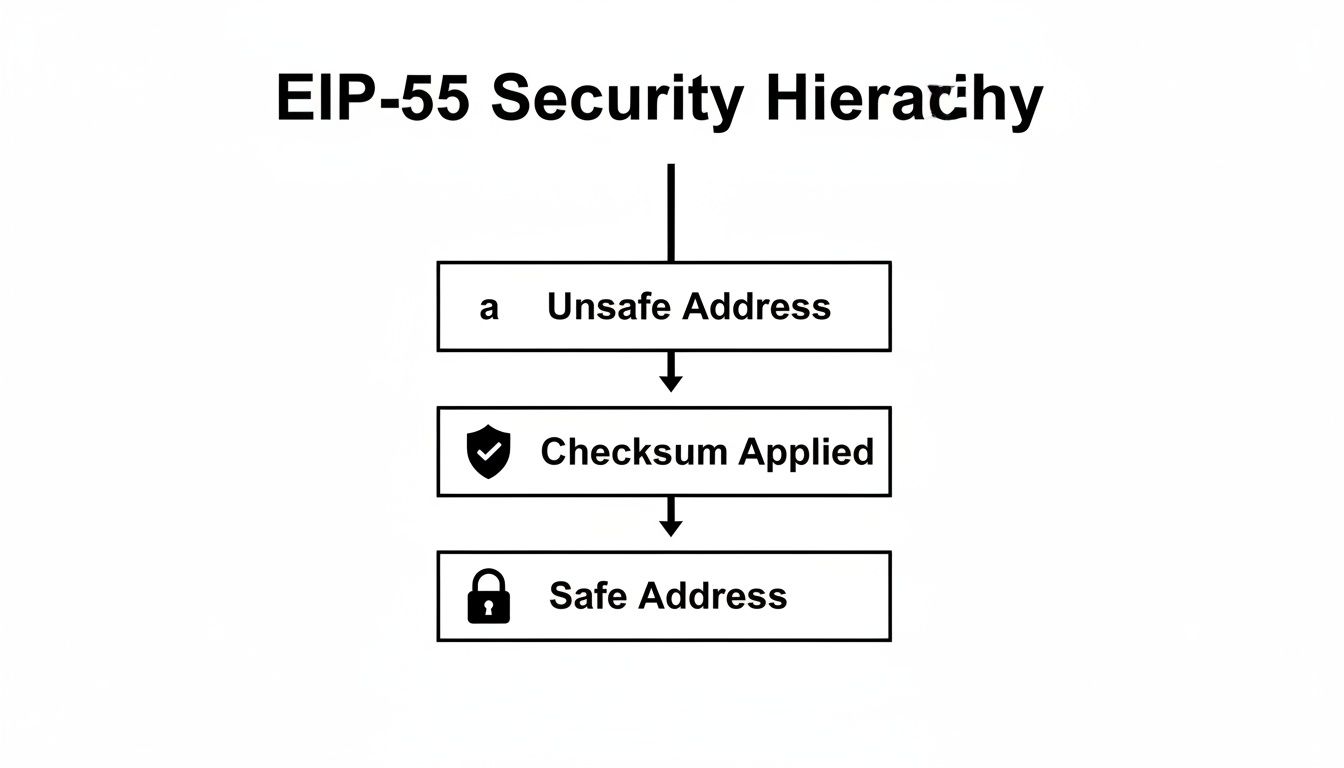
This checksum process turns a standard address into a secure, verifiable one, which is crucial for protecting every payment from costly typos.
This kind of automation is incredibly powerful. Whether you need a one-time-use address for an e-commerce checkout or a static address for a monthly subscription, the xpub model gives you the flexibility to handle it all.
The process couldn't be smoother:
- Your customer decides to pay on your site.
- BlockBee instantly uses your xpub to generate a unique address just for that order.
- The customer sends their crypto to that address.
- Because you hold the master private key, the funds land directly in your wallet.
This setup gives you the best of both worlds: the top-tier security of self-custody combined with the hands-off convenience of an automated payment gateway. It’s the perfect foundation for any business looking to accept Ethereum securely and at scale, without adding a bunch of operational headaches.
Managing Your Business Wallet Address Securely
Alright, let's move from theory to real-world application. Managing your business's ethereum wallet address isn't just about hiding a private key. It's about building a solid security system to protect your company's digital cash from a whole host of threats. Without a smart strategy, you're leaving your operations and finances wide open.
One of the first big questions you'll face is this: should you use one single address for all incoming payments, or generate a fresh one for every transaction? A single, static address might feel easier, especially for things like subscriptions. But it has a massive privacy problem. Every payment is a public record, meaning anyone—including your competition—can track your revenue, see how often you get paid, and even figure out who your top customers are.
To Reuse or Not to Reuse An Address
The decision between a static address and a dynamic one directly impacts your privacy and how easily you can balance your books.
- Static Address (Reusing one address): Simple for things like donations or recurring billing. The huge downside is that it ties your entire financial history together on the public blockchain for all to see.
- Dynamic Addresses (Unique per transaction): Giving each invoice its own address makes you a ghost on the blockchain, preserving privacy. It also makes accounting a breeze—you know instantly which payment belongs to which order. No more guesswork.
For almost any business, the privacy and accounting benefits of dynamic addresses are a no-brainer. This approach keeps your financial activities under wraps and makes your bookkeeper's life a whole lot easier.
The safety of your business's funds is about more than just a private key. It’s about being proactive with your entire operational security, from how you manage addresses to the tools you use for every transaction.
This proactive mindset is even more crucial when you're sending money out. Think about mass payouts for payroll, affiliate commissions, or paying suppliers. This is where the risk really ramps up. One tiny mistake—sending a large sum to the wrong address—is permanent. That money is gone. This is why having a strict protocol, like double- or even triple-checking addresses before hitting 'send' on a big transfer, is absolutely essential.
Automating Security with Non-Custodial Tools
Trying to handle all of this manually is a recipe for headaches and human error. This is where a non-custodial payment gateway like BlockBee becomes your best friend. By plugging in a platform that handles these best practices for you, you get top-tier security without all the manual work. The best part? You always keep complete control over your money because it never leaves your own self-custodial wallet.
It’s also critical to lock down access to any platform you use to manage your Ethereum wallet. Implementing simple but powerful security measures like Two-factor authentication (2FA) adds an extra shield, making sure that even if someone steals your password, they can't get in.
The sheer size of the Ethereum network shows just how important this is. As of early 2026, there are over 366.94 million unique Ethereum addresses out there. That’s up from 294.75 million just a year before, meaning the network is growing by more than 72 million new addresses annually. You're operating in a massive, active ecosystem. You can see more about this explosive growth on ycharts.com.
Ultimately, securing your company's Ethereum operations comes down to creating a smart system of checks and balances. Using a non-custodial service helps enforce these rules automatically, protecting your assets and your privacy, so you can stop worrying and focus on what you do best: growing your business.
Turning Your Ethereum Address into a Business Tool
An Ethereum wallet address is more than just a string of characters; it's the gateway to accepting crypto payments. For any business, the real challenge is moving beyond manually sharing that address and creating a professional, automated payment system. The aim should be a checkout experience so seamless that paying with crypto feels as simple and familiar as swiping a credit card.
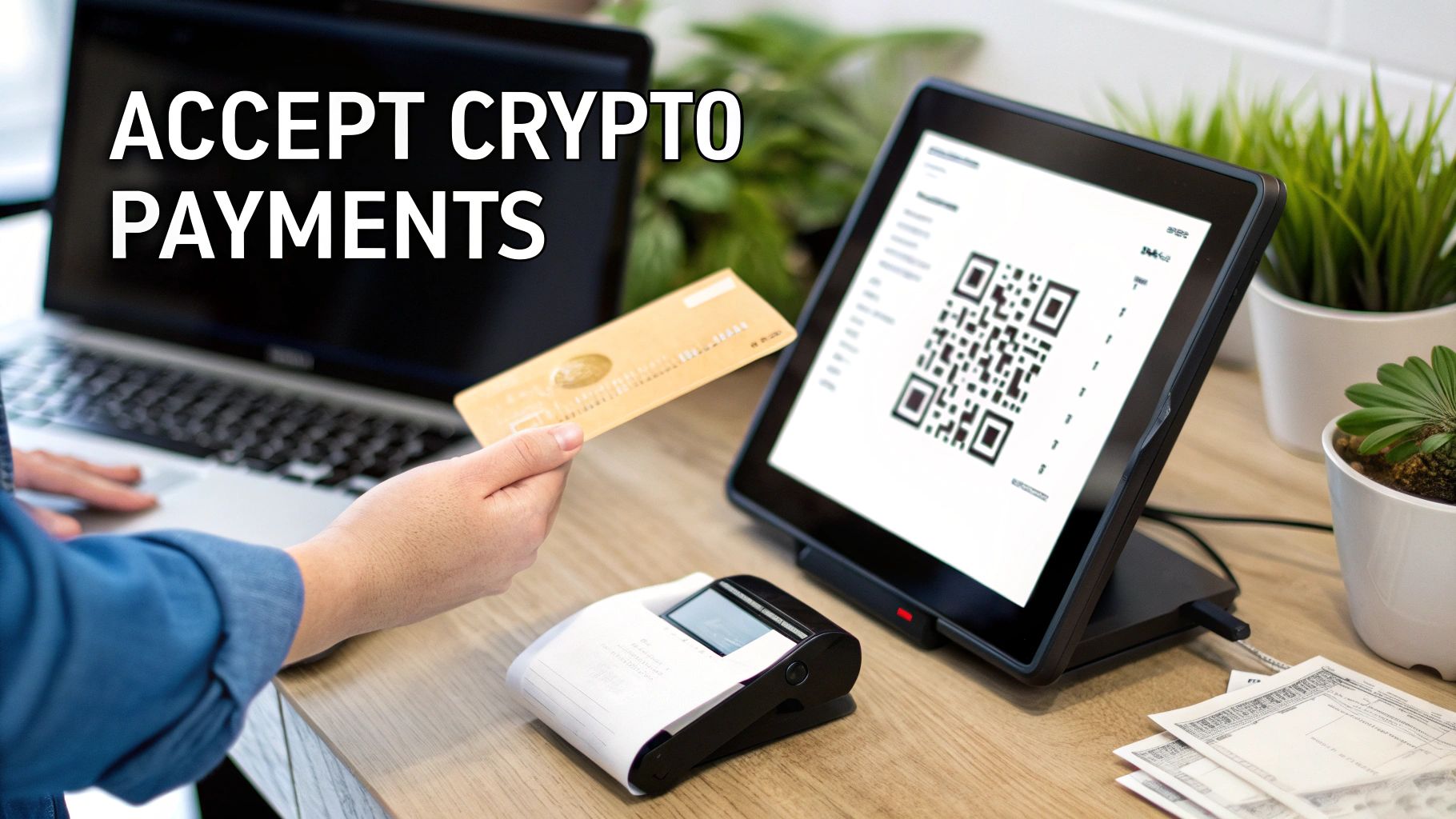
This is precisely where payment gateways like BlockBee step in. Instead of getting tangled up in the complexities of the blockchain, you can lean on ready-made tools that do all the heavy lifting. This approach means you can have secure, instant crypto payments up and running in a few hours, not weeks.
Frictionless Checkout with E-commerce Plugins
If you run an online store, the quickest way to start accepting Ethereum is with a simple plugin. BlockBee offers official plugins for all the major e-commerce platforms, making integration a breeze. These include:
- WooCommerce: Perfect for the millions of stores built on WordPress.
- Magento: A robust choice for larger businesses with extensive product lines.
- PrestaShop: A popular open-source platform with a dedicated user base.
- OpenCart: Known for its user-friendly interface and flexibility.
These plugins are built for easy installation. Once active, they add a crypto payment option directly into your existing checkout flow. When a customer decides to pay with Ethereum, the system instantly generates a unique deposit address and a QR code just for their order. It's professional, smooth, and completely removes the chance of user error.
Leveraging QR Codes for Mobile Payments
With so many people managing their crypto on their phones, QR codes are no longer a nice-to-have; they're essential. A customer can just scan the code with their mobile wallet, and the recipient address and payment amount are instantly populated. This simple step single-handedly solves the biggest headache of manual crypto payments: typos and copy-paste mistakes.
By displaying a QR code at checkout, you're directly catering to the modern crypto user. It’s a small touch that makes a huge difference in usability and builds the customer's confidence, which ultimately leads to more completed sales.
Integrating tools like QR codes and automated notifications isn't just about convenience; it’s about risk reduction. Every manual step you eliminate is one less opportunity for a costly human error that could lead to lost funds for you or your customer.
The sheer volume of activity on the Ethereum network highlights why a solid payment system is crucial. Think about this: the number of daily active Ethereum wallet addresses, which gives us a great pulse on network usage, hit an incredible peak of 1,420,187 on December 9, 2022. The network continues to see high levels of activity, showing there's a huge and active user base ready to transact. You can see these trends for yourself on Etherscan's active address chart.
Real-Time Notifications with Webhooks
One of the trickiest parts of accepting crypto is knowing the exact moment a payment is confirmed. Constantly checking the blockchain by hand just isn't practical. This is where webhooks become a true game-changer for your operations.
Put simply, a webhook is an automatic message that one system sends to another when something happens. In our case, BlockBee sends a notification straight to your e-commerce store the instant an Ethereum payment is confirmed on the blockchain.
This single notification can kick off a whole chain of events automatically:
- Update the order status in your system from "Pending Payment" to "Processing."
- Send an order confirmation email to your customer.
- Alert your fulfillment team to start packing the order.
This level of automation means you never have to manually check or reconcile payments. Your business runs like a well-oiled machine, and your customers get the instant feedback they expect from any modern online store. By connecting your Ethereum address to a system that uses webhooks, you create a completely hands-off payment and order management workflow.
Beyond Payments: Advanced Business Applications
While an Ethereum wallet address is perfect for receiving a payment, its true potential for businesses unlocks when you look past simple transactions. Think of it less as a digital mailbox and more as a programmable gateway for sophisticated financial workflows that can seriously scale your operations.
One of the biggest operational headaches for crypto-native businesses is managing large-scale payouts. If you're paying employees, affiliates, or a long list of suppliers, processing each transaction one by one isn't just slow—it's a recipe for disaster.
Streamlining Payouts at Scale
This is exactly why tools like BlockBee’s Mass Payouts exist. It lets you send crypto to thousands of different Ethereum addresses in one smooth, consolidated action. Imagine running your entire monthly payroll or affiliate commission payouts in just a few minutes. All you need is a list of recipient addresses and the amounts they're owed, and the system handles the batch transfer right from your wallet.
This approach brings some huge wins:
- Saves a Ton of Time: It completely gets rid of the mind-numbing task of creating potentially thousands of individual transactions by hand.
- Cuts Down on Mistakes: Automating payouts minimizes the risk of human error, like sending the wrong amount or pasting the wrong address. We've all been there.
- You Keep Control: Your funds never leave your wallet until the moment of transfer. You maintain full self-custody from start to finish.
An Ethereum address isn't just a destination for money; it's a programmable endpoint for complex financial logic. Using it for mass payouts showcases how businesses can build sophisticated, automated financial systems on the blockchain.
This capability becomes even more interesting when you look at the bigger picture of the network. A small number of high-value addresses—often called "whales"—hold a significant chunk of all ETH. For instance, top addresses like 0x17e554... hold over 212,000 ETH, and major exchanges like Bitfinex manage wallets with nearly 100,000 ETH. Understanding these dynamics helps paint a clearer picture of the ecosystem your business operates in. You can dig deeper into Ethereum's wealth distribution on mitrade.com.
Simplifying Payments with Human-Readable Names
Another game-changer is the Ethereum Name Service (ENS). Think of ENS as the internet's DNS, but for your crypto wallet. It lets you swap that long, intimidating 42-character address for a simple, memorable name like yourcompany.eth. It’s the difference between telling someone to visit an IP address versus just saying google.com.
For any business, grabbing an ENS name is a massive upgrade for both branding and customer experience. Instead of forcing customers to copy and paste a long string of random characters (and pray they got it right), you can just give them a clean, professional name. This one change makes crypto payments feel far less scary and dramatically reduces the chance of a costly typo.
By using an ENS name, you're not just making life easier for your customers. You're building brand recognition and trust right on the blockchain, showing that your business is both professional and focused on a great user experience. It's a perfect example of how flexible the Ethereum ecosystem really is for modern business.
Common Questions Businesses Ask About Ethereum Addresses
When you start accepting crypto, a few practical questions about handling Ethereum addresses always come up. Getting these right from the start makes for a much smoother, safer operation.
Can I Just Keep Using the Same Address?
Technically, yes. A single Ethereum address can receive funds forever. But should you? For businesses, the answer is almost always no.
Reusing the same public address for every customer payment is like publishing your company’s bank statement for the world to see. Anyone can look it up on a block explorer and trace all your incoming revenue. For privacy and cleaner accounting, it’s a best practice to generate a fresh, unique address for every single transaction.
Do I Need a Separate Address for USDT or Other Tokens?
This is a common point of confusion, but the answer is refreshingly simple: no.
Your one Ethereum address is your universal inbox for ETH and all ERC-20 tokens. That includes major stablecoins like USDT, USDC, and thousands of others. This is a huge advantage of the Ethereum network, as it keeps your wallet management from becoming a tangled mess.
What About Taxes?
As with any form of payment, you've got to think about taxes. Every crypto transaction needs to be tracked for reporting purposes. A critical first step is figuring out exactly how to calculate crypto taxes in your jurisdiction to stay compliant. Don't leave this as an afterthought.
Key Takeaway: For better privacy, use a new address for each transaction. And remember, that single address works for both ETH and all your ERC-20 tokens. Just be sure you have a solid plan for tax compliance.
So, Do I Need a Bunch of Different Wallets?
While you could juggle multiple wallets, it's usually not the most efficient way to run a business. A better approach is to use one secure, self-custodial wallet as your foundation and then let a payment gateway like BlockBee handle the heavy lifting of generating and managing all those unique customer addresses for you automatically.
Ready to turn your Ethereum address into a powerful, automated payment tool? BlockBee provides secure, non-custodial solutions to streamline your crypto transactions. Get started at https://blockbee.io.
Review Us