
Crypto Custody Solutions: Secure Your Digital Assets with Confidence (crypto custody solutions)
When you’re dealing with crypto, you’re dealing with keys—specifically, the private keys that grant access to your funds. How you store and manage those keys is what we call "custody," and it's the most fundamental decision your business will make when it comes to digital assets.
This choice boils down to a simple question: do you trust a third party to hold your keys, or do you take on that responsibility yourself? Your answer will directly shape your security posture, your day-to-day operations, and where the buck stops.
Why Your Crypto Custody Choice Matters
Figuring out how to handle your company's digital assets isn't just a technical detail; it's a core strategic decision. Think of it like this: are you going to keep your company's cash in a safe in your office, deposit it in a high-security vault at a bank, or use an armored truck service for transport? Each comes with its own trade-offs in terms of access, security, and who's ultimately responsible.
This guide is designed to cut through the jargon and get to the heart of the matter: finding the right balance between iron-clad security and the flexibility you need to actually run your business. The wrong choice can expose you to unnecessary risks, create operational headaches, or even hold back your ability to grow.
The Growing Importance of Secure Custody
As more and more capital has flooded into the crypto space, the demand for solid custody solutions has exploded. The global market for crypto custody providers was already worth around $2.92 billion in 2024, and it’s on track to grow at an annual rate of 12.95% through 2032. That's not just a random statistic; it’s a clear signal that serious businesses recognize that winging it with asset management is no longer an option. You can dig into the numbers in this crypto custody market growth report from ResearchAndMarkets.com.
We’ll walk through the main options available, giving you a clear roadmap for the entire topic:
- Custodial Solutions: This is where a third party holds your private keys for you. It’s a lot like a traditional bank account.
- Non-Custodial (Self-Custody) Solutions: You hold your own keys, giving you complete and total control. Think of it as being your own bank.
- Institutional and Hybrid Models: These are more advanced setups, often blending features of both to meet the complex needs of large-scale operations.
Setting the Stage for Your Decision
To make the right call, you need to know what you’re getting into with each model. For instance, a small online shop might prefer a custodial service because it's simple and they don't want the technical responsibility of managing keys. On the other hand, a larger company managing a significant treasury will likely prioritize minimizing risk from third parties and will lean heavily toward a non-custodial setup for full control.
The central question isn't "Which crypto custody solution is best?" but rather, "Which solution best aligns with our specific operational needs, risk tolerance, and long-term business goals?"
Our aim here is to arm you with the practical knowledge to pick a solution that doesn't just protect your assets but also fits right into how your business works. Once you understand the core differences, you can confidently choose a path that secures your funds and supports your company's growth.
Understanding the Three Models of Crypto Custody
Picking a crypto custody solution feels a lot like deciding where to keep your most valuable possessions. You could put them in a bank's safe deposit box, lock them up in a safe at home, or even hire an armored truck service for transport. Each choice comes with its own trade-offs between convenience, security, and who's ultimately responsible. The world of digital assets is no different.
To make the right call for your business, you need to get to grips with how each model works. It all boils down to one fundamental question: who controls the private keys? The answer to that single question changes everything, from how you operate day-to-day to who's on the hook if something goes wrong.
This balance between security, flexibility, and responsibility is the core concept of custody.
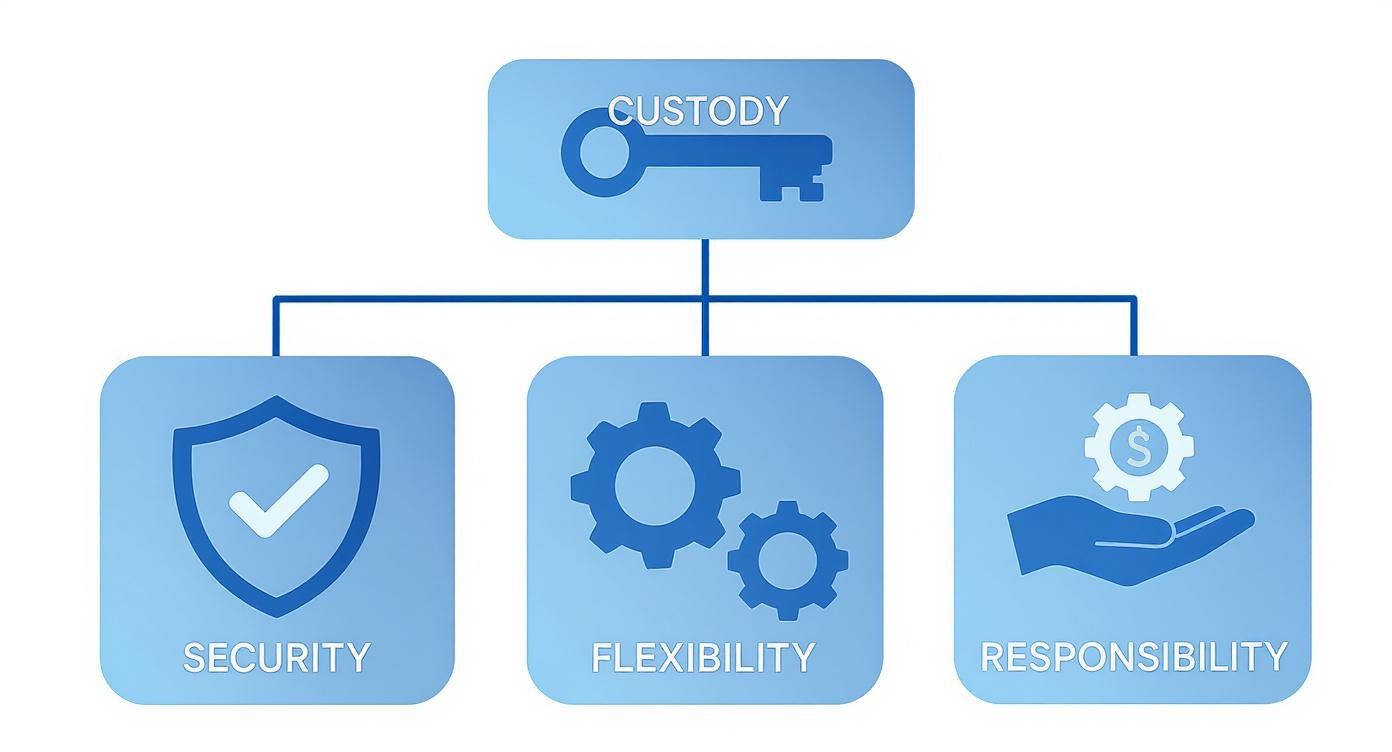
As you can see, holding the keys directly impacts your operational freedom, the security measures you need, and who bears the final risk for the assets.
H3: Custodial Solutions: The Digital Bank Vault
The custodial model is probably the one that feels most familiar, especially if you're used to traditional banking. Here, a third-party company—like a crypto exchange or a dedicated custody firm—holds and manages your private keys for you.
Think of it just like your bank account. You trust the bank to keep your money safe, and you use their app or a debit card to access it. With a custodial crypto service, you log into their platform to manage your funds while they handle the heavy lifting of securing the keys behind the scenes.
This is a go-to option for many individuals and businesses who value convenience above all else.
H3: Non-Custodial Solutions: Your Personal Safe
Next up is non-custodial custody, which most people call self-custody. This approach is the complete opposite—it puts you firmly in the driver's seat. You, and only you, hold the private keys. No third party can touch or move your funds without your direct action.
This is the digital equivalent of keeping valuables in a personal safe where only you know the combination. You get direct, instant access, but you also carry all the responsibility for keeping it secure. If you lose the keys, there’s no one to call for help.
This model is the true embodiment of the crypto ethos: "Not your keys, not your coins." It gives you genuine ownership and completely removes counterparty risk, since you're not depending on another company's security or financial stability.
Businesses that need total control over their treasury, process frequent mass payouts, or simply want to sidestep intermediary fees often gravitate toward non-custodial solutions. To really understand how these systems work, it's helpful to know about the different types of crypto wallets that make them possible.
H3: Institutional Solutions: The Armored Car Service
The third category is built for the big players: hedge funds, financial institutions, and large corporations that have to meet strict security and regulatory demands. Institutional custody is a high-octane mix of advanced technology and rigorous compliance, often including features like multi-party computation (MPC), insured cold storage, and frequent, formal audits.
Think of these as the high-security armored transport services of the crypto world. They offer a level of protection that most individuals or small businesses could never replicate on their own, complete with complex checks and balances to prevent any unauthorized activity. Some providers even offer hybrid models that blend elements of self-custody with third-party oversight for a more balanced approach.
The growth in this space has been explosive. The crypto custody software market was valued at $4.056 billion in 2024 and is projected to hit a staggering $18.04 billion by 2035. This surge is almost entirely driven by big institutions jumping into crypto and regulators providing clearer rules of the road.
To see which companies are leading the charge in this area, take a look at our deep dive on choosing the right crypto custody providers.
H3: Crypto Custody Models at a Glance
To make things even clearer, let's break down the key differences between these models side-by-side.
| Feature | Custodial | Non-Custodial (Self-Custody) | Institutional |
|---|---|---|---|
| Key Management | Third-party holds and manages keys | User holds and manages their own keys | Third-party with advanced security (e.g., MPC, cold storage) |
| Security Responsibility | Lies with the third-party custodian | Lies entirely with the user | Shared responsibility with high-level insurance and compliance |
| Typical User | Beginners, traders, businesses prioritizing convenience | Experienced users, developers, businesses needing full control | Hedge funds, corporations, financial institutions |
Each model offers a distinct set of benefits and trade-offs. Understanding these core differences is the first, and most important, step in finding the right fit for your specific business needs.
Weighing the Security and Compliance Trade-Offs
Picking a crypto custody solution is a high-stakes balancing act. Every model comes with its own unique set of pros and cons, forcing you to pit the convenience of a third-party service against the absolute control of managing assets yourself. This isn't just a technical decision; it's a fundamental choice about your business's risk appetite.
With custodial solutions, you're essentially handing over the complex and stressful job of managing private keys. This can be a massive operational weight off your shoulders, letting your team focus on your actual business instead of becoming cybersecurity experts overnight. But that convenience comes with a major catch: counterparty risk.
You're putting an enormous amount of faith in the custodian's security measures, their financial stability, and their basic honesty. The crypto world is littered with horror stories of exchange hacks and sudden collapses where users' funds vanished or were locked up for years. When you go custodial, you're making a bet that their security is better than yours and that they’ll always be a reliable partner.
The Self-Custody Security Burden
At the other end of the scale, non-custodial solutions wipe out counterparty risk completely. The assets are in your wallet, protected by keys that you and only you control. This offers powerful protection against external disasters like a custodian going bust, but it also means the entire weight of security lands squarely on your shoulders.
And that responsibility is final. There’s no 1-800 number to call if you lose your private key or get tricked by a phishing scam. Internal threats, like a disgruntled employee, also become a much more immediate problem. One slip-up can mean your funds are gone forever.
Proper self-custody isn't for the faint of heart. It demands:
- Rock-Solid Key Management: You need ironclad procedures for generating, storing, and backing up your private keys.
- Strict Internal Controls: Think multi-signature protocols and carefully managed access rights to stop unauthorized transactions before they happen.
- Ongoing Team Education: Everyone involved needs to be trained on security best practices and how to spot emerging threats.
If you want to dive deeper into securing your keys, our guide on what hardware wallets are is a great place to start understanding the gold standard of cold storage.
Navigating the Compliance Maze
Compliance throws another huge wrench into the custody decision. Regulators across the globe are zooming in on the crypto space, and your custody model has a direct impact on how well you can keep up with the ever-changing rules.
Institutional custodians are built from the ground up for this reality. They offer services specifically designed to keep regulators happy, which makes them a go-to choice for businesses in regulated fields or those handling other people's money.
For many large companies, the real value of an institutional custodian isn't just security—it's compliance-as-a-service. They handle the audits, reporting, and regulatory hoops that would be a nightmare to build from scratch.
These providers typically come with built-in frameworks for:
- Know Your Customer (KYC) and Anti-Money Laundering (AML): They have established processes for verifying identities and flagging suspicious transactions.
- Auditing and Reporting: They can generate the detailed reports that auditors and government agencies demand.
- Insurance: Many offer robust insurance policies, often backed by major underwriters, to cover assets against theft or loss.
On the flip side, taking the non-custodial route means you are 100% responsible for building and running your own compliance program. This gives you more flexibility, but it also requires serious in-house expertise to make sure you're following the laws in every single place you do business. The path you choose will shape your risk exposure and daily operations for years to come.
How Custody Impacts Your Daily Business Operations
Picking a crypto custody solution isn't some abstract security choice you make once and forget. It's a decision that weaves itself into the very fabric of your daily business, dictating how you get paid, how you pay others, and how you manage your company’s digital assets.
Think of it this way: using a custodial service is like hiring a full-service accounting firm. They handle a lot of the heavy lifting, which is convenient, but you're paying them for it and adding another company into your financial loop. Going non-custodial is like running your own finance department. You get total control and cut out the middleman fees, but all the responsibility for keeping things secure and running smoothly lands squarely on your shoulders.

Payments, Treasury, and Payouts
Let's get practical and see how this plays out in three critical areas. Each model comes with its own set of daily trade-offs.
Getting Paid by Customers: With a custodial service, a customer's payment goes into an account the custodian controls. This can make bookkeeping easier since their platform usually spits out clean reports. The downside? You’re at the mercy of their system’s uptime and processing times to get to your own money.
Managing Your Treasury: A custodian pools your funds in one place, which can look simple on a balance sheet. But this also creates a giant bullseye—a single point of failure. A non-custodial wallet puts you in direct command of your treasury, giving you the agility to move assets and execute strategies on your own terms, instantly.
Sending Mass Payouts: This is a huge deal for businesses paying out to affiliates, creators, or suppliers. Custodial services might offer payout tools, but they often come with extra fees and frustrating approval delays. A non-custodial tool like BlockBee lets you send mass payouts right from your own wallet, giving you more speed, full autonomy, and serious cost savings.
Integration and Technical Considerations
Beyond the money flow, you have to think about the tech. A brilliant solution is worthless if it gives your developers a constant migraine. Your custody choice will directly affect how well your business can scale and adapt down the road.
The lynchpin here is the Application Programming Interface (API). A clean, well-documented API is what lets your systems talk to the custody platform smoothly. It’s how you automate everything from generating new payment addresses to confirming transactions and updating your books.
The real goal is to find a solution that plugs into your existing tech stack without causing a fuss. A clunky integration creates data headaches, forces manual workarounds, and ultimately puts a ceiling on your growth.
When your tech team is vetting options, they need to ask:
- API Quality and Documentation: Is the API logical and easy to work with? Is the documentation actually helpful?
- Scalability: Can this thing handle our transaction volume a year from now without slowing to a crawl?
- Software Compatibility: Does it have ready-made plugins for our e-commerce platform (like WooCommerce) or accounting software?
Banking and Fiat Off-Ramps
Finally, how you hold your crypto affects how easily you can interact with the traditional banking world. Custodial providers usually have banking relationships already in place, which can make converting crypto to cash feel simpler. But you’re locked into their partners and their fees.
This is where it's smart to look into the wider world of crypto-friendly banking alternatives to see what’s possible.
A non-custodial setup gives you the freedom to pick your own banking and exchange partners. You can shop around for the best rates and find services that fit your specific needs. This independence is a powerful strategic advantage. If one of your partners goes sideways, you can simply pivot to another without your entire treasury being frozen. That's the kind of agility that keeps a business resilient, no matter what the market throws at it.
Streamlining Payments with Non-Custodial Tools
When you use institutional or custodial services, you’re essentially getting a familiar, bank-like experience. But that convenience comes with a catch: you're placing an intermediary between your business and your money. For any company that puts a premium on direct control, tight security, and operational speed, there’s a much better way forward: non-custodial payment processors.
Tools like BlockBee are built from the ground up to let businesses accept crypto and handle payouts directly from their own wallets. Picture this: you run an online store, and every single crypto payment lands instantly in your company's wallet. No third party ever touches it. This setup completely sidesteps counterparty risk—the ever-present danger that a custodian gets hacked, goes bankrupt, or decides to freeze your funds.
Unlocking Control and Efficiency
The biggest draw of a non-custodial model is keeping absolute, sovereign control over your funds. Your private keys are yours, and your assets are never mixed in a giant pool with other users' money on some third-party platform. If you want a deeper dive into how this all works under the hood, our overview of non-custodial crypto wallets breaks down the core technology that puts you in the driver's seat.
This level of direct control brings some serious business advantages:
- Enhanced Security: You eliminate the central honeypot that hackers love to target. By not using a large custodial platform, you dramatically reduce your risk of getting caught up in a massive breach.
- Lower Operational Costs: Non-custodial processors typically have more transparent and straightforward fee structures, helping you dodge the hidden fees and withdrawal charges that often come with intermediaries.
- Increased Agility: Need to move funds, manage your treasury, or send out payments? You can do it instantly, without waiting for a third party's approval or getting stuck in a withdrawal queue.
This shift towards self-managed crypto custody solutions is no small trend. The digital asset custody market was already valued at USD 683.38 billion in 2024. It’s projected to explode to USD 4,378.84 billion by 2033, a clear signal that businesses are demanding more secure and efficient ways to manage their assets. You can find more details on the expansion of the digital asset market on kbvresearch.com.
A Real-World Example: The Non-Custodial Advantage
Let's make this concrete. Imagine an online marketplace for digital artists that needs to pay hundreds of creators across the globe each month.
If they used a custodial service for these mass payouts, the process would be clunky. They'd have to send a lump sum to the custodian, wait for security checks, and then pay a fee on every single payout. It’s slow, it’s expensive, and it introduces an unnecessary layer of risk.
Now, let's see what happens when they switch to a non-custodial tool like BlockBee. By integrating a powerful API, the marketplace can automate the entire payout system. They simply connect their own secure, multi-signature wallet. When payday comes, they trigger a mass payout that sends crypto from their wallet directly to each artist’s address in one clean, efficient operation.
The difference is night and day:
- Full Automation: The API does all the heavy lifting, from checking addresses to broadcasting the transactions on the blockchain.
- Instant Payouts: Artists get their money in minutes, not days. This kind of speed builds tremendous goodwill and loyalty.
- Complete Transparency: The marketplace gets real-time tracking and a perfect audit trail, all visible directly on the blockchain.
What was once a complicated operational headache becomes a smooth, secure, and cost-effective process. This is the real power of non-custodial crypto custody solutions in action for today's businesses.
Your Checklist for Making the Right Custody Decision
Picking the right crypto custody solution isn’t just a tech problem to solve; it's a strategic decision that will shape how your business operates for years to come. To make the right call, you have to get past the generic advice and take a hard look at your company's specific situation. The best way to do that is by asking the right questions—the ones that cut straight to your operational needs, risk appetite, and what your team can realistically handle.
This checklist is designed to be that practical guide. By walking through these questions, you’ll build a clear picture of what your business actually needs, which will naturally guide you to the custody model that makes the most sense.
Questions on Transaction Volume and Flow
First up, let's look at how money moves through your business. The number and type of crypto transactions you manage will have a huge impact on which model is efficient and won't bleed you dry with fees.
What’s our real daily and monthly transaction volume going to look like?
A company that handles a few large transactions a month has completely different needs than one that’s processing thousands of micro-payments every day. High volume often thrives with the direct, automated control of a non-custodial setup, which helps you sidestep those pesky per-transaction fees from middlemen.How important are mass payouts to our business?
If you're constantly paying out to suppliers, affiliates, or content creators, the efficiency of that system is everything. This is where non-custodial tools like BlockBee really shine. They let you send automated, low-cost payments directly from your own wallet, without waiting on a third party to process them.Do we need immediate access to our money?
Custodial services can sometimes hit you with withdrawal limits or processing delays. If your cash flow depends on having instant access to incoming funds, a non-custodial model where payments go straight into your wallet gives you far more control and flexibility.
Evaluating Your Technical and Security Capacity
Next, it's time for an honest conversation about what your team is actually capable of managing. Being overconfident here can open the door to some serious security risks.
- Does anyone on our team truly know how to manage private keys?
Self-custody means you—and only you—are responsible for your private keys. This isn't something you can wing. It demands strict, documented procedures for key generation, secure storage, and disaster recovery. If you don't have that expertise in-house, leaning on a reputable custodian might be the safer bet, at least to start.
Choosing a custody model is about finding the right balance between control and responsibility. A non-custodial solution offers ultimate control, but only if you have the internal systems to manage that responsibility effectively.
- Can we actually implement and use a multi-signature (multisig) wallet?
For any business seriously considering self-custody, multisig isn't optional; it's a fundamental security layer. It ensures no single person can move funds, which protects against both external hacks and internal threats. Be honest: does your team have the know-how to manage the extra operational steps this requires?
Assessing Compliance and Regulatory Needs
Finally, you can't ignore the rulebook. The regulations you have to follow might make certain custody options a non-starter for your business.
What are our specific KYC/AML and reporting duties?
If you're in a heavily regulated field, you'll often find that institutional custodians are the path of least resistance. They come with built-in compliance tools, handle the necessary customer checks, and can produce the audit-ready reports your regulators will demand.Do we need our crypto assets to be insured?
If your investors, partners, or board are requiring you to have insurance on your digital assets, an institutional custodian is often your only choice. They typically offer significant insurance policies that are nearly impossible to get if you're managing everything yourself.
Answering these questions won't just give you a better idea of what to do—it'll give you a clear, actionable path forward.
Common Questions About Crypto Custody
Even after you get the hang of the different custody models, a lot of practical questions pop up when you're trying to figure out what's best for your business. Let's tackle some of the most common ones we hear from merchants and developers.
What's The Real Difference Between Custodial and Non-Custodial?
It all boils down to who holds the keys.
Think of a custodial service like a traditional bank. You deposit your money, and the bank holds it for you. They have control. With a non-custodial (or self-custody) wallet, you are the bank. You hold your own private keys, giving you absolute, direct control over your funds.
Are Non-Custodial Wallets Actually Safer?
They certainly can be, but the security is now in your hands. A non-custodial setup gets rid of the risk that comes with trusting a third party—you don't have to worry about the custodian getting hacked or going bankrupt.
The flip side is that you're now the one responsible for security. You need to have solid practices in place, like using multi-signature wallets and storing your keys in a truly secure way to prevent theft or accidental loss.
The security of a non-custodial setup is a direct reflection of your own internal controls. When you get it right, it's a far more secure way to operate because you've removed that central point of failure.
This shift toward self-sovereignty is gaining traction, especially as regulators globally, like those in Hong Kong, are putting stricter frameworks in place for virtual asset (VA) custodians to better protect investors.
Can My Business Mix And Match Custodial And Non-Custodial?
Absolutely. In fact, a hybrid strategy is often the smartest move.
Many businesses use a non-custodial wallet for their day-to-day operations—things like managing incoming payments or sending out mass payouts—because it offers speed and flexibility. At the same time, they might keep their long-term treasury funds with a qualified institutional custodian that provides insurance and beefed-up security. This approach gives you the best of both worlds: operational agility and long-term peace of mind.
How Do Regulations Impact Which Custody Model I Choose?
Regulations are a huge piece of the puzzle. All over the world, governments are rolling out specific licensing rules for companies that deal with or hold crypto.
For example, recent guidance from the U.S. Office of the Comptroller of the Currency (OCC) confirmed that national banks are allowed to offer crypto custody, which points to more regulated and mainstream options becoming available.
If your business is in a regulated field or you work with institutional clients, you’ll almost certainly need to use a licensed custodian. They handle critical compliance tasks like KYC/AML and can provide the audit trails you need. With self-custody, you’re on the hook for building and maintaining that entire compliance system yourself.
Ready to take full control of your business's crypto payments and payouts? BlockBee provides a secure, non-custodial platform that eliminates intermediaries and puts you in the driver's seat. Explore our powerful API and e-commerce plugins at https://blockbee.io.
Review Us