

Top 12 Crypto Custody Providers for Businesses in 2025
For businesses handling digital assets, the security of private keys and the protection of funds are paramount. Choosing the right partner to safeguard these assets is a foundational decision that impacts everything from operational security to regulatory compliance. This choice often begins with a fundamental question: Should you delegate control to a third-party specialist (custodial) or retain direct, sovereign control over your keys (self-custodial)?
This comprehensive guide is designed to help you navigate the complex world of crypto custody providers. We will dissect the top 12 institutional-grade solutions available today, offering a clear and practical analysis for decision-makers. Instead of generic marketing points, we provide an in-depth look at what truly matters for your business operations.
Inside this resource, you will find:
- Detailed Vendor Profiles: We examine leading providers like Coinbase Prime, Anchorage Digital Bank, BitGo, and Fireblocks, assessing their core strengths and weaknesses.
- Practical Use-Case Analysis: Discover which solutions are best suited for corporate treasury management, e-commerce payment processing, SaaS subscription models, or executing secure mass payouts.
- Key Decision Criteria: Each profile evaluates critical factors including security architecture, compliance certifications (like SOC 1/2), API support for integration, and pricing models.
- Direct Comparisons: We include screenshots and direct links, helping you visualize the platforms and access them quickly.
We'll also clarify when a non-custodial or self-custodial approach might be more appropriate for your specific needs, ensuring you have a complete picture. This resource cuts through the noise to provide the clarity needed to select a crypto custody provider that aligns perfectly with your business’s technical, security, and strategic goals.
1. Coinbase Prime (Coinbase Custody Trust Company, LLC)
Coinbase Prime stands as an institutional-grade, all-in-one platform from one of the most recognized names in the crypto industry. It integrates secure, qualified custody through the Coinbase Custody Trust Company, LLC, with advanced trading, financing, and data analytics. This structure makes it a go-to choice for businesses seeking a comprehensive solution from a single, trusted entity. The platform is particularly dominant in the U.S. market, serving as the custodian for a significant number of spot Bitcoin ETFs.
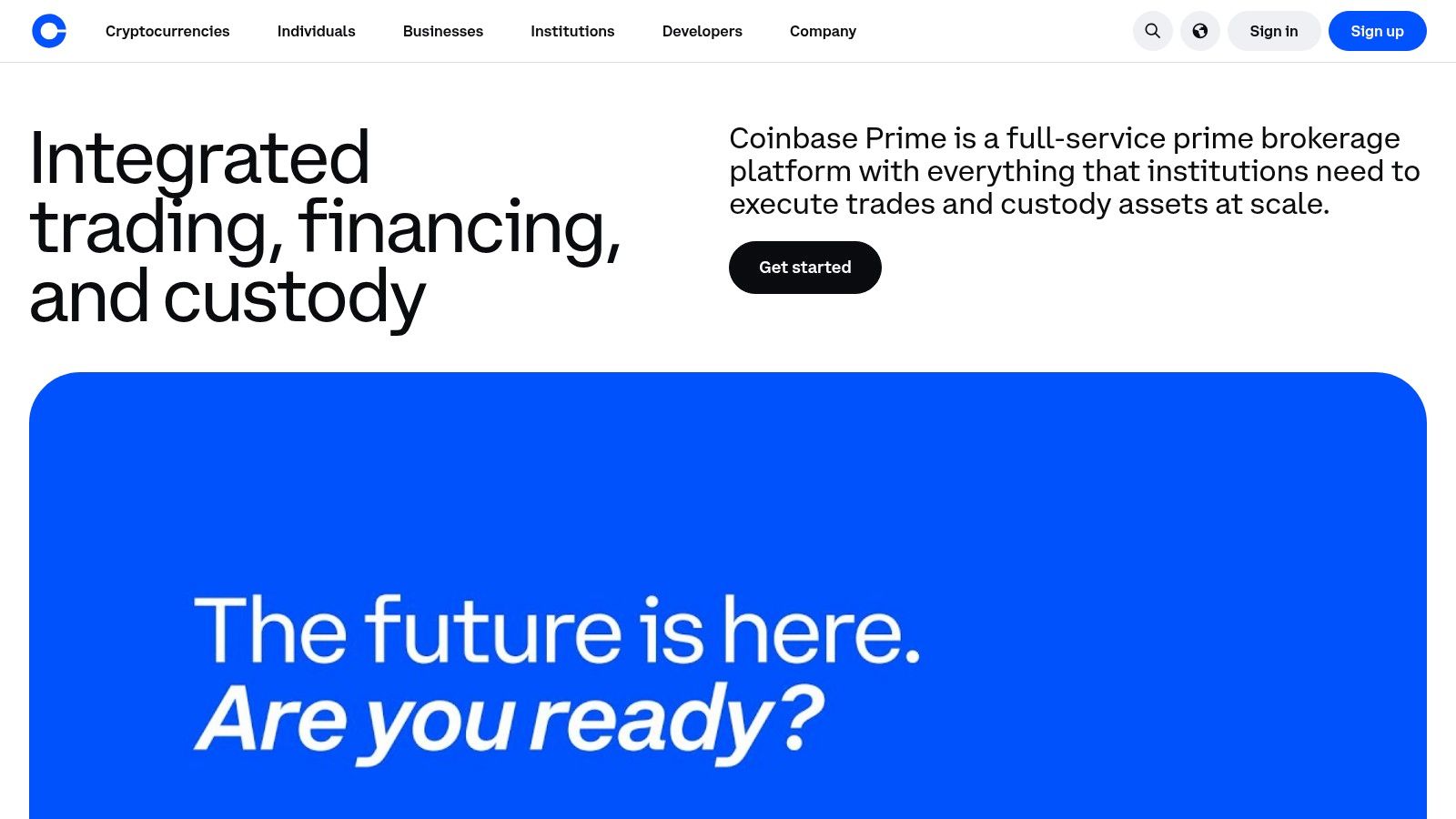
Its status as a New York Department of Financial Services (NYDFS) chartered trust company provides a high level of regulatory assurance, which is a critical decision factor for enterprises. This robust compliance framework is a key differentiator among crypto custody providers. For businesses new to the space, it's important to understand the model Coinbase uses. For a deeper dive into the differences, you can learn more about custodial vs. non-custodial services.
Key Features & Use Cases
Coinbase Prime is built for scale and complexity, making it suitable for various business needs from simple asset storage to intricate trading operations.
- Best For: Institutional investors, ETF issuers, corporate treasuries, and large-scale FinTech platforms requiring a single, regulated partner for trading and custody.
- Unique Offerings: The platform supports staking and on-chain governance directly from segregated cold storage accounts, allowing clients to participate in network operations without sacrificing security.
- Security & Compliance: It boasts SOC 1 Type 2 and SOC 2 Type 2 reports, alongside comprehensive insurance coverage.
Website: https://www.coinbase.com/prime
| Feature Analysis | Assessment |
|---|---|
| Custody Model | Qualified Custodial via NYDFS-chartered trust |
| Asset Support | 420+ assets, with extensive staking options |
| Integration | Robust APIs for programmatic trading and custody |
| Pricing | Bespoke, not publicly available |
| Pros | Strong U.S. regulatory standing; deep liquidity |
| Cons | Opaque pricing; can be overly complex for smaller firms |
2. Anchorage Digital Bank
Anchorage Digital Bank distinguishes itself as the first federally chartered digital asset bank in the United States, granted by the Office of the Comptroller of the Currency (OCC). This unique regulatory status offers institutional clients a high degree of confidence and compliance, positioning it as a premier choice among crypto custody providers. The platform provides a unified solution for secure custody, trading, staking, settlement, and governance, all accessible through a single, integrated interface.
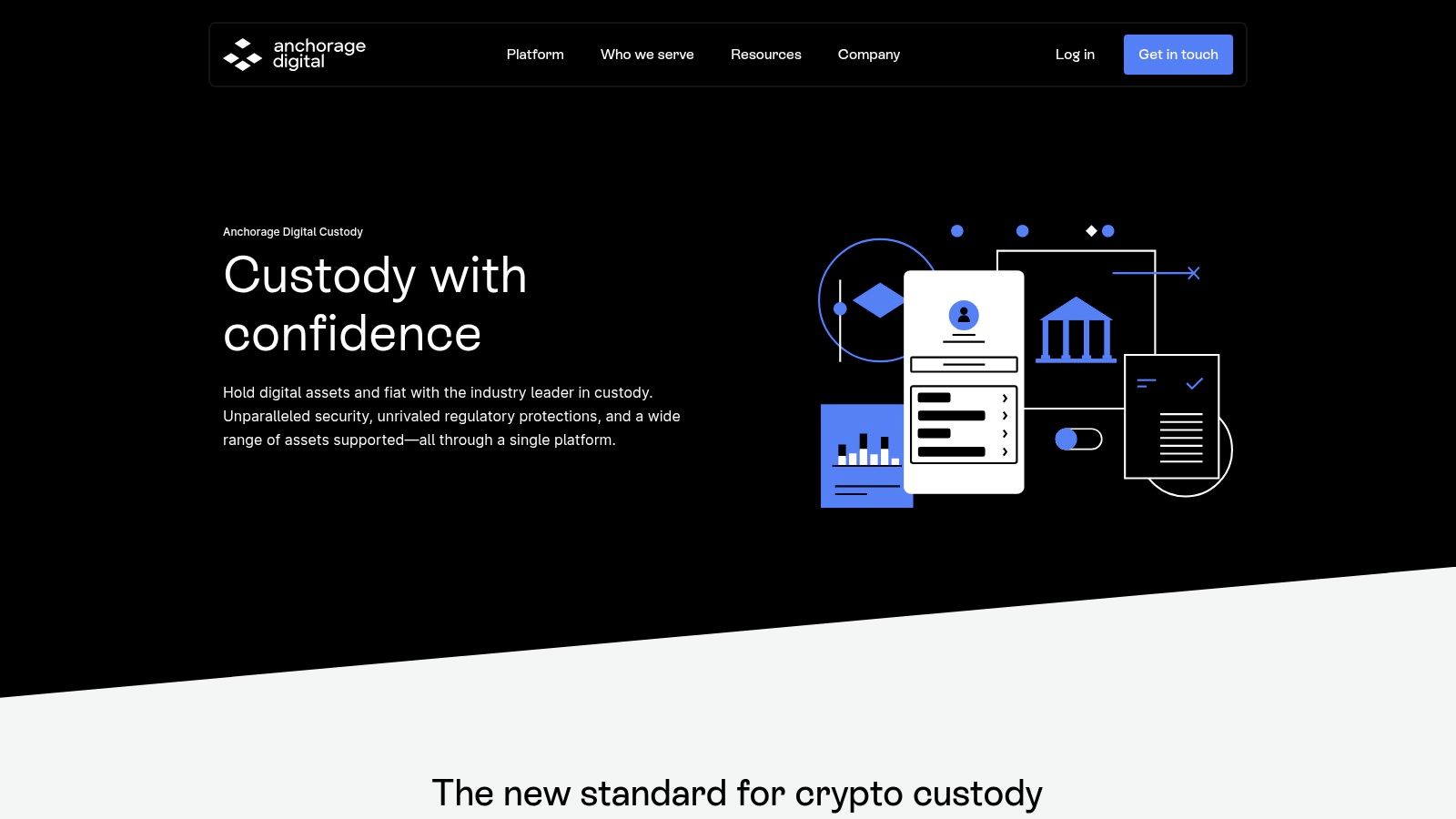
Its federal charter ensures that assets are held in bankruptcy-remote custody, a critical security feature for fiduciaries and large enterprises. Anchorage Digital's model is designed for institutional-grade security and operational efficiency, combining hardware security modules (HSMs) with sophisticated policy controls. For businesses prioritizing federal regulatory oversight and a comprehensive suite of services, Anchorage Digital presents a compelling, highly secure option for managing digital assets.
Key Features & Use Cases
Anchorage Digital is engineered for institutions that demand both top-tier security and fluid access to crypto services like trading and staking.
- Best For: Registered Investment Advisors (RIAs), venture capital firms, corporate treasuries, and institutions requiring a federally regulated custodian.
- Unique Offerings: The platform's federal bank charter provides a unique level of regulatory clarity and protection. It also features integrated USD on/off-ramps and API access for seamless integration into existing financial workflows.
- Security & Compliance: As an OCC-chartered bank, it adheres to stringent federal banking standards, including robust security, capital, and liquidity requirements.
Website: https://www.anchorage.com/platform/custody
| Feature Analysis | Assessment |
|---|---|
| Custody Model | Qualified Custodial via OCC-chartered federal bank |
| Asset Support | Broad support for a wide range of digital assets |
| Integration | Full API access for custody, trading, and settlement |
| Pricing | Bespoke; requires direct enterprise engagement |
| Pros | Strong federal regulatory standing; bankruptcy-remote custody |
| Cons | Opaque pricing; exclusively for institutional clients |
3. Gemini Custody (Gemini Trust Company, LLC)
Gemini Custody offers institutional-grade security through its qualified custodian, the Gemini Trust Company, LLC. Regulated by the New York State Department of Financial Services (NYDFS), it provides a high-assurance environment that appeals to businesses prioritizing compliance and regulatory oversight. This makes it a strong contender among crypto custody providers, especially for those operating under strict fiduciary standards. Its key advantage lies in combining top-tier security with operational flexibility.
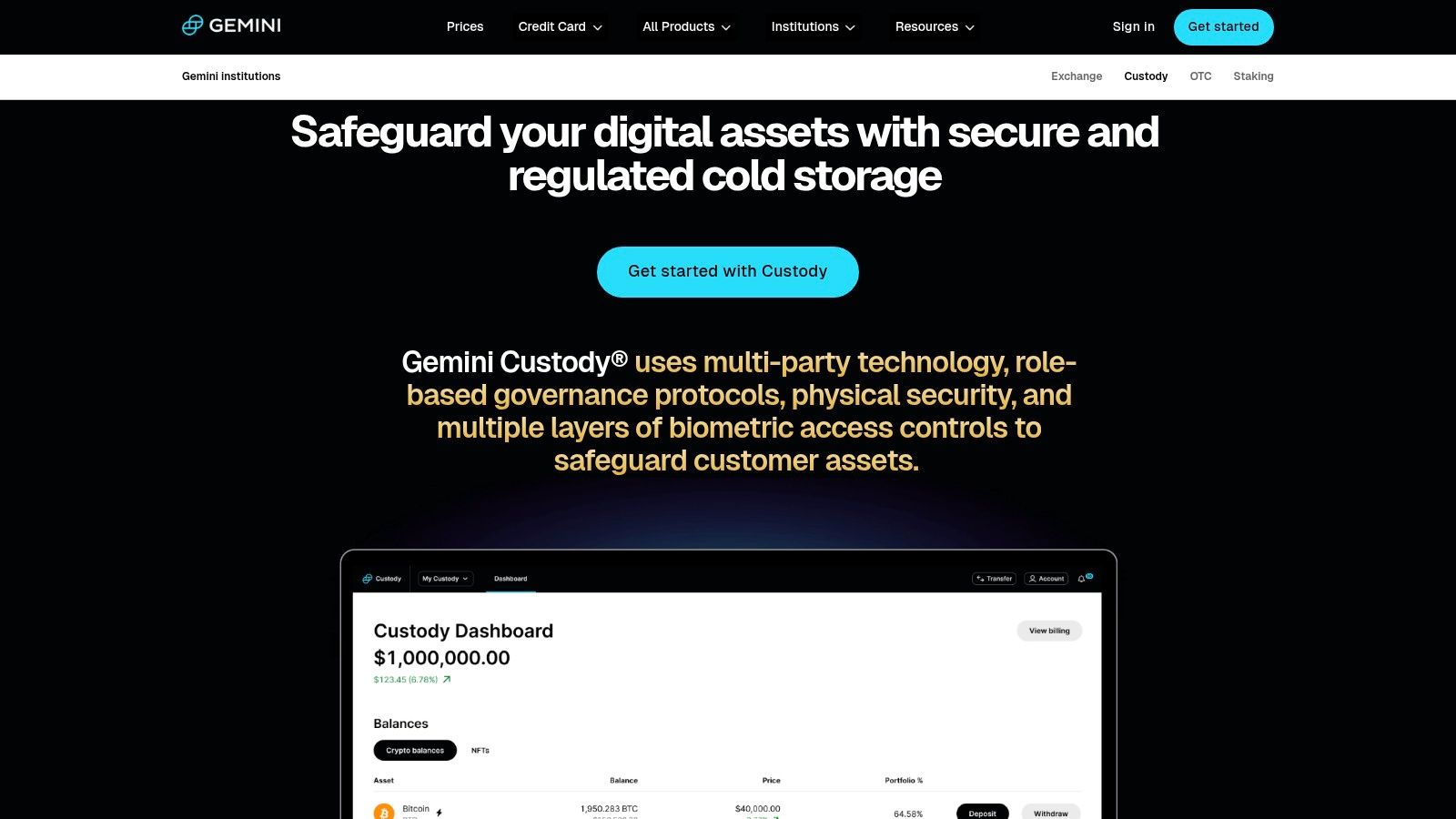
Unlike some competitors with opaque fee structures, Gemini stands out by publishing its custody fee schedule, offering greater transparency for financial planning. The platform is engineered to bridge the gap between secure, offline cold storage and the need for market agility. This balance is crucial for active managers who require both robust protection and the ability to react quickly to market movements.
Key Features & Use Cases
Gemini Custody is designed for institutions that demand both security and liquidity, providing tools that facilitate active management of custodied assets.
- Best For: Asset managers, hedge funds, and corporate treasuries that require transparent pricing and the ability to trade directly from secure cold storage.
- Unique Offerings: The 'Instant Trade' feature allows clients to trade their custodied assets on the Gemini exchange instantly, without waiting for funds to move from cold storage. This provides a significant liquidity advantage.
- Security & Compliance: It holds SOC 2 Type II and ISO 27001 certifications, backed by comprehensive insurance coverage for custodied assets.
Website: https://www.gemini.com/institutions/custody
| Feature Analysis | Assessment |
|---|---|
| Custody Model | Qualified Custodial via NYDFS-chartered trust |
| Asset Support | 120+ assets supported in custody |
| Integration | API access for custody and auditor view-only roles |
| Pricing | Published fee schedule with a minimum monthly fee |
| Pros | Transparent pricing; 'Instant Trade' from cold storage |
| Cons | Ecosystem is primarily tied to the Gemini exchange |
4. Kraken Custody (via Kraken Financial, Wyoming SPDI)
Kraken Custody operates through Kraken Financial, a Wyoming Special Purpose Depository Institution (SPDI), marking a unique approach to digital asset banking and custody. This structure provides regulated, qualified custody integrated with Kraken's institutional-grade prime services, but within a state-chartered bank framework. It's designed for institutions that prioritize on-chain segregation and auditability while demanding a unified workflow for trading, staking, and financing.
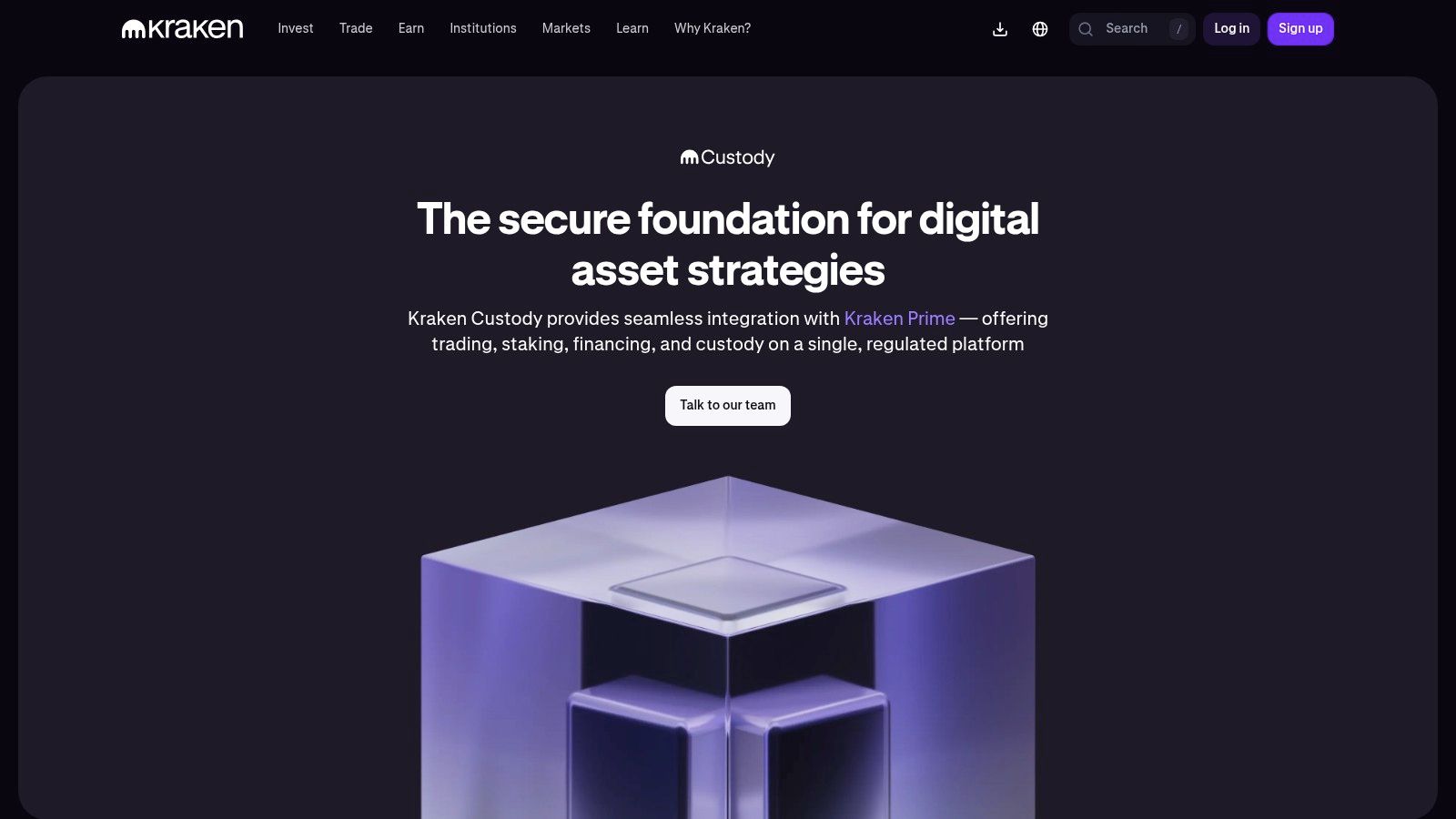
The key differentiator for Kraken Custody is its SPDI charter, which blends traditional banking principles with the nuances of digital assets. This model ensures client assets are kept separate and are not rehypothecated, offering a high degree of transparency. As one of the pioneering crypto custody providers utilizing this framework, Kraken offers a compelling alternative for firms seeking bank-grade security and governance without sacrificing access to the broader crypto market ecosystem.
Key Features & Use Cases
Kraken Custody is tailored for enterprises that require a high-touch, secure, and regulated environment with direct integration to market services.
- Best For: Hedge funds, asset managers, and corporate treasuries that require bank-grade custody with seamless access to trading and staking.
- Unique Offerings: The SPDI charter provides a unique regulatory status, and the service emphasizes on-chain segregated wallets, which allows for straightforward and verifiable audits of assets.
- Security & Compliance: Kraken Custody holds a SOC 2, Type II certification and employs a combination of MPC and HSM technologies along with strict role-based access controls.
Website: https://www.kraken.com/institutions/custody
| Feature Analysis | Assessment |
|---|---|
| Custody Model | Qualified Custodial via Wyoming SPDI Bank Charter |
| Asset Support | Supports a broad range of digital assets |
| Integration | Unified workflow with Kraken Prime trading and staking |
| Pricing | Enterprise/custom, not publicly available |
| Pros | Strong security stack; bank-grade regulatory framework |
| Cons | Newer SPDI model; firms must verify 'qualified custodian' fit |
5. Fidelity Digital Assets
Fidelity Digital Assets brings the operational discipline and brand trust of a traditional finance giant to the digital asset space. As the institutional arm of Fidelity Investments, it offers an integrated solution for secure custody and trade execution, specifically designed for institutional clients, financial advisors, and investment funds. This backing from a major U.S. financial institution provides a level of comfort and operational rigor that is highly attractive to enterprises accustomed to traditional finance standards.
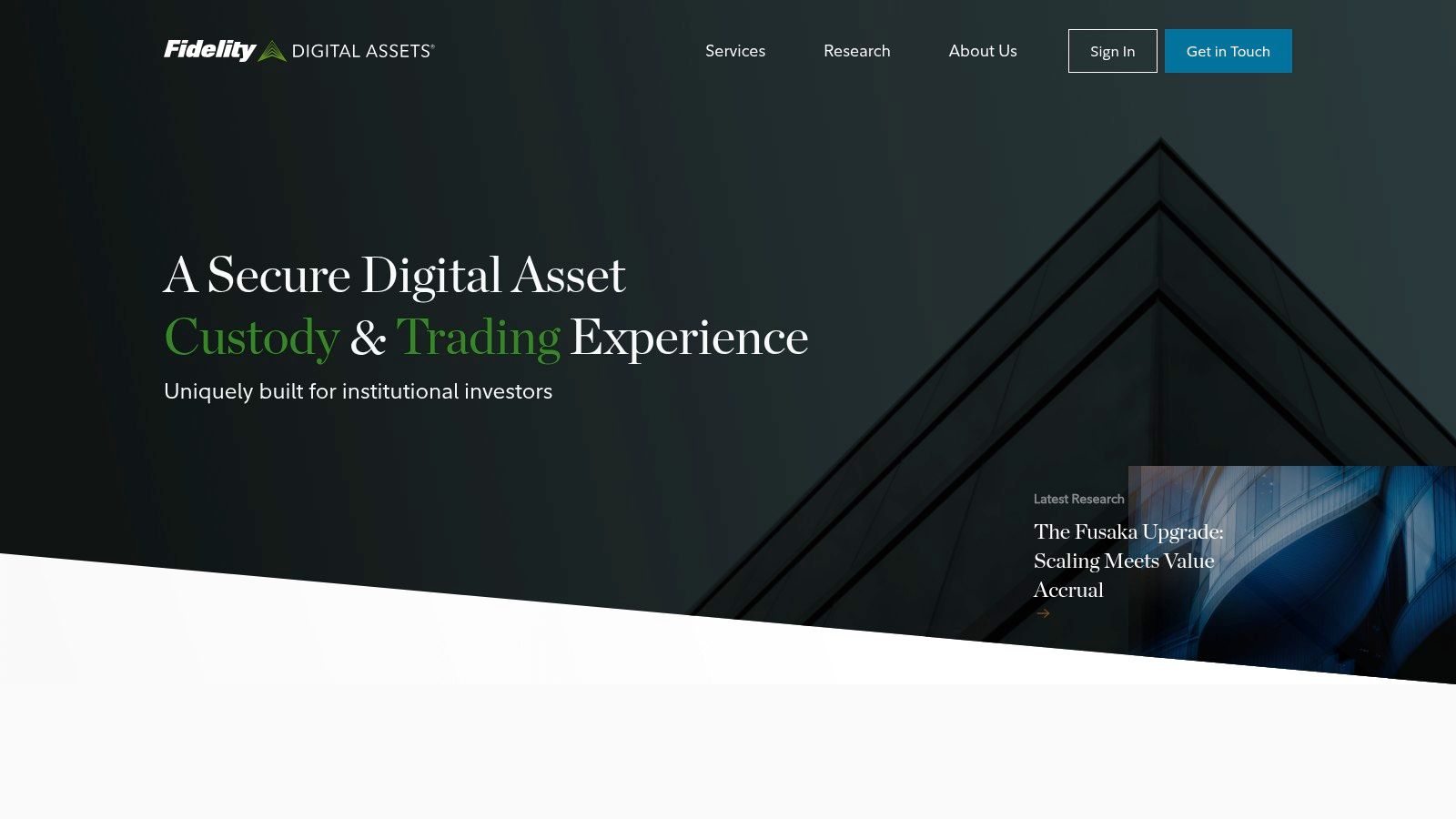
The platform distinguishes itself by supplementing its core custody services with in-depth digital asset research and extensive client education resources. This focus on institutional adoption helps businesses navigate the complexities of the crypto market with greater confidence. The enterprise-grade onboarding process includes dedicated service and compliance support, ensuring a smooth transition for firms entering the digital asset ecosystem. Fidelity Digital Assets is one of the key crypto custody providers that bridges the gap between traditional finance and the crypto-native world.
Key Features & Use Cases
Fidelity Digital Assets is engineered for institutions that prioritize security, regulatory clarity, and a trusted counterparty for their digital asset strategies.
- Best For: Hedge funds, asset managers, corporate treasuries, and family offices seeking a custody provider with a well-established reputation in traditional finance.
- Unique Offerings: The integration of proprietary research and educational content provides clients with valuable market insights directly from their custodian, supporting informed decision-making.
- Security & Compliance: Leverages Fidelity’s decades of experience in asset management to implement robust security protocols, operational controls, and compliance frameworks.
Website: https://fidelitydigitalassets.com/
| Feature Analysis | Assessment |
|---|---|
| Custody Model | Institutional Custodial via NYDFS-chartered trust |
| Asset Support | Focused on major assets like Bitcoin and Ethereum |
| Integration | Geared towards institutional workflows and service support |
| Pricing | Bespoke; requires direct contact with the sales team |
| Pros | High brand trust and operational rigor; integrated research |
| Cons | Narrower asset coverage than crypto-native firms; opaque pricing |
6. BitGo
BitGo is a veteran in the digital asset space, offering a comprehensive suite of custody and wallet infrastructure services since its founding in 2013. The US-based firm provides regulated, qualified custody through BitGo Trust Company, making it a trusted partner for institutional clients, including those involved with ETFs and corporate treasuries. Its offerings span both fully managed custodial cold storage and self-custody wallet technology, providing flexibility for businesses with varying security and operational needs.
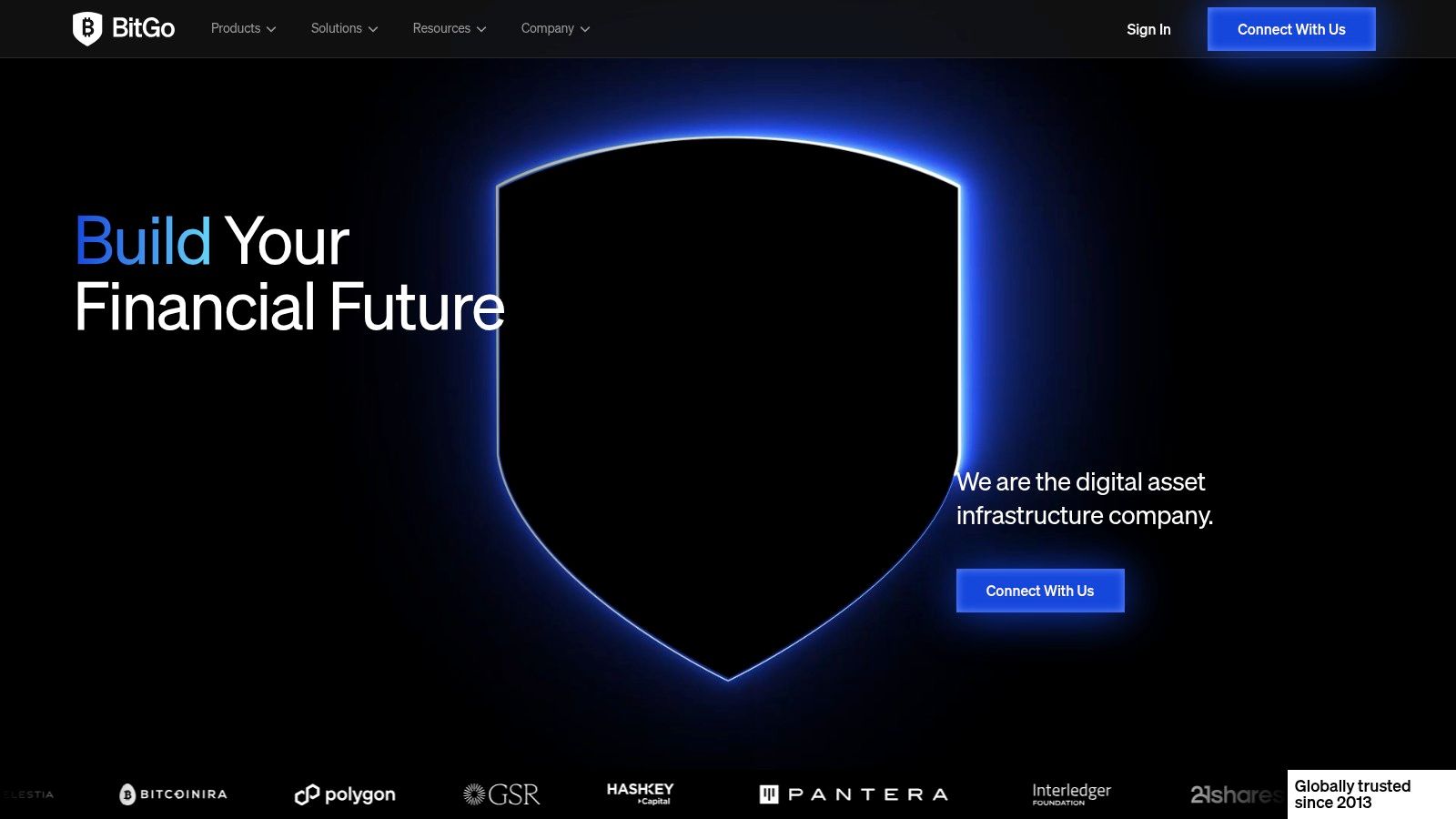
As one of the pioneering crypto custody providers, BitGo emphasizes institutional-grade security, backed by substantial insurance programs and a strong compliance posture. The platform’s Go Network facilitates instant, off-chain settlements between BitGo clients, a valuable feature for active trading firms. This combination of regulated custody, broad asset support, and deep infrastructure makes it a formidable choice for enterprises managing significant digital asset portfolios.
Key Features & Use Cases
BitGo’s infrastructure is designed to meet the rigorous demands of institutional finance, from secure asset storage to active participation in the digital economy.
- Best For: Institutional investors, hedge funds, ETF issuers, and exchanges requiring a battle-tested custodian with extensive asset support and insurance.
- Unique Offerings: The platform offers staking, prime services, and the Go Network for rapid asset transfers, all built upon its core multi-signature wallet technology.
- Security & Compliance: It provides qualified custody under a South Dakota charter and has completed SOC 1 Type 2 and SOC 2 Type 2 examinations.
Website: https://www.bitgo.com/
| Feature Analysis | Assessment |
|---|---|
| Custody Model | Qualified Custodial via regulated trust & self-custody |
| Asset Support | 1,100+ assets, one of the broadest in the industry |
| Integration | Comprehensive APIs for custody and wallet services |
| Pricing | Custom, tailored to client needs |
| Pros | Deep institutional experience; extensive asset support |
| Cons | Custom pricing lacks transparency; insurance details vary |
7. Paxos Trust Company
Paxos positions itself as a regulated blockchain infrastructure platform, with qualified custody at its core. Operating as a New York Department of Financial Services (NYDFS) chartered trust company, it provides the foundational technology for enterprises to build and offer crypto products. Its services are strictly B2B, powering crypto brokerage, asset tokenization, and settlement for major financial institutions and fintech partners rather than serving retail clients directly.
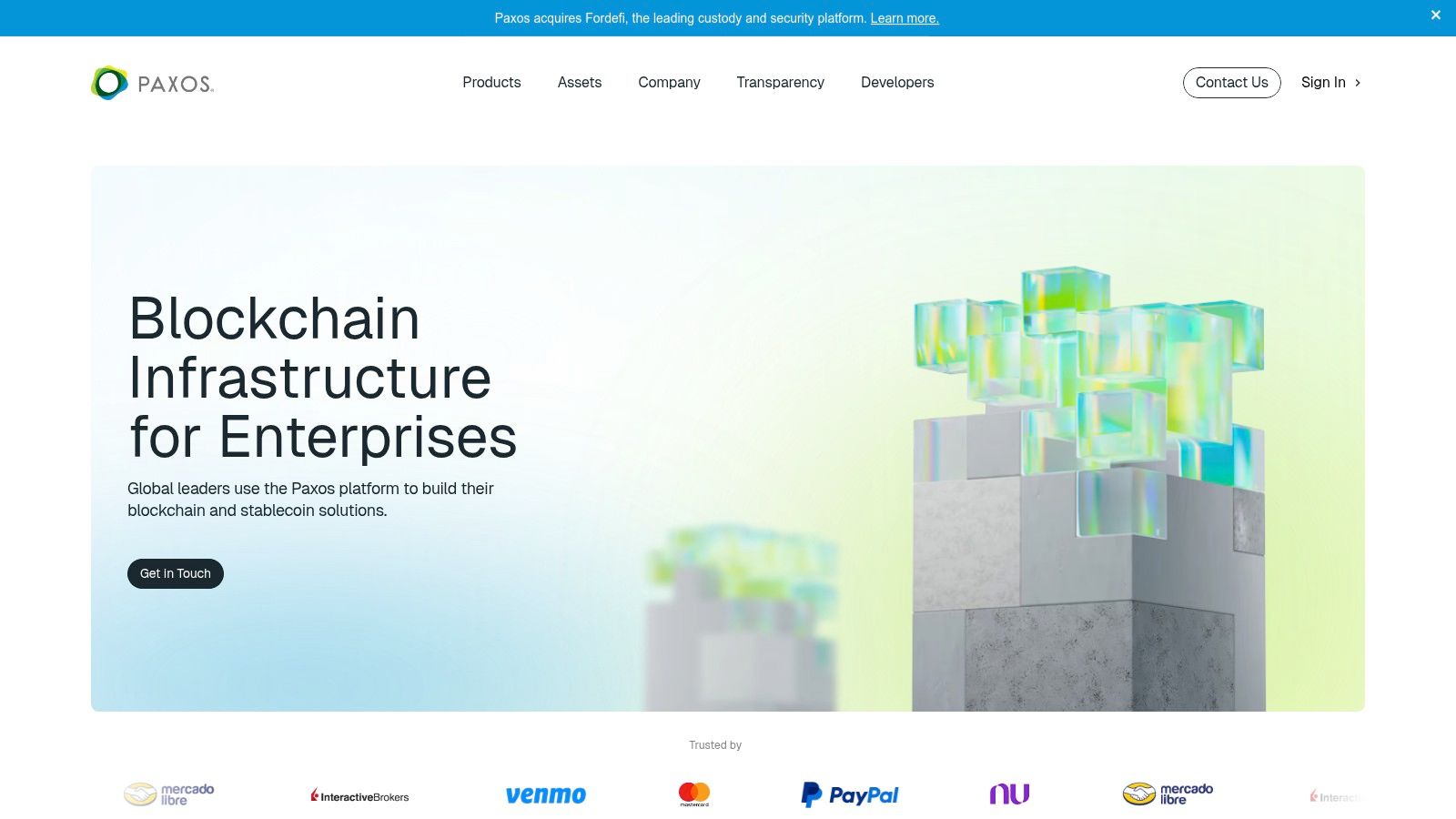
This B2B focus means Paxos provides the secure, compliant custody layer that underpins the crypto offerings of well-known brands. The company is also a leading issuer of regulated stablecoins, such as PayPal USD (PYUSD), showcasing its deep integration of custody and tokenization infrastructure. This makes Paxos a critical, albeit often invisible, component in the ecosystem of crypto custody providers, emphasizing regulatory adherence and institutional-grade reliability.
Key Features & Use Cases
Paxos is engineered for businesses that need to embed crypto capabilities into their existing platforms without building the complex custody and regulatory infrastructure from scratch.
- Best For: Large fintech companies, financial institutions, and enterprise platforms seeking a white-label, regulated custody and brokerage solution.
- Unique Offerings: The platform provides "Crypto Brokerage as a Service," which bundles qualified custody with trading APIs and identity management, allowing partners to launch crypto services quickly.
- Security & Compliance: As an NYDFS-chartered trust, Paxos is subject to stringent regulatory oversight, capital requirements, and regular examinations, providing a high degree of assurance.
Website: https://www.paxos.com/
| Feature Analysis | Assessment |
|---|---|
| Custody Model | Qualified Custodial via NYDFS-chartered trust |
| Asset Support | Partner-driven; curated list focused on major assets |
| Integration | API-first for embedding crypto brokerage and custody |
| Pricing | Bespoke for enterprise partners |
| Pros | Strong U.S. regulatory alignment; proven B2B scale |
| Cons | Enterprise/B2B focus with no retail interface; limited asset selection |
8. NYDIG
NYDIG establishes itself as a Bitcoin-first institutional platform, offering a suite of financial services built around the leading digital asset. It provides regulated, audited, and insured custody through its in-house, New York Department of Financial Services (NYDFS) chartered trust company. This specialized focus, combined with trading, derivatives, and financing solutions, makes it a powerful partner for traditional financial institutions like banks and asset managers looking to enter the Bitcoin space securely.
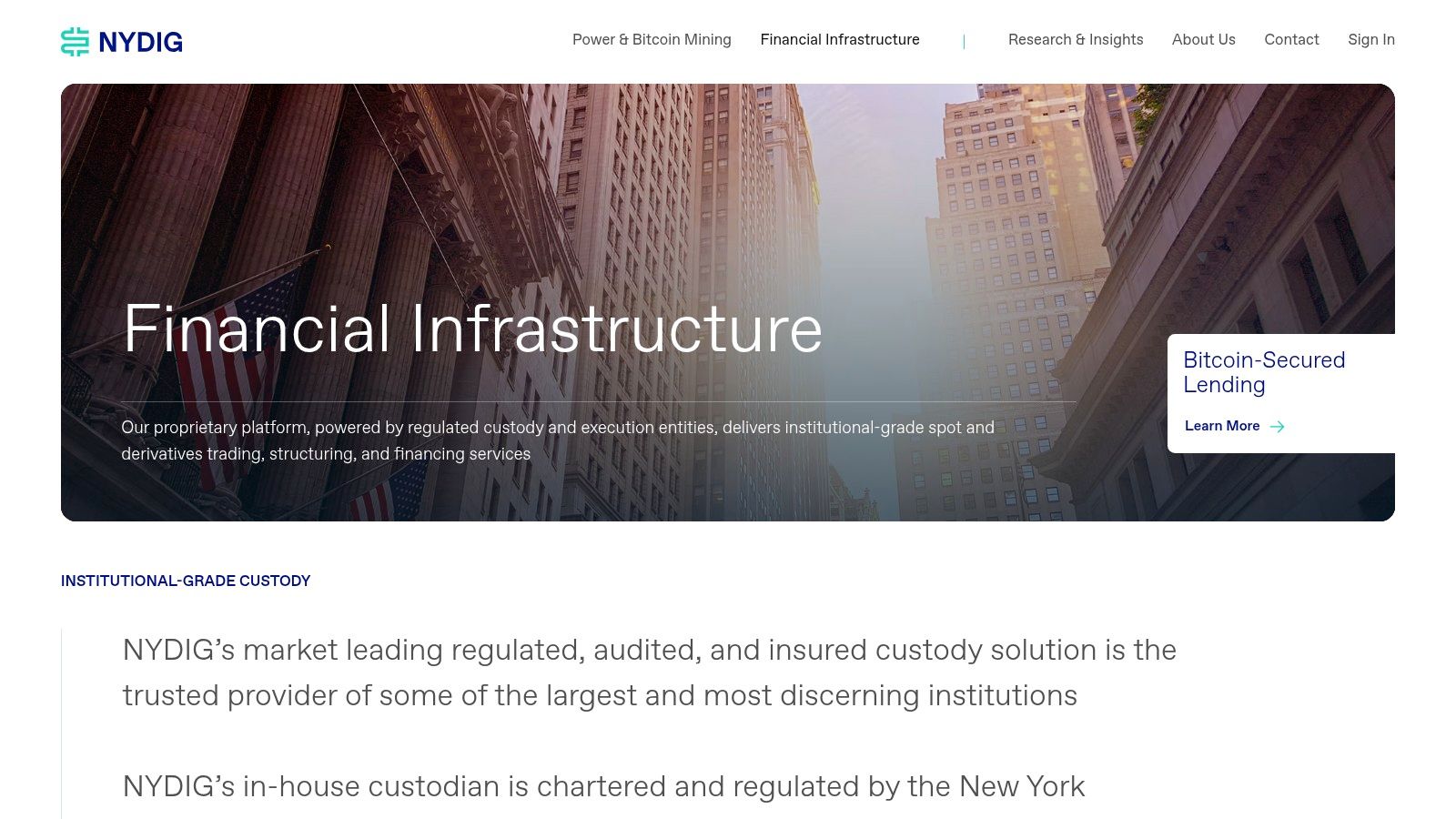
The platform's deep expertise in Bitcoin and its strong relationships with U.S. financial institutions are key differentiators among crypto custody providers. NYDIG often acts as a sub-custodian, enabling established banks to offer Bitcoin products to their clients without building the underlying infrastructure themselves. This B2B model underscores its role as a core component of the financial infrastructure bridging traditional and digital asset markets.
Key Features & Use Cases
NYDIG is designed for institutions that require a high-touch, regulated, and Bitcoin-centric approach to digital asset management. Its services are tailored for integration into existing financial frameworks.
- Best For: Banks, credit unions, asset managers, and other financial institutions seeking a regulated partner to offer Bitcoin products and custody services.
- Unique Offerings: The platform provides institutional-grade Bitcoin research and educational resources, alongside structured products and lending solutions collateralized by Bitcoin.
- Security & Compliance: As an NYDFS-chartered trust, NYDIG undergoes regular audits and holds SOC 1 and SOC 2 examinations, providing a high degree of regulatory assurance.
Website: https://www.nydig.com/financial-infrastructure
| Feature Analysis | Assessment |
|---|---|
| Custody Model | Qualified Custodial via NYDFS-chartered trust |
| Asset Support | Primarily Bitcoin-focused |
| Integration | Geared towards sub-custody and B2B partnerships |
| Pricing | Custom; requires enterprise onboarding |
| Pros | Deep Bitcoin expertise; strong bank connectivity |
| Cons | Limited multi-asset coverage; not for direct retail |
9. Fireblocks
Fireblocks offers a unique, technology-first approach to digital asset management with its enterprise-grade platform for moving, storing, and issuing crypto. Rather than acting as a traditional custodian itself, it provides a powerful infrastructure layer that enables businesses to build their own direct custody solutions using multi-party computation (MPC). This model gives institutions direct control over their assets while benefiting from sophisticated, policy-driven security workflows.
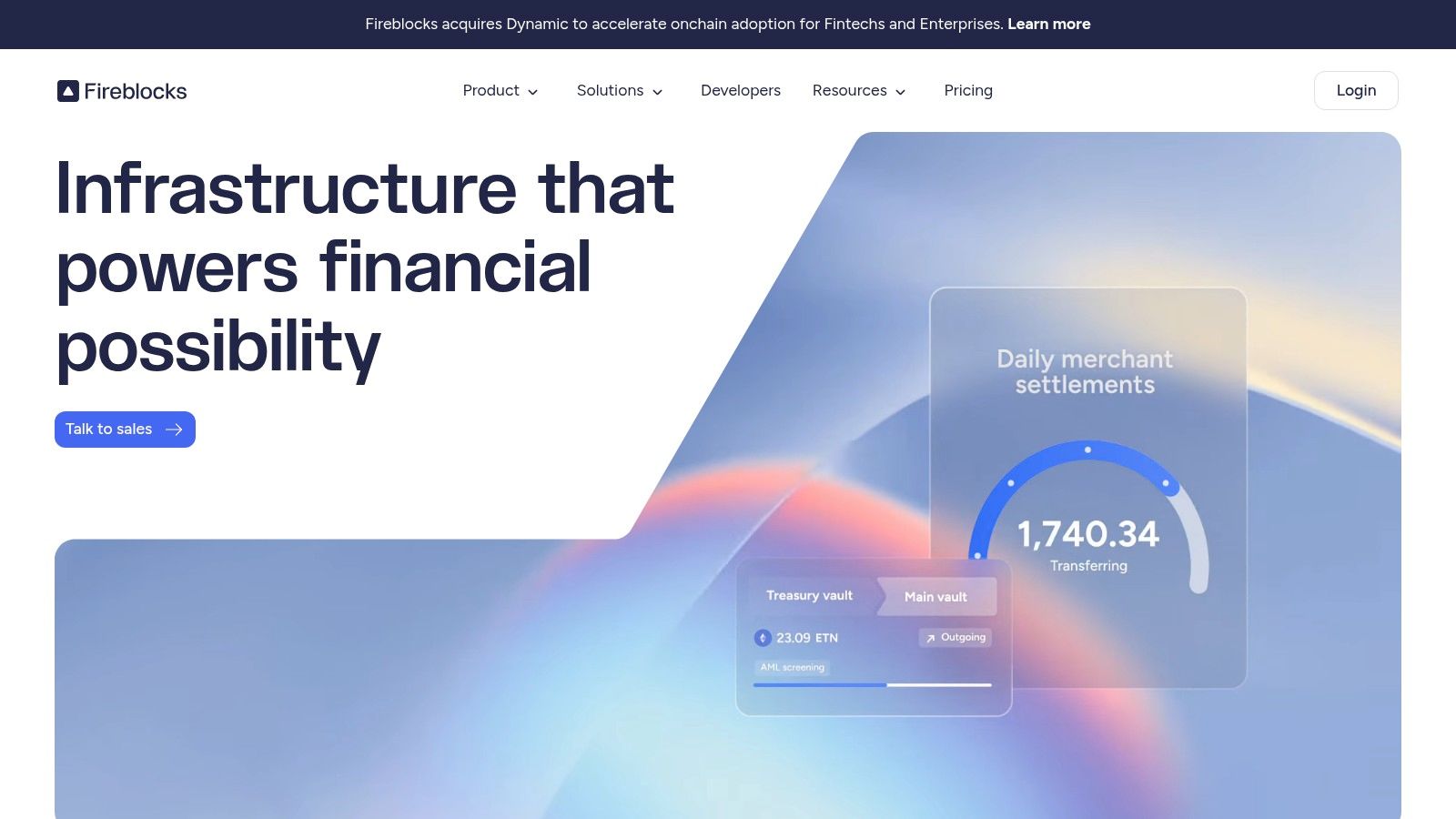
For organizations requiring a regulated entity, Fireblocks operates a Global Custodian Partner Program, connecting clients to a network of licensed custodians. This hybrid model offers unparalleled flexibility, allowing a business to choose between direct, software-enabled self-custody or a connected qualified partner. Its MPC-CMP technology is a cornerstone of its security, removing single points of failure by eliminating the need for a complete private key to ever be held in one place. You can learn more about private key security to understand the importance of this model.
Key Features & Use Cases
Fireblocks is built for businesses that need a high degree of control, security, and connectivity in their digital asset operations, making it one of the most versatile crypto custody providers.
- Best For: FinTechs, exchanges, and enterprises that need a flexible custody infrastructure to either manage assets directly or connect to a network of third-party custodians.
- Unique Offerings: The Fireblocks Network provides secure, instant settlement and asset transfer capabilities between over 1,800 institutional participants, streamlining counterparty transactions.
- Security & Compliance: The platform is SOC 2 Type II certified and has undergone penetration testing by leading cybersecurity firms.
Website: https://www.fireblocks.com/
| Feature Analysis | Assessment |
|---|---|
| Custody Model | Direct/Self-Custody via MPC or connection to qualified partners |
| Asset Support | Extensive, supporting thousands of tokens across 50+ blockchains |
| Integration | Comprehensive REST APIs for full platform functionality |
| Pricing | Enterprise SaaS licensing; bespoke pricing |
| Pros | Flexible custody models; wide institutional and exchange network |
| Cons | Not a qualified custodian itself; requires enterprise contract |
10. Ledger Enterprise (Ledger Vault)
Ledger Enterprise leverages the renowned security stack of Ledger to offer a self-custody technology platform for institutions. It provides a sophisticated blend of hardware security modules (HSMs) and multi-party computation (MPC) style policy controls, allowing organizations to manage their own digital assets with stringent governance and clear audit trails. This solution is tailored for firms that prioritize direct control over their assets while requiring enterprise-grade security and operational workflows.
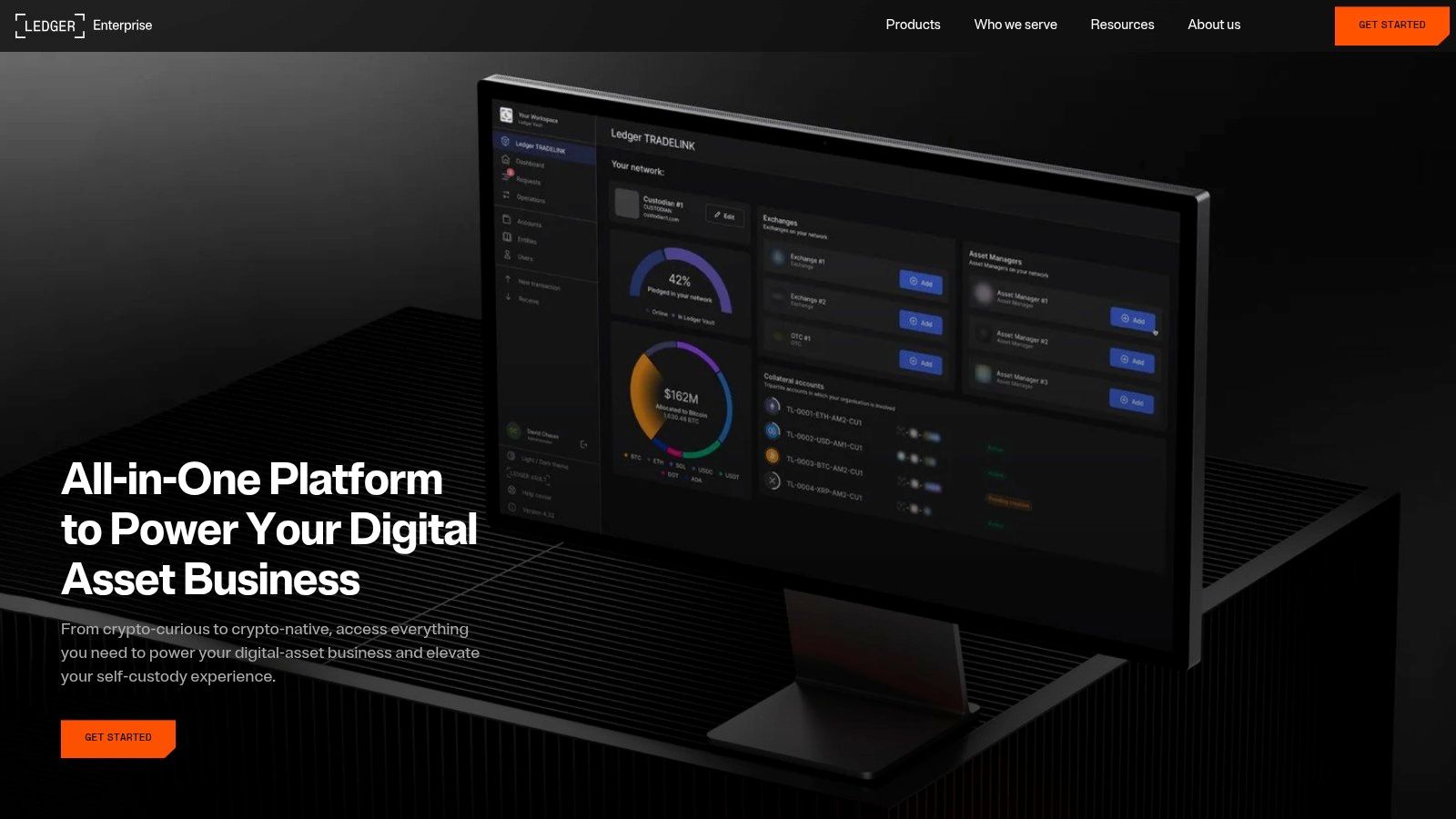
Unlike fully managed services, Ledger Enterprise empowers businesses to build their own custody infrastructure on a battle-tested foundation. It is a technology provider, not a qualified custodian, meaning businesses that need to meet specific regulatory requirements (like investment advisors) must pair it with a licensed trust or bank. This model is ideal for firms looking to avoid counterparty risk associated with third-party custodians. You can explore the core principles of this approach and learn more about crypto cold storage to better understand its benefits.
Key Features & Use Cases
Ledger Enterprise is built for organizations that demand granular control over transaction policies and asset management without relying on external parties.
- Best For: Crypto hedge funds, trading firms, and corporate treasuries seeking a highly secure, self-custody solution with customizable governance.
- Unique Offerings: The platform offers a unique combination of hardware-based security with flexible, software-defined transaction rules and a robust audit trail feature for compliance.
- Security & Compliance: It holds SOC 2 Type II certification and is referenced by ANSSI (the French National Agency for the Security of Information Systems), demonstrating a strong commitment to security standards.
Website: https://enterprise.ledger.com/
| Feature Analysis | Assessment |
|---|---|
| Custody Model | Self-Custody Technology Platform |
| Asset Support | Thousands of coins and tokens supported |
| Integration | API-driven for integration into custom workflows |
| Pricing | Custom enterprise contracts; not public |
| Pros | Trusted security brand; mature self-custody tech |
| Cons | Not a qualified custodian; requires custom pricing |
11. Komainu
Komainu emerges as a specialized, institution-first digital asset custodian established through a joint venture involving Nomura, Ledger, and CoinShares. This unique backing provides a blend of traditional financial institution rigor with cutting-edge crypto security technology. The platform is designed from the ground up to meet the complex governance, security, and regulatory demands of institutional clients, offering segregated, on-chain wallets and verifiable ownership.
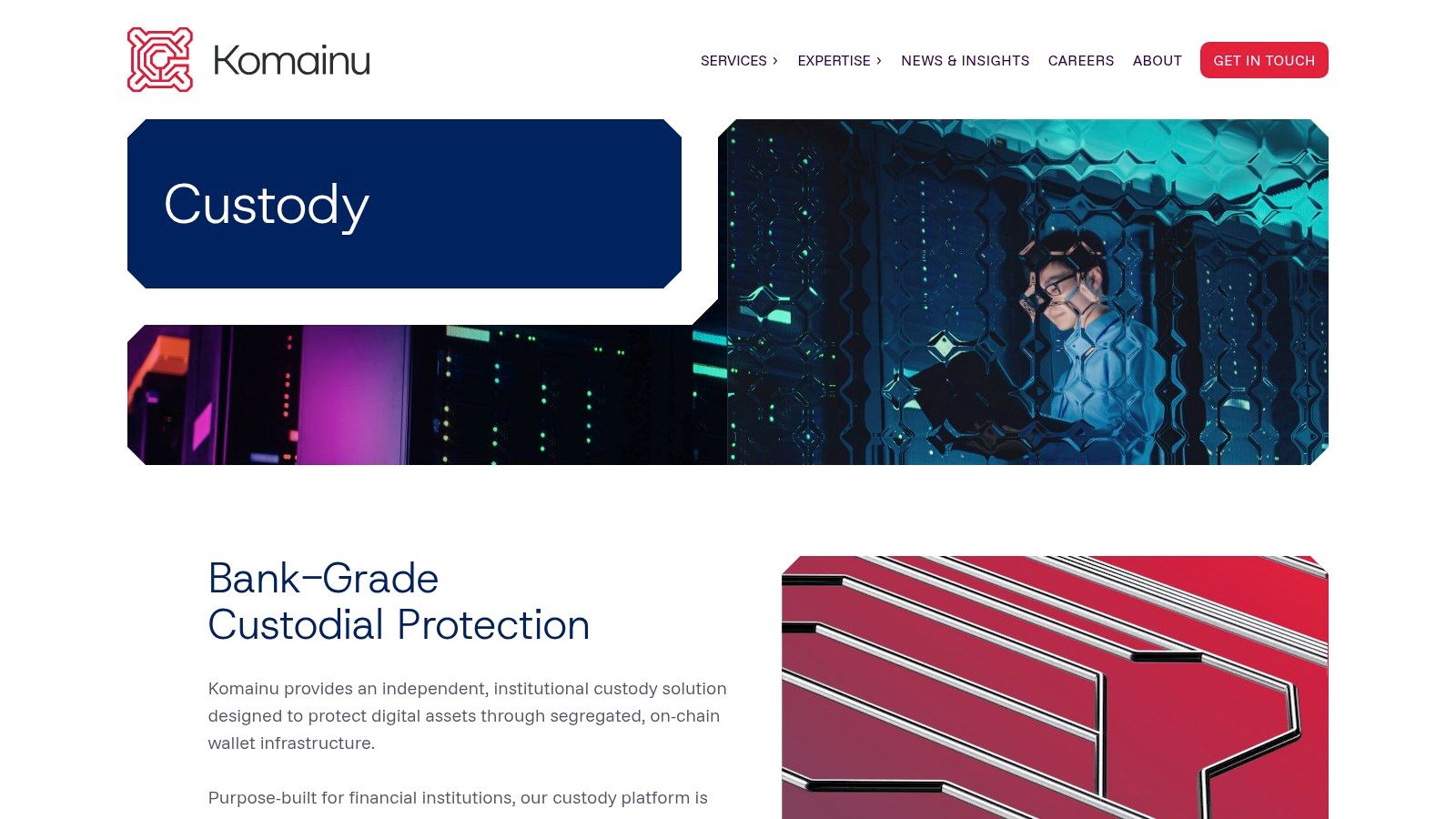
Regulated across multiple key jurisdictions, Komainu provides a robust compliance framework that appeals to global financial players. Its selection by Nasdaq as a core custodian for their crypto indices serves as a powerful third-party validation of its security and operational integrity. This focus makes it a distinct choice among crypto custody providers for enterprises prioritizing bank-grade controls and bankruptcy-remote asset protection.
Key Features & Use Cases
Komainu’s architecture is tailored for institutional-grade security and governance, ensuring assets are managed with the highest level of oversight.
- Best For: Hedge funds, asset managers, financial institutions, and corporate treasuries requiring a highly regulated, secure, and segregated custody environment.
- Unique Offerings: The platform's bankruptcy-remote structure legally separates client assets from the custodian’s balance sheet, offering a critical layer of protection. It also provides institutional-grade governance, auditing, and insurance frameworks.
- Security & Compliance: Komainu leverages a hybrid custody model that combines hardware security modules (HSMs) with multi-party computation (MPC) and holds regulatory licenses in key financial hubs.
Website: https://komainu.com/services/custody
| Feature Analysis | Assessment |
|---|---|
| Custody Model | Institutional-grade hybrid (HSM & MPC) |
| Asset Support | Focused on major digital assets and tokens |
| Integration | Institutional integrations with trading and settlement platforms |
| Pricing | Bespoke and enterprise-focused |
| Pros | Strong institutional pedigree; robust global regulatory footprint |
| Cons | Primarily focused on institutional clients; onboarding can be lengthy |
12. Zodia Custody
Zodia Custody emerges from a unique collaboration of banking giants, including Standard Chartered, Northern Trust, and SBI Holdings. This bank-backed heritage instills a deep sense of institutional-grade governance and risk management into its DNA. The platform is strategically focused on serving institutional clients across Europe and Asia, offering a high-touch service model built on robust regulatory foundations and insolvency-remote asset protection.
Its approach provides a compelling option for global asset managers, family offices, and corporations operating across multiple jurisdictions. As one of the dedicated crypto custody providers with strong banking parentage, Zodia emphasizes security frameworks like SOC 1 and ISO 27001 certifications. This ensures that its operational and security controls meet the stringent standards expected by traditional financial institutions venturing into digital assets.
Key Features & Use Cases
Zodia Custody is engineered for institutions that prioritize regulatory compliance and a global operational footprint, particularly within the UK, EU, and Asian markets.
- Best For: Institutional asset managers, corporate treasuries, and financial institutions requiring bank-grade custody with a multi-jurisdictional regulatory presence in Europe and Asia.
- Unique Offerings: The platform provides institutional staking services directly from cold storage and sub-custody solutions, enabling clients to build and scale their digital asset offerings securely.
- Security & Compliance: It holds key registrations with regulators in the UK, Ireland, and Luxembourg, offering a clear and compliant framework for institutional capital.
Website: https://zodiacustody.com/
| Feature Analysis | Assessment |
|---|---|
| Custody Model | Institutional Custodial |
| Asset Support | Supports top-tier digital assets with a focus on institutional demand |
| Integration | API access available for institutional clients |
| Pricing | Bespoke, requires direct consultation |
| Pros | Strong bank-backed credibility; insolvency-remote structure |
| Cons | Primarily focused on UK/EU/Asia; requires enterprise-level onboarding |
Top 12 Crypto Custody Providers — Feature Comparison
| Provider | Core features ✨ | Security & Compliance 🏆 | Target audience 👥 | Unique selling points ✨🏆 | Pricing & Value 💰★ |
|---|---|---|---|---|---|
| Coinbase Prime | Qualified custody + trading, 420+ assets, prime APIs | NYDFS trust; institutional compliance stack | 👥 Institutions, ETF issuers | Large US market share; integrated prime workflows | 💰 Custom enterprise pricing · ★★★★ |
| Anchorage Digital Bank | Custody + trading/staking/fiat rails, fast settlement | OCC federal bank charter; bankruptcy‑remote custody | 👥 Institutions, enterprises | Federal charter & auditor‑friendly segregation | 💰 Enterprise pricing · ★★★★ |
| Gemini Custody | Cold storage + insurance, API/portal, Instant Trade | NY‑regulated trust; SOC2 & ISO27001; insured cold storage | 👥 Institutions seeking transparent custody | Published fee schedule; Instant Trade from cold vault | 💰 Published fees (min.) · ★★★★ |
| Kraken Custody | Regulated SPDI custody, integrated prime services | Wyoming SPDI; SOC2; MPC/HSM & role controls | 👥 Institutional traders using Kraken Prime | On‑chain segregated wallets; auditable flows | 💰 Custom enterprise pricing · ★★★ |
| Fidelity Digital Assets | Custody + execution; research & client education | Backed by Fidelity's enterprise compliance | 👥 Institutions, advisors, funds | Brand trust; deep ops & research support | 💰 Bespoke pricing · ★★★ |
| BitGo | Qualified custody, 1,100+ assets, settlement network | Insured cold storage programs; enterprise security | 👥 Institutions, ETFs, treasuries | Broad asset support; ETF custody experience | 💰 Custom pricing · ★★★★ |
| Paxos Trust Company | Qualified custody + brokerage, partner infra | NYDFS trust oversight; transparency reporting | 👥 B2B partners, fintechs, enterprises | Stablecoin issuance; B2B brokerage integrations | 💰 Enterprise/B2B pricing · ★★★ |
| NYDIG | Bitcoin‑first custody, trading & financing solutions | In‑house NYDFS‑chartered custodian; SOC exams | 👥 Banks, asset managers focused on BTC | Deep Bitcoin expertise; bank connectivity | 💰 Custom pricing · ★★★★ |
| Fireblocks | MPC wallet infra, policy workflows, network & connectors | MPC‑based security; partners provide qualified custody | 👥 Enterprises building custody or integrations | Flexible: self‑custody or custodian connections | 💰 SaaS licensing (enterprise) · ★★★★ |
| Ledger Enterprise (Vault) | Enterprise wallet + granular policy controls | SOC2; hardware security & audit trails | 👥 Firms building self‑custody workflows | Trusted hardware brand; extensive coin support | 💰 Enterprise contracts · ★★★ |
| Komainu | Segregated on‑chain custody, verifiable ownership | Bank‑grade security; multi‑jurisdiction regulation | 👥 Institutions, asset managers | Nomura backing; Nasdaq selection for indices | 💰 Bespoke pricing · ★★★ |
| Zodia Custody | Bank‑backed custody, global regs & staking | SOC/ISO certifications; insolvency‑remote structures | 👥 Institutional managers with global needs | Bank backing (Standard Chartered et al.); multi‑region reach | 💰 Enterprise pricing · ★★★ |
Making Your Choice: A Decision Framework for Your Business
Choosing from the top crypto custody providers requires a clear understanding of your business's specific needs. It’s not about finding the 'best' provider, but the right one for your use case, risk profile, and operational model. We've explored a wide range of solutions, from regulated bank-chartered institutions like Anchorage Digital and Kraken Custody to technology-first platforms like Fireblocks and Ledger Enterprise. The key takeaway is that the digital asset landscape is mature enough to offer specialized solutions for virtually any business requirement.
Your final decision hinges on a strategic evaluation of your internal needs against the offerings in the market. A global enterprise requiring segregated accounts and extensive compliance reporting for mass payouts will have vastly different priorities than a SaaS startup that needs a simple, secure API to accept recurring crypto payments. The former might lean towards Fidelity Digital Assets or Coinbase Prime for their institutional pedigree, while the latter might find BitGo's or Fireblocks' developer-centric tools more suitable.
A Practical Checklist for Your Evaluation
To distill this complex decision into actionable steps, use the following framework. Revisit these questions with your team to create a clear requirements document before you engage with any sales representatives.
1. Define Your Security and Control Model:
- Custodial vs. Self-Custody: Is your organization comfortable delegating key management to a third party for operational ease (custodial)? Or does your security policy mandate that you retain ultimate control over your private keys (self-custody or MPC)?
- Governance Policies: What level of control do you need? Consider your requirements for multi-user approvals, wallet whitelisting, and transaction limits. Platforms like Fireblocks and Ledger Enterprise excel at offering granular, programmable policy controls.
2. Assess Regulatory and Compliance Needs:
- Jurisdiction: Where does your business operate, and what are the local regulations? A provider with a New York BitLicense and Trust Charter, like Gemini or Paxos, offers a high standard of regulatory compliance recognized globally.
- Certifications: Do you require specific certifications like SOC 1 Type II or SOC 2 Type II? These are standard among most top-tier crypto custody providers but are crucial for audits and enterprise partnerships.
- Insurance: What level of insurance coverage is non-negotiable for your assets? Dig into the specifics of their policy, including what it covers (e.g., hot vs. cold storage, internal collusion, hardware failure).
3. Evaluate Technical and Operational Fit:
- API and Integration: How deeply will this solution integrate with your existing tech stack? Assess the quality of their API documentation, SDK availability, and support for the specific blockchains and tokens you need.
- Supported Assets: Does the provider support the full range of digital assets your business plans to hold or transact with? Check not just for major cryptocurrencies but also for specific stablecoins or DeFi tokens relevant to your operations.
- Use Case Alignment: Is the provider optimized for your primary use case? If you are a high-frequency trading firm, the low-latency capabilities of a provider like Anchorage Digital will be more critical than for an e-commerce merchant simply accepting payments.
Finally, consider the financial implications beyond just custody fees. The efficiency of a provider's API can reduce your development costs, while robust reporting can simplify your accounting and tax obligations. As businesses navigate the complex world of digital assets, it's crucial to also consider tax efficiency. For instance, you might want to learn how to optimize your tax strategy through crypto tax loss harvesting. A good custody partner should provide the data you need to make these strategic financial decisions easily. By methodically working through this framework, you can move beyond the marketing materials and select a crypto custody provider that truly functions as a strategic partner for your business.
For businesses that find custodial solutions overly complex or restrictive, a non-custodial payment gateway offers a powerful alternative. BlockBee provides the tools to accept cryptocurrency payments directly into your own wallets, giving you full control over your funds without the high fees and onboarding friction of many institutional custodians. Explore how BlockBee can simplify your crypto payment processing today.
Review Us