
Choosing a Crypto Custody Solution Your Business Can Trust
Think of a crypto custody solution as a high-security vault for your business’s digital assets. It’s a specialized service built to securely store, manage, and protect the private keys that grant access to your cryptocurrency funds. This effectively lifts the heavy burden of managing complex security protocols off your shoulders.
Why Your Business Needs a Digital Vault
Imagine your company’s financial reserves are stored in a physical, high-security vault. You certainly wouldn't give the only key to a single employee, and you definitely wouldn't leave the door unlocked. A crypto custody solution serves this exact purpose for your business's digital currency. Instead of protecting stacks of cash, it’s all about safeguarding the private keys that control your funds.
In the crypto world, the phrase "not your keys, not your coins" is gospel. A private key is a secret, complex string of data that proves you own your assets and gives you the power to spend them. If that key is lost, stolen, or otherwise compromised, your funds are gone for good. There's no bank to call, no transaction to reverse. This reality introduces a massive operational risk for any business that deals with digital assets.
If you'd like to dive deeper into the basics of how wallets and keys function, be sure to read our guide on how crypto wallets work.
The Problem Custody Solutions Solve
Let's be honest: managing private keys is a nightmare for most businesses. It demands deep technical knowledge, a rock-solid security infrastructure, and staying constantly ahead of sophisticated cyber threats. Building this kind of system from scratch is not only impractical but also incredibly expensive. This is where a professional custody solution comes in. They solve this problem by providing:
- Advanced Security: Custodians use a multi-layered security approach, often involving things like multi-signature authorization, hardware security modules (HSMs), and cold storage to keep funds safe from hackers.
- Operational Efficiency: They handle the tedious, complex work—like managing hundreds of wallets, sending mass payouts, and reconciling transactions—so your team can focus on what they do best.
- Regulatory Compliance: Established custodians operate under strict regulatory frameworks, managing the necessary Anti-Money Laundering (AML) and Know Your Customer (KYC) requirements to keep your business compliant.
The explosive growth in institutional adoption of crypto has created a massive demand for these services. It’s a clear signal that the market needs professional, secure, and reliable ways to manage digital assets.
The numbers back this up. The cryptocurrency custody software market was valued at $4.056 billion and is on track to hit an incredible $18.04 billion by 2035, as detailed by Market Research Future. This isn't just a niche service anymore; it's a foundational piece of the digital economy.
Before we get into the nitty-gritty of the technologies involved, let's start with a high-level look at the different ways you can approach custody.
Crypto Custody Models at a Glance
The right custody model really depends on your business's needs for control, security, and convenience. This table breaks down the three main approaches to give you a quick lay of the land.
| Custody Model | Who Holds the Keys? | Best For | Key Feature |
|---|---|---|---|
| Custodial | A third-party provider | Large institutions needing convenience and high-level security | Simplicity and outsourced security management |
| Non-Custodial | The business itself (you) | Businesses wanting full control and autonomy over their assets | Complete control and elimination of third-party risk |
| Hybrid | A combination of both | Businesses needing a balance of control and security | Flexible policies that mix self-custody with third-party features |
Each of these models comes with its own set of trade-offs. Choosing the right one is a critical first step in building a secure and efficient treasury management strategy for your digital assets.
Exploring Different Crypto Custody Models
Picking the right crypto custody solution isn't a one-size-fits-all kind of deal. It’s a strategic choice that really boils down to your business's specific needs for security, control, and day-to-day operational smoothness. The model you end up with determines who holds the ultimate power over your digital assets—is it you, or is it someone else?
Think of it like choosing between a bank's vault and a personal safe you keep at home. Each has its clear advantages and its own set of responsibilities, directly shaping how you manage and access your funds.
This diagram shows the basic hierarchy. The custody solution is the gatekeeper to the private keys, which in turn control your crypto.
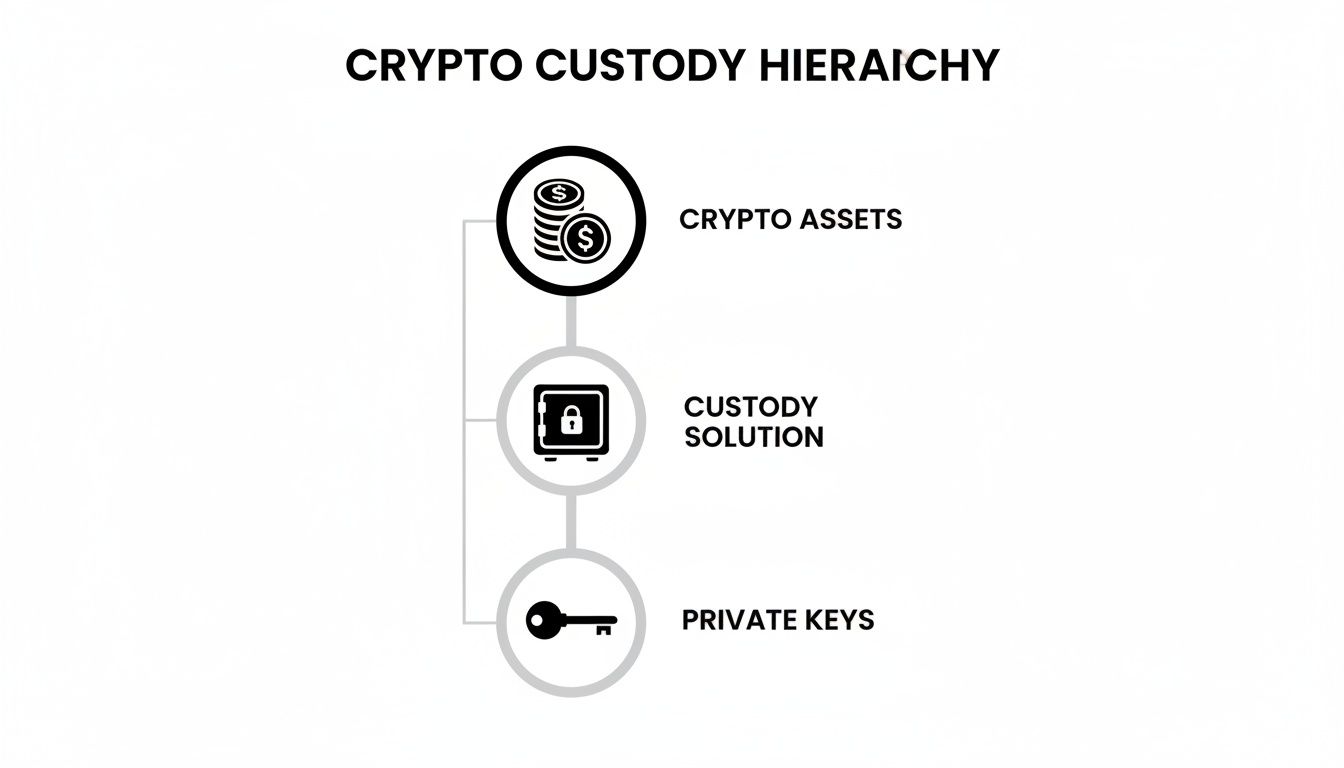
It’s a simple but crucial point: whoever controls the keys controls the assets. That’s why this decision is so foundational to your security.
Custodial Solutions: The Bank Vault Approach
A custodial crypto custody solution is basically the digital version of storing your gold bars in a high-security bank vault. You hand over your private keys to a specialized third-party company, trusting them to manage the complex security, execute transactions for you, and generally keep your assets safe.
This is the go-to model for many big players—think financial institutions, hedge funds, and large corporations dipping their toes into crypto. Why? It lets them outsource the massive technical and security headaches. These businesses often value convenience and regulatory compliance, and they want access to perks like insurance, which top-tier custodians provide.
The trade-off, of course, is control. You're placing your trust entirely in another company's hands, which introduces counterparty risk. If your custodian gets hacked, runs into regulatory trouble, or goes bust, your funds could be stuck in limbo.
Non-Custodial Solutions: Your Personal Safe
On the flip side, a non-custodial (or self-custody) solution is like owning your own personal, impenetrable safe. In this setup, your business keeps exclusive control over its private keys. You are your own bank. No third party can freeze your assets, seize them, or lose access to them.
This approach is a favorite for businesses that live and breathe autonomy and decentralization. You'll often see Web3 startups, e-commerce shops accepting crypto payments, and companies needing programmatic fund access choose non-custodial solutions. If you want to dive deeper, you can explore the differences between non-custodial and custodial services.
The biggest win with non-custodial solutions is the complete removal of third-party risk. Your assets are secured by your own rules, giving you total sovereignty over your financial operations.
But with great power comes great responsibility. Your team is solely on the hook for securing those private keys. One slip-up, like losing the keys or falling for a phishing scam, could mean your funds are gone forever, with no one to call for help.
Hybrid Models: The Best of Both Worlds?
Since neither model is perfect for every situation, hybrid crypto custody solutions have popped up to fill the gap. These setups try to blend the heavy-duty security and convenience of custodial services with the control and freedom of a non-custodial approach.
A common hybrid strategy is to use a custodian for the bulk of your long-term holdings (your "cold storage") while keeping a non-custodial wallet for daily operational cash (a "hot wallet"). Another way is to use tech like multi-party computation (MPC), where pieces of a key are split between your business and a service provider. This way, no single entity can run off with the funds.
This balanced approach lets businesses tailor their security to their exact needs. For instance, a trading firm might secure its large reserves with a custodian but use a non-custodial system for high-frequency automated trading. It’s all about striking that perfect balance between managing risk and staying agile.
Core Security Technologies That Protect Your Assets
Beyond the high-level custody model you choose, the real strength of any solution comes down to the specific tech it uses to protect your private keys. Think of these technologies as the digital equivalent of vault doors, armed guards, and time-locked safes.
Knowing how they work is crucial. It’s the only way to tell a genuinely secure provider from one that just talks a good game. Let’s break down the core components that form the security backbone of modern digital asset protection.
Multi-Signature Wallets for Shared Control
The simplest way to remove a single point of failure is to make it impossible for one person or device to authorize a transaction alone. That’s the whole idea behind Multi-Signature (Multi-Sig) technology.
Imagine a bank's safe deposit box that needs two different keys, held by two different people, turned at the same time to open it. A Multi-Sig wallet works on the exact same principle. It's set up to require a certain number of approvals (signatures) from a larger group of keyholders before any crypto can move.
A common setup is a “2-of-3” configuration:
- Three people are authorized, and each holds a unique private key.
- To move funds, at least two of them must sign off on the transaction.
- If one person's key is lost or stolen, the funds are still safe. The attacker can't do anything without that second signature.
This structure is incredibly effective at preventing both external hacks and internal fraud. A thief can’t drain the wallet with just one key, and a rogue employee can’t act alone. It builds mandatory collaboration right into your security process.
Hardware Security Modules: The Digital Fortress
While Multi-Sig distributes authority, Hardware Security Modules (HSMs) are all about protecting the keys themselves. An HSM is a specialized, tamper-resistant piece of hardware built for one job: to safeguard and manage digital keys in an extremely secure environment.
Think of an HSM as a military-grade bunker built specifically to hold your private keys. It's hardened physically and digitally against any kind of intrusion. Keys are generated inside the HSM and are cryptographically bound to it, meaning they can never be extracted or viewed in plain text.
The core function of an HSM is to create a "black box" where cryptographic operations, like signing a transaction, can happen without ever exposing the private key to the outside world.
When a transaction needs signing, the unsigned data is sent to the HSM. The device signs it internally and sends the signed transaction out. The private key never leaves the hardware's secure confines, keeping it safe from malware, network attacks, and even physical tampering.
Multi-Party Computation: The Key That Never Exists
Multi-Party Computation (MPC) is a game-changing cryptographic method that takes key security to a whole new level. Instead of creating one private key and then trying to protect it, MPC gets rid of the single key altogether.
Here’s an analogy: imagine you have a secret recipe. Instead of writing it down on one piece of paper, you tear it into three pieces and give one piece to three different chefs. No single chef knows the full recipe, but by working together using a special protocol, they can still cook the dish.
That’s how MPC works. It splits a private key into multiple encrypted "key shares," which are then distributed across different devices or servers. The full private key is never created or stored in one place at any point. To sign a transaction, the parties combine their shares to generate a valid signature without ever reconstructing the key itself.
This approach is blowing up for a reason. With cyber threats on the rise—over 20 major hacks in one year alone pushed institutions toward professional custody—MPC offers enhanced security without a single point of failure.
Hardware Wallets for Offline Security
For individuals and businesses who manage their own assets, Hardware Wallets offer a personal layer of cold storage. These are small, physical devices that store your private keys completely offline, isolating them from internet-connected computers that could be riddled with viruses or spyware.
Much like HSMs, hardware wallets sign transactions internally. You connect the device to your computer, review the transaction details on the wallet's own screen, and physically press a button to approve it. You can learn more in our detailed guide on what hardware wallets are.
Ultimately, truly safeguarding your digital assets means mastering application security best practices across every system that interacts with your funds. Together, these technologies form a powerful, multi-layered defense against a wide array of threats.
Navigating Compliance, Regulation, and Insurance
Having the best security tech protecting your digital assets is only half the story. The other half is wading through the complex world of financial regulations and making sure you have a real safety net if the worst happens. A great crypto custody solution isn't just about locking down private keys; it's about operating in a way that’s legal, transparent, and built on solid ground.
If you're running a serious business, compliance isn't optional. Regulators across the globe are taking a much closer look at digital assets to stamp out illegal activities. This is where you'll constantly hear two key acronyms: AML (Anti-Money Laundering) and KYC (Know Your Customer). These aren't just industry jargon; they're the bedrock of any trustworthy financial operation.
AML covers all the rules and procedures meant to stop criminals from laundering dirty money. A huge part of that is KYC, which requires financial services to actually verify who their customers are. Any custody provider worth its salt will have strict AML and KYC processes to ensure they aren't accidentally helping bad actors.
The Regulatory Maze
Think of compliance as your ticket to play in the big leagues of finance. A custody provider that cuts corners on these rules is a massive risk to your business. If regulators shut them down for breaking the law, your assets could get frozen or tangled up in a legal nightmare for years.
When you're vetting a provider, keep these things in mind:
- Licensing and Registration: Is the provider legally allowed to operate where you do? Regulations can vary wildly from one country to the next, so their legal status is everything.
- Audits and Reporting: Reputable custodians don't just say they're secure; they prove it. They undergo regular, independent audits to check their security, financial stability, and how they run things. A good starting point is understanding SOC compliance, which shows they meet professional standards.
- Data Privacy Rules: How are they handling your customers' sensitive information? They need to follow rules like GDPR to protect both your business and your clients.
These aren't just boxes to tick. They're clear signs of a provider's stability, professionalism, and whether they'll still be around in the long run.
What You Need to Know About Digital Asset Insurance
Insurance is that crucial fallback for when things go catastrophically wrong. But in the crypto space, not all insurance policies are the same. You have to look past the marketing claims and get into the nitty-gritty of what’s actually covered.
A top-tier custody solution will carry specialized insurance policies built specifically for digital assets. These policies provide a financial backstop for very specific, clearly defined risks, giving you confidence that your assets can be recovered even in a worst-case scenario.
A provider’s insurance policy tells you a lot about how seriously they take risk. It shows they’ve thought about disasters and have a real plan to make their clients whole again.
When you're evaluating a provider, don't be shy about digging into their insurance details. You need to ask direct, specific questions to make sure their coverage matches your needs.
Here are the essential questions you should be asking:
- What specific risks are covered? Does the policy protect against external hacks, an inside job from a rogue employee, or even the physical loss of a hardware device?
- What are the coverage limits? Is there a maximum payout per incident or per customer? You need to be sure the limit is high enough to cover your assets.
- Who is the underwriter? Is the policy backed by a big, reputable insurance company or someone you've never heard of?
- Are both hot and cold storage covered? Online "hot" wallets have very different risks than offline "cold" storage. A good policy will adequately cover both.
How to Choose the Right Crypto Custody Solution

Picking the right crypto custody solution is one of the most important decisions you'll make for your business. This isn’t about finding a one-size-fits-all "best" provider. It's about finding the perfect match for your specific business model, risk appetite, and future goals. A high-frequency trading firm and an e-commerce shop accepting crypto have completely different needs, after all.
You have to be methodical. Look past the shiny marketing and get into the weeds of a provider’s technology, security posture, and legal standing. This framework will walk you through the non-negotiables to make sure you choose a partner that not only protects your assets but helps your business thrive.
And this decision is only getting more critical. The global digital asset custody market is expected to explode to $4,378.84 billion by 2033, which tells you just how seriously big players are taking this. You can get a deeper look at this growth from the latest digital asset custody market research.
Security Protocols and Technology Stack
Security is, without a doubt, job number one. A breach isn’t just a financial loss; it’s a complete and utter destruction of your customers' trust. Your evaluation has to start with a deep dive into the provider’s security architecture.
First, ask what core technology they're built on. Are they using Multi-Signature (Multi-Sig), Multi-Party Computation (MPC), or Hardware Security Modules (HSMs)? Each has its own strengths and trade-offs. You need to understand which model they use and, more importantly, why they chose it for their system.
Beyond the core tech, you need to grill them on their day-to-day security habits:
- Key Generation and Storage: How and where are private keys actually born and kept? You want to hear that they’re generated in a secure, offline environment, far away from online threats.
- Asset Segregation: Are your assets sitting in your own dedicated, segregated wallet, or are they lumped together with every other client's funds? Segregation is crucial—it protects you if another customer causes a problem.
- Third-Party Audits: Has their setup been put through the wringer by reputable cybersecurity firms? Ask to see the reports from independent security audits and penetration tests.
A trustworthy provider will give you clear, confident answers. If you get vague responses or deflections on security questions, that’s a massive red flag.
Regulatory Standing and Compliance Framework
A custodian's regulatory status tells you a lot about their stability and legitimacy. If they're operating without the right licenses, they're a ticking time bomb. Regulators could shut them down with zero warning, and your assets could be frozen in the chaos.
Make sure you verify their licenses and registrations in every jurisdiction you operate in. A qualified custodian should be a registered trust company or hold the necessary financial licenses for their region. Just as important, confirm they are strictly following global standards for Anti-Money Laundering (AML) and Know Your Customer (KYC).
A solid compliance program isn't just about ticking boxes for the government. It's a foundational part of risk management that proves the provider is a serious, long-term player committed to playing by the rules and protecting its clients.
And don't even think about skipping the insurance conversation. A hefty policy from a well-known underwriter is non-negotiable. Dig into the details: Does it cover losses from internal theft? What about external hacks? Get clarity on the coverage limits to ensure they’re high enough to make you whole if the worst happens.
Operational Fit and Business Scalability
Finally, the solution has to actually work for your business day-to-day. The most secure vault in the world is useless if getting your funds in and out is a nightmare. You need to assess how well the platform fits into your existing workflows.
Think about these key operational points:
- Supported Assets: Does the custodian support all the coins and tokens you use now, plus the ones you're looking to add down the road?
- API and Integration: How painful will it be to connect the solution to your current systems? A well-documented, flexible API is a must for automating things like mass payouts or reconciling payments.
- Transaction Speed and Fees: How long does it take to actually get your money out? Get a complete breakdown of the fee structure—are you paying per transaction, for withdrawals, or a flat monthly fee? No surprises.
- User Roles and Permissions: Can you give different team members different levels of access? You'll want a system that lets you set specific permissions for who can initiate, approve, and send transactions to avoid costly internal mistakes or fraud.
Choosing a custody partner is a strategic move. By putting every potential provider through this checklist, you can find a solution that not only secures your digital assets but also becomes a real engine for your company's growth.
Vendor Evaluation Checklist for Crypto Custody
When you're comparing different custody solutions, it's easy to get lost in the technical jargon and marketing promises. This checklist is designed to cut through the noise and help you systematically evaluate potential partners based on what truly matters for your business's security and operational success. Use these questions as a guide during your due diligence process.
| Evaluation Criteria | Key Questions to Ask | Importance (High/Medium/Low) |
|---|---|---|
| Security Technology | What is your core security model (MPC, Multi-Sig, HSMs)? Have you undergone third-party security audits? Can we see the reports? | High |
| Asset Management | Are client assets held in segregated accounts? How do you manage key generation and storage? | High |
| Regulatory Compliance | What licenses do you hold and in which jurisdictions? How do you handle AML/KYC compliance? | High |
| Insurance Coverage | Who is your insurance underwriter? What is the total coverage amount, and what specific risks (theft, hacking) are covered? | High |
| Asset Support | Which cryptocurrencies and tokens do you currently support? What is your process for adding new assets? | Medium |
| API & Integration | Do you offer a well-documented REST API or SDKs? What level of developer support do you provide during integration? | Medium |
| Operational Efficiency | What are your typical settlement times for withdrawals and deposits? Can we set custom transaction policies and user roles? | Medium |
| Fee Structure | Can you provide a complete breakdown of all fees (custody, transaction, withdrawal, setup)? Are there any hidden costs? | Medium |
| Customer Support | What are your support hours and available channels (phone, email, chat)? Do you provide a dedicated account manager? | Low |
| Scalability & Reliability | What is your guaranteed uptime (SLA)? How has your platform handled periods of high market volatility? | Medium |
By diligently working through this checklist, you can make a much more informed and confident decision, ensuring your chosen partner is a true asset to your operations rather than a potential liability.
Common Questions About Crypto Custody
Even after you've got a handle on the different models and technologies, a few practical questions always seem to pop up. Let's tackle some of the most common ones we hear from businesses trying to figure this all out.
What's the Real Difference Between Hot and Cold Custody?
The simplest way to think about it is connectivity. Hot custody solutions, often called "hot wallets," are constantly connected to the internet. This is great for speed and convenience—perfect for when you need to make frequent payments or trades. The trade-off, of course, is a higher risk of exposure to online attacks.
On the other hand, cold custody (or "cold storage") is completely offline. Think of it like a vault. By taking the assets offline, you create a powerful barrier against hackers, making it the go-to choice for securing large amounts of crypto for the long haul. Most businesses end up using a mix of both, keeping a smaller amount in a hot wallet for daily operations and the bulk of their funds in cold storage.
Are My Funds Actually Insured with a Crypto Custodian?
This is a huge one, and the answer is: it depends entirely on the provider. The most established, regulated custodians usually have private insurance policies. These are designed to cover very specific types of loss, like a major hack or internal theft by an employee.
But it's crucial to understand this isn't the same as government-backed insurance like the FDIC, which protects your bank deposits. Always dig into the details of a custodian's insurance policy—what it covers, what it doesn't cover, and the coverage limits—before you hand over your assets.
Why on Earth Would a Business Pick a Non-Custodial Solution?
It all comes down to one word: control. A business goes the non-custodial route when having absolute, final say over its private keys and funds is non-negotiable. This setup completely removes the risk of a third party freezing your account, getting hacked, or going out of business and taking your assets with them.
This approach is perfect for businesses built on the principles of decentralization and self-sovereignty. For instance, online merchants or platforms that need direct, automated control over their crypto transactions often prefer this model. It lets them sidestep the potential delays, restrictions, and fees that come with relying on an intermediary. The responsibility for security rests squarely on their shoulders, which is exactly where they want it.
How Does Multi-Party Computation (MPC) Make Things More Secure?
Multi-Party Computation, or MPC, is a clever cryptographic technique that gets rid of the single biggest vulnerability in crypto: the single private key. Instead of one key that can be lost or stolen, MPC breaks that key into multiple encrypted "shards." These shards are then distributed across different devices, people, or even locations.
Here's the magic part: the full key is never actually reassembled in one place. To sign a transaction, a pre-set number of parties combine their shards through a cryptographic process. This generates a valid signature without ever exposing the complete key, making it exceptionally difficult for an attacker to piece together what they need to steal your funds.
Ready to take full control of your business's crypto payments without sacrificing security or efficiency? With BlockBee, you get a non-custodial solution that empowers you to manage your funds your way. Explore our developer-friendly tools and start accepting crypto today at https://blockbee.io.
Review Us