
Your Guide to Building a Whitelabel Payment Gateway
At its core, a white-label payment gateway is a fully-developed payment processing technology that a business can license, rebrand, and offer to its customers as its very own. This lets you provide a seamless, branded payment experience without getting bogged down in building the incredibly complex infrastructure from the ground up.
Your Brand, Your Rules: The White-Label Gateway Advantage
Let's use a real-world example. Say you run a popular SaaS platform for freelance graphic designers. Your users rely on your tools every day. But when it's time for them to invoice a client and get paid, they’re suddenly kicked over to a generic third-party site like Stripe or PayPal.
That transition feels disjointed. It shatters the user experience and pulls your customers away from your platform right at the most critical moment—the transaction.
This is exactly the headache a white-label payment gateway is designed to fix. It’s like having a powerful, world-class payment engine running silently in the background. Your customers only ever see your brand's logo, your colors, and your interface, which builds trust and keeps the entire experience cohesive from start to finish.
Breaking Down the Core Concept
To really get it, it helps to understand the broader idea of What Is A White Label Solution Really. You're essentially taking a proven, battle-tested product built by specialists and putting your own name on it.
This model is a fantastic fit for:
- SaaS Platforms looking to embed payment processing as a native feature.
- Marketplaces that need to manage smooth transactions between buyers and sellers.
- Independent Sales Organizations (ISOs) wanting to offer a branded payment solution to their merchants.
It strikes a perfect balance. You avoid being just another company using a big-name (and very external) payment brand, but you also sidestep the enormous undertaking of building a payment system from scratch. You get the speed and reliability of a finished product with all the branding power of a custom-built solution.
By using a white-label solution, a business can get to market in a fraction of the time—often in just a few weeks. That’s a stark contrast to the years and massive capital investment required to build something similar in-house.
So, how does this stack up against the other options out there? The table below gives a quick overview of the key differences in control, cost, and branding to show you exactly where the white-label model shines.
Payment Gateway Models at a Glance
This table compares the three main approaches to handling payments, giving you a clear look at the trade-offs.
| Attribute | Whitelabel Gateway | Branded Gateway (e.g., Stripe) | Build In-House |
|---|---|---|---|
| Branding Control | High—fully customizable to match your brand identity. | Low—uses the provider's branding, redirecting users. | Complete—total control over every visual element. |
| Time to Market | Fast—often ready to launch within weeks. | Very Fast—can be implemented in days or hours. | Very Slow—typically requires 1-2 years of development. |
| Upfront Cost | Low to Medium—involves licensing or setup fees. | Very Low—usually no setup fees, just transaction costs. | Extremely High—significant investment in development. |
| Customer Experience | Seamless—users stay within your branded ecosystem. | Disjointed—users are sent to a third-party platform. | Cohesive—a fully integrated part of your application. |
As you can see, the white-label approach offers a strategic sweet spot. It provides the branding and cohesive user experience of an in-house build without the crippling development timelines and costs.
Key Business Benefits of Whitelabeling Payments

Choosing a white-label payment gateway isn't just a technical fix. It's a powerful business move that sharpens your brand, boosts your revenue, and strengthens your position in the market. When you own the entire payment journey, you're no longer just a middleman—you're creating a cohesive, trustworthy, and profitable ecosystem under your own name.
Think about a software platform for event management. An organizer sells a ticket, but at the last second, their customer is kicked over to an unfamiliar third-party site to pay. That jarring handoff breaks the flow, creates friction, and can easily spook a buyer into abandoning their cart. That's a lost sale.
A white-label solution keeps everything in-house. The payment process is woven directly into the platform, making the brand experience seamless from start to finish. It’s a subtle detail, but one that builds serious brand authority and user trust.
Strengthen Customer Trust and Loyalty
When customers never have to leave your branded environment to complete a transaction, it sends a powerful message of security and professionalism. You control the look, the feel, and the messaging of the checkout. Payments feel like a natural part of your service, not a bolt-on from someone else.
That seamless experience is the bedrock of customer retention. When people trust you with their money, they’re far more likely to stick around. This consistency reinforces your brand identity and turns a simple transaction into a positive, reassuring interaction.
A white-label approach means you control the entire commercial relationship. You own the platform data, you manage the support, and you create a consistent journey that builds deep platform loyalty and cuts down on churn.
Unlock New Revenue Streams
One of the biggest draws of a white-label payment gateway is the chance to open up a brand-new income stream. Since you're the one providing the payment service to your clients or merchants, you call the shots on pricing.
You get to set your own transaction fees, creating a direct line to more revenue. This isn't just about covering your costs; it's about building an entirely new profit center from an existing operation.
Here are a few popular ways to generate revenue:
- Per-Transaction Fees: Add a small percentage or a flat fee to every single payment processed through your gateway.
- Tiered Plans: Create different service levels based on transaction volume, features, and support to match the needs of different user segments.
- Value-Added Services: Sell premium features like advanced fraud protection, in-depth analytics, or custom reporting dashboards for an extra monthly fee.
This kind of financial control turns a necessary business function into a strategic asset, directly improving your margins and overall profitability.
Accelerate Your Time to Market
Let's be blunt: building a payment system from scratch is a monumental task. You're looking at navigating a maze of compliance standards like PCI DSS, hiring teams of specialized (and expensive) developers, and then spending years building, testing, and maintaining the whole thing. The cost for just a minimum viable product can easily run from $350,000 to over $700,000.
A white-label payment gateway lets you skip that entire nightmare. The technology is already built, secured, and compliant.
This means you can launch a fully branded, reliable payment solution in a matter of weeks, not years. By starting with a proven foundation, you can pour your time, money, and energy into what really matters—growing your core business, marketing, and winning new customers. That’s a massive competitive edge.
What to Look For: The Must-Have Features in a White-Label Gateway
Choosing a white-label payment gateway provider isn't just a technical decision; you're picking a partner to build your entire payment business on. The right set of features is the foundation for a secure, scalable, and user-friendly service that feels completely your own. Nail this checklist, and you're setting yourself up for success.
At its heart, any payment gateway has to be good at one thing: moving money. But in today's global market, that means moving any kind of money from anywhere. If you limit your customers to a single currency or a few card types, you’re actively turning away business. A great solution is built for a borderless economy from the get-go.
Global Reach and Payment Flexibility
To really compete, your gateway has to welcome a diverse customer base. That means thinking beyond just Visa and Mastercard and embracing how people actually want to pay around the world.
Here's what that looks like in practice:
- Multi-Currency Processing: Your platform absolutely must be able to accept and process payments in dozens of international currencies. This is a huge deal for international customers who want to see prices and pay in their own currency without doing mental math on exchange rates.
- Diverse Payment Methods: A solid gateway supports everything. We're talking major credit and debit cards, of course, but also digital wallets like Apple Pay and Google Wallet, plus direct bank transfers (like ACH in the US). Even better, offering local payment methods specific to certain countries can be a massive conversion booster.
- Customizable Checkout Pages: The checkout has to feel like yours. Your provider must give you the tools to completely brand the payment flow—logos, colors, form fields, the whole nine yards. This consistency is critical for building trust right at the moment a customer is about to hand over their money.
Rock-Solid Security and Fraud Prevention
Beyond just taking payments, the gateway's most important job is to guard sensitive financial data. Security isn't an optional add-on; it’s the bedrock of your business. A single data breach can wreck your reputation and cost you a fortune. Customers are smart about this stuff—security worries are a top reason people abandon their shopping carts.
This is why your gateway needs a multi-layered defense strategy.
Your white-label payment gateway must come with PCI DSS compliance baked in. This is non-negotiable. This certification means the provider meets the incredibly strict security standards for handling card data, saving you from navigating that nightmare of a compliance process yourself.
Key security tools you should demand include:
- Advanced Fraud Detection: Look for a system that uses a smart mix of rules, machine learning, and behavioral analysis to flag and block sketchy transactions before they happen. This proactive approach saves both you and your merchants from headaches and financial loss.
- Tokenization: This is a clever security technique that swaps sensitive card numbers with a unique, meaningless "token." The real card details are locked away in a secure vault, drastically reducing the risk if a transaction is ever compromised.
Powerful Tools to Run Your Operations
A truly great white-label gateway does more than just process payments; it gives you the tools to manage your entire operation efficiently. It should empower you and your merchants to handle onboarding, track performance, and pull real insights from your transaction data. These are the features that turn a simple processor into a genuine business partner.
Make sure your checklist includes:
- Merchant Onboarding Dashboard: The system needs a simple, automated way to get new merchants signed up and selling. This should include streamlined Know Your Customer (KYC) and Anti-Money Laundering (AML) checks, letting your users get started quickly with minimal paperwork.
- Comprehensive Analytics and Reporting: You need a dashboard that gives you the full picture—transaction volumes, approval rates, chargeback stats, and revenue trends. This data is pure gold for making smart business decisions, spotting growth opportunities, and fixing small problems before they become big ones.
How to Navigate Integration and Security
Getting a white-label payment gateway up and running boils down to two things: a smooth technical integration and rock-solid security. It might sound daunting, but the whole process becomes much clearer when you break it down. At the heart of it all is the API, or Application Programming Interface.
Think of an API as the ultimate translator between your software and the gateway's technology. It's a set of rules that lets them talk to each other, swapping information instantly and securely. This constant communication is what allows your platform to kick off payments, confirm transactions, and manage funds, all without your users ever leaving your site. If you want to get into the nitty-gritty, our guide on payment gateway API integration breaks it all down.
This seamless API connection is what makes the whole experience feel native to your brand. It’s a powerful piece of the puzzle, but it also handles extremely sensitive data, which brings us to the second, equally important pillar: security.
Upholding Ironclad Security Standards
When you're dealing with payments, security isn't just a nice-to-have feature—it’s the entire foundation of trust. Your customers are trusting you with their most sensitive financial details, and they have every right to expect that information is locked down tight. This is where industry standards like PCI DSS (Payment Card Industry Data Security Standard) enter the picture.
PCI DSS is a strict set of security rules for any company that handles credit card information. By choosing a white-label provider that is already PCI DSS compliant, you essentially inherit their top-tier security. This saves you a massive amount of time and money you'd otherwise spend on getting certified yourself.
A provider’s commitment to security goes beyond just compliance. It involves proactive measures like tokenization—where sensitive card data is replaced with a unique, non-sensitive equivalent—and advanced fraud detection systems that use machine learning to stop threats before they impact your merchants.
Building a secure system also requires effective secrets management for protecting things like API keys and encryption credentials. These are the digital "keys to the kingdom," and keeping them safe protects both your business and your customers from a potential breach.
Your Step-by-Step Implementation Roadmap
Bringing your white-label payment gateway online should follow a clear, predictable path. A good roadmap will help you move from planning to launch with no nasty surprises.
- Provider Vetting and Due Diligence: First things first, you need to research your potential partners. Dig into their security credentials, check out their API documentation, and get a feel for their technical support. A solid partner will be transparent and provide everything your developers need.
- API Integration: This is where your developers get to work, using the provider's API to hook your platform into the gateway. They’ll build out the core functionality that connects your interface to the payment processing engine.
- Sandbox Testing: Never go live without extensive testing. A "sandbox" environment lets you run simulated transactions, try out different payment methods, and squash any bugs without putting real money or data at risk.
- Customization and Branding: While you're testing, you'll also be styling the checkout pages, dashboards, and reports to match your brand's look and feel. The goal is a completely seamless user experience.
- Go-Live and Monitoring: Once you're confident everything is stable and secure, it's time for launch. But the work doesn't stop there. You'll need to continuously monitor transaction performance, approval rates, and security alerts to keep your payment ecosystem healthy.
This diagram helps visualize the key pillars of a strong gateway: reliable payments, robust security, and useful analytics.
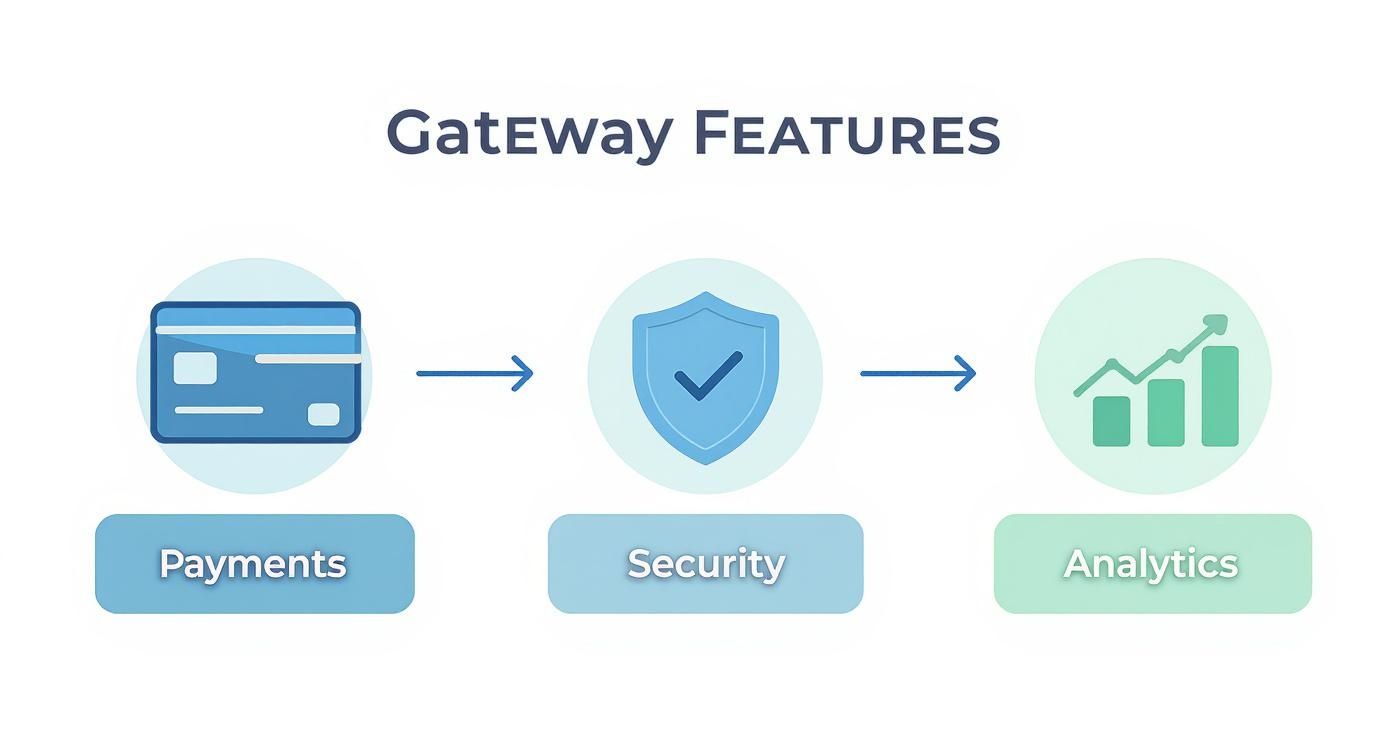
It’s a good reminder that a successful gateway is more than just a transaction processor—it's a balanced system of secure technology and valuable data.
7. Choosing Your Pricing and Go-to-Market Strategy
Once you've nailed down the technical side of things, it’s time to focus on the business model. This is where your white-label payment gateway goes from a great idea to a real, sustainable revenue stream. It boils down to two key decisions: picking a provider whose pricing works for you, and then figuring out how to price and sell your new branded service to your own customers.
Think of it like this: your provider sets your wholesale cost, and you determine the retail price. Getting this right is the difference between a new profit center and a costly headache.
Understanding Provider Pricing Models
Choosing a white-label provider isn't just a tech decision; it's a financial partnership. Their pricing structure is baked directly into your cost of doing business, so you need to look at it from all angles. Some will charge a hefty one-time setup fee plus a monthly license, while others might focus almost entirely on a per-transaction model.
Neither is automatically better. A high monthly fee might seem scary at first, but for a business processing thousands of transactions, it could actually be the cheaper option in the long run. On the flip side, a pure transaction-based model is great for getting started with low risk, but those small fees can add up quickly as you grow. If you want to see a full breakdown, check out our payment gateway fees comparison.
To help you evaluate your options, here’s a look at the most common pricing setups you’ll encounter.
Common Whitelabel Gateway Pricing Structures
| Pricing Model | How It Works | Best For | Potential Drawbacks |
|---|---|---|---|
| Setup + License Fee | A one-time fee to get started, plus a fixed recurring monthly or annual cost. Transaction fees are often lower or non-existent. | Businesses with high, predictable transaction volumes that can absorb the fixed cost. | High upfront investment and ongoing costs, even during slow periods. |
| Per-Transaction Fee | You pay a small flat fee, a percentage of the transaction value, or a combination of both for every payment processed. | Startups and businesses with fluctuating or low volume, as costs are directly tied to revenue. | Can become very expensive as transaction volume scales, eating into margins. |
| Tiered/Volume-Based | The cost per transaction decreases as your total processing volume increases over a set period (e.g., monthly). | Growing businesses aiming to scale, as it rewards higher volume with better rates. | The best rates are often locked behind very high volume tiers that can be hard to reach. |
| Hybrid Model | A mix of a lower monthly license fee and a competitive per-transaction rate. | Businesses looking for a balance between predictable costs and usage-based pricing. | Can be more complex to forecast total costs compared to simpler models. |
Ultimately, you need to run the numbers. Don't just look at the sticker price—project your costs for the next six months, and then two years out. A good partner’s pricing should feel like it's scaling with you, not holding you back.
Key Takeaway: Model your projected transaction volume against different pricing structures. A cheap starting price might not be the most cost-effective choice once your business takes off.
The demand for these kinds of flexible payment solutions is exploding globally. In the Asia-Pacific (APAC) region, for instance, the market is growing faster than anywhere else, all thanks to massive digital adoption and a booming e-commerce scene. This trend highlights the huge opportunity waiting for businesses that can price and position their payment services effectively. You can read more about this growing market on marketsandata.com.
Crafting Your Customer-Facing Strategy
Once you have a clear picture of your own costs, you can start building your customer-facing pricing. This is where you actually create that new revenue stream. Your goal should be to offer pricing that's competitive and easy to understand, all while highlighting the unique value of paying directly through your platform.
You’ve got a few solid options for how to structure this:
Flat-Rate Pricing: This is the simplest approach. You offer one clear, all-in rate for every transaction, like 2.9% + $0.30. Merchants love this model because it’s predictable and easy to calculate.
Tiered Pricing: You can create different plans based on features or monthly processing volume. This is a great way to serve everyone from small businesses just getting started to large enterprises with complex needs.
Hybrid Model: Another popular option is to combine a low monthly subscription fee with a competitive transaction rate. This gives you a baseline of recurring revenue while still keeping the service attractive for merchants of all sizes.
Your marketing should hammer home the real benefits: a seamless, trustworthy payment experience that keeps customers inside your brand’s world. When you frame it correctly, your payment gateway isn't just a utility—it's a premium feature that builds trust and boosts conversions.
Integrating Crypto with a White‑Label Gateway
As businesses scout for ways to grow internationally and cut down on costs, cryptocurrency has become an undeniable opportunity. Folding digital assets into a white‑label payment gateway isn't just about keeping up with trends; it's a smart way to innovate and offer your customers a branded crypto payment option right on your platform.
This is more than just adding another button to your checkout page. It’s a deliberate strategy to connect with a fast-growing market of tech-forward consumers. For this audience, crypto isn't a curiosity—it's their go-to method for fast, secure, and cheap transactions.
Solutions like BlockBee are perfect examples of this model in action. They provide a self-custodial, white‑label crypto option that hands you the reins. You can start accepting crypto payments under your own brand, which helps solidify your place in the market.
The Self-Custodial Advantage
When you step into the world of crypto payments, the concept of "custody" is a big deal. Many third-party processors will hold your funds in their wallets, which adds risk and often means you're waiting for your money. A self-custodial model completely flips that script.
With a self-custodial gateway, payments travel directly from your customer's wallet to a wallet that you control. The gateway provider is simply a facilitator; they never hold your funds. This one difference brings some huge benefits to the table:
- Ironclad Security: You hold the private keys, so you hold the power. This removes the risk of a third-party provider getting hacked, freezing your account, or going out of business.
- Instant Payouts: Forget about settlement periods. As soon as the transaction is confirmed on the blockchain, the funds are in your wallet, ready to use.
- Reduced Counterparty Risk: Your revenue isn't sitting on someone else's balance sheet. You don't have to rely on another company’s financial health to get paid.
This direct, peer-to-peer settlement is the very essence of why cryptocurrency is so compelling for payments. It cuts out the middleman, reduces friction, and puts merchants back in control of their money.
Unlocking Global Reach and Lower Fees
A white-label crypto solution also tackles two of the oldest headaches in e-commerce: steep cross-border fees and payment friction. Traditional card networks can skim 2-4% off international payments, taking a direct bite out of your profits.
Crypto transaction fees, on the other hand, are usually well below 1%. This means you can serve customers all over the world much more profitably. Better yet, crypto payments are inherently borderless. They sidestep the maze of local banking systems, currency conversion fees, and settlement delays. For any business with global ambitions, this is a massive operational win.
If you're curious about the mechanics behind it all, exploring a crypto payment gateway API will show you how these seamless integrations are powered. By offering a secure, low-cost crypto option under your own brand, you’re not just appealing to a new audience—you’re building a more efficient and robust payment system for whatever comes next.
Frequently Asked Questions
Jumping into the world of payment processing always brings up questions. Let's tackle some of the most common ones we hear about running a white-label payment gateway so you can move forward with confidence.
How Long Does It Take to Go Live?
This is where white-label solutions really shine. If you were to build a payment gateway from scratch, you'd be looking at a timeline of 1-2 years and a budget deep into the six figures. It's a massive undertaking.
With a white-label solution, you're not starting from zero. Most businesses can get a fully branded, live payment gateway running in a matter of weeks. A typical launch window is anywhere from four to eight weeks. The exact timing really depends on how complex your integration is and how quickly your team can work, but the speed to market is a huge competitive edge.
What Are the Biggest Challenges to Expect?
While going white-label is faster and cheaper than building from scratch, it’s not a completely hands-off process. Knowing the potential bumps in the road ahead of time is the best way to plan for a smooth launch.
Here are the most common hurdles you might face:
- Technical Integration: Getting your platform to talk perfectly with the gateway's API is a job for skilled developers. Any small mistake here can create bugs and lead to a frustrating experience for your users.
- Merchant Support: The moment you go live, you become the go-to support for your merchants. If they have a payment issue, they're calling you. Having a well-trained support team ready from day one is essential for keeping everyone happy.
- Regulatory Awareness: Your provider handles the heavy lifting of PCI DSS compliance, but you're not entirely off the hook. You still need to understand the rules of the road for payments in the regions you serve, like KYC (Know Your Customer) requirements.
My advice? Plan ahead. Pick a provider with fantastic technical support and crystal-clear API documentation. And start training your customer service team long before you even think about launching.
How Do You Measure the ROI of a Whitelabel Gateway?
Measuring the return on investment here isn't just about counting the new transaction fees you're collecting. A smart white-label strategy creates value that ripples across your entire business.
To see the full picture, you need to track a few key metrics:
- New Revenue Stream: This one is straightforward. It’s the profit you make from transaction fees after you've paid your provider's costs.
- Increased Customer Lifetime Value (LTV): When you offer a smooth, integrated payment experience, your customers stick around longer. Compare the LTV of customers who joined after the gateway launch to those who were there before. You should see a nice lift.
- Reduced Churn Rate: A seamless user experience gives customers fewer reasons to look elsewhere. Keep an eye on your churn rate—embedding payments should help you hold onto more customers.
- Higher Conversion Rates: A branded checkout process that people trust means fewer abandoned carts. Measure your checkout completion rate before and after you launch the gateway to see the direct impact.
By tracking these metrics together, you'll get a real sense of the financial and strategic value your white-label payment gateway is adding to your business.
Ready to offer secure, branded crypto payments without the complexity? BlockBee provides a non-custodial white-label solution that puts you in full control. Explore BlockBee's Features
Review Us