
Your Guide to White-Label Payment Gateways
So, what exactly is a white-label payment gateway? Think of it as a fully-built, ready-to-go payment processing engine that you can license, put your own brand on, and sell as if you developed it yourself. You're effectively leasing a powerful, complex infrastructure from a specialist and presenting it to your customers with your company's logo front and center.
This approach lets you offer a seamless, branded payment experience without getting bogged down in the years of development and massive costs required to build a payment system from scratch.
Breaking Down the White-Label Concept
Here’s a simple analogy. Walk into any major supermarket and you'll find their own "store brand" coffee. Did the supermarket chain buy a coffee plantation and build a roasting facility? Almost certainly not. They struck a deal with a large-scale coffee producer who roasts and packages the beans for them, and the supermarket just slaps its own label on the bag.
The customer gets a great product and connects that positive experience directly with the store's brand, building loyalty. The store, in turn, avoided the enormous operational headache of becoming a coffee producer.
A white-label payment gateway works the exact same way. A third-party provider handles the heavy lifting—developing the technology, maintaining it, and ensuring it’s secure. Your business licenses this tech, customizes the look and feel, and offers it to your clients as your own native payment solution.
This model is a game-changer for businesses like SaaS platforms, online marketplaces, and fintech startups that want to get into the payments game without the overwhelming investment.
Who's Who in the White-Label Ecosystem
To really get it, you need to know the players involved. The setup is refreshingly simple and usually involves just three parties:
- The Technology Provider: This is the company that actually built and maintains the core payment gateway. They’re the experts handling security, complex compliance like PCI DSS, and connections to all the different payment networks.
- Your Business (The Reseller): You're the one licensing the gateway. Your job is to market it, sell it, and provide support to your end-users, all under your own brand. You own the customer relationship.
- The End-User (Your Client): This is the merchant using the payment service you’re offering. From their point of view, they are dealing exclusively with your brand. The underlying technology provider is completely invisible to them.
This isn't a niche strategy; it's a booming market. The global white-label payment gateway space was valued around USD 2.29 billion and is on track to hit nearly USD 6.87 billion by 2033. That’s a compound annual growth rate of roughly 14.5%, largely driven by the explosion in e-commerce and the corresponding demand for better, more flexible payment options.
The Core Idea: A white-label solution lets you own the entire customer payment journey. Instead of redirecting users to a third-party checkout like PayPal or Stripe, you keep them inside your own branded ecosystem. This builds trust and creates a much more cohesive experience.
How White-Label Stacks Up Against Other Models
A white-label gateway is just one path to accepting online payments. Seeing how it compares to other common methods really highlights where it shines. For a deeper look at how these systems are architected, you can also check out our guide on what makes a payment platform.
Here's a quick look at how the main options compare.
Payment Processing Models at a Glance
Choosing the right payment integration model depends entirely on your goals, resources, and how much control you want over the customer experience. This table breaks down the key trade-offs.
| Gateway Model | Branding Control | Technical Effort | Ideal For |
|---|---|---|---|
| White-Label Gateway | Complete | Moderate | SaaS platforms, ISOs, marketplaces wanting to offer branded payment services. |
| Hosted Payment Page | Minimal | Low | Small businesses needing a quick and simple way to accept payments. |
| Direct API Integration | High | High | Large enterprises with development teams building a fully custom checkout. |
As you can see, a white-label gateway hits a sweet spot. It offers the branding control of a custom-built solution without the extreme technical overhead, making it a powerful tool for businesses ready to own their payment ecosystem.
The Big Wins: Why a White-Label Gateway is a Game-Changer
Choosing a white-label payment gateway isn't just a tech upgrade; it's a strategic business decision. The upsides go way beyond just moving money around. We're talking about a powerful toolkit for making your brand stronger, boosting your bottom line, and making your operations run smoother.
The most obvious win is creating a perfectly seamless brand experience. When customers hit "buy," they stay right there in your world, seeing your logo, your colors, your design. That kind of consistency is huge for building trust and keeping customers loyal.
Instead of getting bounced to a third-party site—a moment that often screams "abandon cart"—the customer's journey feels whole and secure. You're in control of the entire checkout process, which solidifies your company's credibility at the most critical point of the sale.
Turn a Cost Center into a Profit Center
This is where things get really interesting. A white-label payment gateway can flip a necessary expense into a new source of income. By reselling a payment solution under your brand, you get to call the shots on pricing and earn a cut from transaction fees. Suddenly, you have a whole new revenue stream.
You could set up different pricing plans for various clients, bundle payment processing with your other services, or simply add a markup to the provider's base fees. This financial advantage is a massive draw, especially for SaaS platforms, digital agencies, and marketplace owners.
And the market for this is booming. Projections show the global white-label payment gateway platform market is on track to nearly triple in size over the next decade. This growth is fueled by fintechs, Payment Service Providers (PSPs), and other businesses hungry for ready-made payment solutions. You can dig into the numbers and explore the full market growth forecast to see just how big this opportunity is.
Get to Market in Record Time
Let's be blunt: building a payment gateway from scratch is a beast of a project. You're looking at years of development, a maze of financial regulations, and the nightmare of achieving and maintaining PCI DSS compliance. It’s a multi-million-dollar headache that demands a highly specialized team.
A white-label solution lets you skip all of that. You can roll out a secure, compliant, and feature-packed payment service in a tiny fraction of the time.
By plugging into a pre-built infrastructure, you can launch in weeks or months, not years. This speed gives you a major competitive edge, letting you meet market demands head-on without the crushing upfront investment and risk.
This kind of agility is invaluable. It frees up your resources to focus on what you do best—improving your core product and winning over customers—instead of getting bogged down in building financial plumbing.
Scale Globally Without the Headaches
Thinking of expanding internationally? That brings a whole new level of complexity, from juggling currencies to navigating different regional laws. A solid white-label payment provider has already done all the hard work for you.
They give you the backend infrastructure needed to support a global business, right out of the box. This typically includes:
- Multi-Currency Processing: Take payments from customers anywhere in the world, in their own currency, without any extra hassle.
- International Compliance: The provider stays on top of global and regional payment standards, which drastically lowers your legal and regulatory burden.
- Local Payment Methods: Offer the payment options people actually use in different countries, like iDEAL in the Netherlands or Boleto in Brazil. This alone can seriously boost your conversion rates in new markets.
Partnering with a provider who's already global-ready makes international expansion faster and far more efficient. It turns a white-label payment gateway into a powerful engine for growth, letting you step into new territories with total confidence.
How to Choose the Right Gateway Provider
Picking a white-label payment gateway provider isn't just a technical decision; it's like choosing a business partner. Get it right, and you've built a solid foundation for growth. Get it wrong, and you're in for a world of technical headaches, unhappy customers, and a bruised brand reputation.
The best providers are more than just transaction processors—they're the engine under the hood of your branded payment service. That means you need to look past the marketing fluff and really kick the tires on their security, technology, and support.
Start with Security and Compliance
Let's be blunt: security is everything. It's the one area where you absolutely cannot compromise. A single data breach can vaporize the trust you've worked so hard to build and saddle you with devastating financial penalties. So, your first order of business is to vet their security credentials.
The gold standard here is PCI DSS (Payment Card Industry Data Security Standard) Level 1 compliance. Think of it as the highest security clearance for handling card data. If a provider doesn't have it, walk away.
But don't stop there. Dig deeper into their security stack:
- Tokenization: Ask if they use tokenization. This process swaps sensitive card details for a secure "token," which dramatically shrinks your own PCI compliance burden. It's a huge win.
- Encryption: How do they protect data? You want to hear about strong, end-to-end encryption for data both in motion and sitting on their servers.
- Fraud Prevention: What's their plan for stopping bad actors? Look for a multi-layered approach with tools like AVS (Address Verification Service), CVV checks, and sophisticated fraud-scoring systems that can spot trouble before it starts.
A provider who is open and proud of their security measures is usually one you can trust.
Evaluate Their Technical Toolkit
A powerful gateway is worthless if your developers can't stand working with it. The quality of a provider's technical resources—their APIs, SDKs, and documentation—will make or break your implementation timeline.
Start with their API documentation. Is it clear, comprehensive, and actually helpful? Great documentation is a gift to your development team, saving them from hours of guesswork and frustration.
A provider’s technical toolkit is a direct reflection of their commitment to developers. Look for a robust sandbox environment for testing, responsive technical support, and clear guides that make implementation straightforward.
Next, see what pre-built tools they offer. Do they have ready-made plugins for common e-commerce platforms like WooCommerce, Shopify, or Magento? These can slash your development time if your merchants are on those platforms. If mobile is a big part of your strategy, make sure they have well-maintained SDKs (Software Development Kits) for both iOS and Android.
Dissect the Fee Structure
Finally, let's talk about money. Gateway pricing can feel intentionally confusing, so you need to look beyond the headline transaction rate to understand the total cost of ownership. The goal is to find a model that actually fits your business, not just the provider's.
You'll typically run into a few common pricing models. Thinking through how each one works will help you figure out what makes the most sense for your revenue goals.
Comparing White-Label Pricing Models
Here's a breakdown of common fee structures to help you choose the most cost-effective option for your business.
| Pricing Model | How It Works | Best For | Potential Drawback |
|---|---|---|---|
| Revenue Share | You earn a percentage of the transaction fees charged to your clients. | Businesses wanting to create a new, scalable profit center from payments. | May require a higher transaction volume to become highly profitable. |
| Flat Monthly Fee | You pay a fixed subscription fee for access to the platform, regardless of volume. | Companies with high transaction volumes that can benefit from predictable costs. | Can be expensive for startups or businesses with low initial volume. |
| Per-Transaction Fee | You pay a small, fixed fee for every transaction processed through the gateway. | Businesses that need a simple, pay-as-you-go model without long-term commitments. | Costs can become high and unpredictable as transaction volume grows. |
Don't be afraid to ask for a complete fee schedule. You need to sniff out any hidden costs like setup fees, monthly minimums, chargeback penalties, or extra charges for international payments. A transparent partner will be completely upfront about their pricing, helping you build a sustainable business on top of their white-label payment gateway.
Integrating and Implementing Your Gateway
Alright, you've chosen a white-label payment gateway. Now comes the fun part: turning that decision into a living, breathing part of your business. This is where the rubber meets the road, moving from strategy to actual execution. Think of it less like flipping a switch and more like a careful, methodical process to ensure everything is secure, stable, and offers a fantastic user experience.
The first step is usually getting your hands on the provider's tools. You'll get your API keys—these are the unique codes that let your platform talk to the gateway—and access to their sandbox environment. This sandbox is your risk-free playground. It's where your developers can run test transactions, iron out kinks, and perfect the integration without a single real dollar changing hands.
Choosing Your Integration Path
There's more than one way to connect to a payment gateway, and the right path really depends on your tech stack and how much control you want. For most businesses, it boils down to two main options.
- RESTful APIs for Custom Platforms: If you’re running a custom-built application or a unique SaaS platform, a RESTful API is going to be your best friend. It gives you the ultimate flexibility to build the checkout experience from the ground up, making it fit seamlessly into your existing user interface. For a deeper dive into the technical side, check out our guide on mastering payment gateway API integration.
- Pre-built Plugins for E-commerce Systems: On the other hand, if your business runs on a popular platform like WooCommerce, Shopify, or Magento, pre-built plugins are a total game-changer. These are essentially ready-made connectors that drastically reduce development time. They do most of the heavy lifting, letting you link your store to the gateway in a fraction of the time it would take to build from scratch.
This whole process involves balancing a few key considerations: security, technology, and cost. Getting these three right is the formula for a successful implementation.
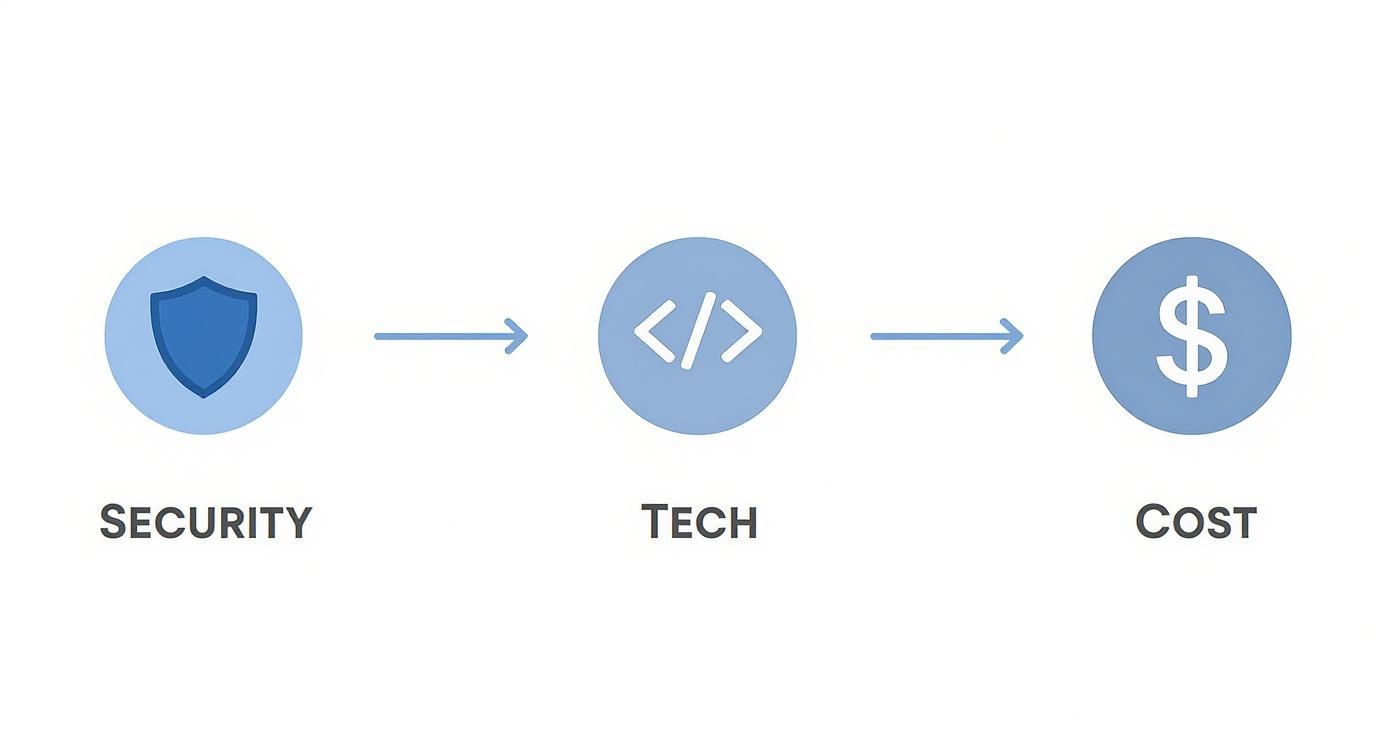
The visual here really drives the point home: a solid integration stands on a foundation of strong security, is built with flexible technology, and is framed by a cost model that makes sense for your business.
Fortifying Security During Implementation
Security isn't a feature you add at the end; it has to be baked into every single step of the integration. While your gateway provider handles the heavy lifting on things like PCI DSS compliance, you're still responsible for making sure the connection between your platform and their gateway is rock-solid.
Tokenization is your most powerful ally. This technique swaps sensitive credit card details for a unique, non-sensitive string of characters called a token. By using tokens, the raw card data never even touches your servers. This massively reduces your PCI compliance burden and, more importantly, keeps your customers' information safe.
Of course, securing the payment gateway is just one piece of the puzzle. It’s critical to follow comprehensive website security best practices to protect your entire digital footprint.
Designing a Frictionless Checkout Experience
At the end of the day, all this technical work has one goal: creating a checkout flow so smooth and trustworthy that customers sail right through it. This is where your brand and user experience (UX) design skills truly shine. A checkout page that looks and feels like the rest of your site builds confidence and can have a huge impact on your conversion rates.
Here’s what to focus on:
- Brand Consistency: Use your own logos, colors, and fonts. The customer should feel like they never left your site.
- Simplicity: Cut out every unnecessary field and step. Each extra click is another chance for a customer to abandon their cart.
- Clarity: Make sure error messages are helpful, not confusing. And always be upfront about costs like taxes and shipping before asking for payment.
The demand for these kinds of integrated, brand-first payment solutions is only growing. The global market was valued at around USD 2.6 billion and is expected to climb to nearly USD 3.7 billion by 2031. This isn't just a fleeting trend; it’s a reflection of how important seamless, secure, and branded payment experiences have become for businesses everywhere.
Real-World White-Label Gateway Use Cases
It's one thing to talk about the theory, but seeing how a white-label payment gateway solves actual business problems is where the lightbulb really goes on. This isn't just a tool for a specific niche; it's a flexible powerhouse that helps companies in all sorts of industries take charge of their payments, build their brand, and open up new ways to make money.
Let's walk through a few concrete examples of this technology out in the wild.
The All-in-One SaaS Platform
Picture a SaaS company that builds booking software for yoga studios. At first, the studios use the software for class schedules, but they're stuck using a separate, third-party system like PayPal or Stripe to actually get paid. The experience feels clunky, and it sends their customers—and a cut of the revenue—away to another brand.
This is where a white-label gateway changes the game. By plugging one in, the SaaS platform can roll out its own branded payment solution, let's call it "StudioPay." Suddenly, the yoga studios can manage their schedules and process payments all from one clean, familiar dashboard.
This move unlocks a few massive advantages:
- Increased Stickiness: When a studio's scheduling and payment systems are intertwined, they're far less likely to even consider switching to a competitor.
- New Revenue Stream: The SaaS company can now take a small percentage of every transaction that runs through StudioPay. Payments go from being a simple feature to a core profit center.
- Enhanced Brand Trust: The entire journey, from booking a class to paying for it, happens under the SaaS platform's banner. This builds a huge amount of credibility and trust.
The Branded Online Marketplace
Now think about an online marketplace for independent artists. Its main job is to make sure transactions between thousands of different sellers and buyers happen smoothly and safely. Relying on a standard payment processor often means kicking buyers off-site to finish a purchase. This breaks the brand experience and can feel a bit sketchy to customers.
A white-label solution allows the marketplace to own the entire checkout flow. When a customer buys a painting, the transaction is processed through "ArtMarket Payments," reinforcing the marketplace's brand as the central, trusted facilitator of the sale.
This is also absolutely critical for handling tricky payout logistics. The gateway can be set up to automatically split payments, sending the artist their cut while keeping the marketplace’s commission—all happening instantly and invisibly in the background.
The Agile Fintech Startup or ISO
Let's say a fintech startup or an Independent Sales Organization (ISO) wants to offer its own payment processing services and take on the big guys. Building that kind of infrastructure from scratch is a monumental task. We're talking millions of dollars, years of development, and a nightmare of PCI compliance hurdles.
A white-label payment gateway is the ultimate shortcut. The startup can license a powerful, pre-built, and fully compliant payment engine and get to market in weeks, not years. This frees them up to pour their resources into what actually makes them different: their marketing, sales, and customer relationships. For companies in specialized or regulated industries, this need for tailored solutions is paramount, extending even to logistics like understanding rules for Firearms and Ammunition Shipping Compliance.
In every one of these cases, the white-label model gives a business the power to offer a sophisticated, branded financial service without taking on the crushing cost and complexity of building it from the ground up.
A Look at BlockBee as a Non-Custodial Solution
As more businesses dive into the world of cryptocurrency, the search is on for a white-label payment gateway built from the ground up for digital assets. This is where a solution like BlockBee comes into the picture, designed specifically for companies ready to handle crypto payments the right way—securely and efficiently.
What really makes BlockBee different is its non-custodial model. It’s best to think of it like a direct deposit for your crypto. When a customer makes a payment, the funds are sent straight to your own personal wallet. BlockBee acts as the facilitator for the transaction, but it never actually holds onto your money.
This is a huge shift from older, traditional models where a payment provider holds your funds for a period before paying them out. By making sure you have complete control over your assets at all times, the non-custodial approach seriously boosts security and gives you true financial freedom.
Why the Non-Custodial Model is a Game-Changer
When your business starts handling crypto, nothing is more important than control and security. A non-custodial framework tackles these issues head-on, creating a more transparent and self-reliant method for managing digital currency payments.
Understanding the difference between custodial and non-custodial models is critical for any business in this space. If you want to dig deeper, our guide on what non-custodial and custodial services are breaks down exactly how each one can affect your operations.
Key Takeaway: With a non-custodial solution like BlockBee, you are essentially your own bank. This gets rid of counterparty risk—there’s no third party that can freeze, lose, or mismanage your funds. That’s powerful peace of mind.
A quick glance at BlockBee's homepage reveals its clean, straightforward interface, which is a core part of its value.
This clean look isn't just for show; it highlights the platform's focus on simplicity and direct wallet integration, which are the cornerstones of its non-custodial promise.
Core Features of BlockBee's White-Label Offering
BlockBee’s platform is packed with the tools you need to build a smooth, branded crypto payment experience for your customers. It’s not just another payment processor; it's a complete toolkit for weaving digital currency right into the fabric of your business.
Here are some of the standout features:
- Developer-Friendly API: The API is well-documented and designed for deep, custom integrations. This lets your team build a checkout flow that looks and feels exactly like your brand.
- Wide Cryptocurrency Support: The platform supports over 70 different cryptocurrencies. This gives your customers the flexibility to pay with the digital assets they already own and prefer.
- Automated Transaction Forwarding: Payments are automatically routed to your wallet the moment they're confirmed. No more manual processing or waiting for settlement periods.
- E-commerce Plugins: For those who need a quicker setup, there are ready-made plugins for major platforms like WooCommerce, Magento, and Shopify. This means you can get up and running without a ton of custom code.
By mixing the ironclad security of a non-custodial system with a strong set of features, BlockBee offers a forward-thinking white-label payment gateway for any business aiming to innovate with crypto. It’s a solution built not just to take payments, but to give businesses total control over their digital finances.
Common Questions About White-Label Gateways
When you start digging into white-label payment gateways, a few practical questions always pop up. It’s all about the money, the time, and who’s on the hook for what. Getting straight answers to these questions is key to setting the right expectations and making a smart decision for your business.
Let’s tackle the big ones.
What Is the Typical Cost of a White-Label Payment Gateway?
There’s no one-size-fits-all price tag here. The cost really depends on the provider you choose and how deep you want to go with their services. Generally, you'll run into a few common fee structures.
- Setup Fees: This is the one-time cost to get everything started—your branding, your configuration, the works.
- Monthly Licensing Fees: Think of this as a subscription for using their underlying technology and keeping the lights on.
- Per-Transaction Charges: You’ll almost always see a small fee for every payment you process, usually a tiny percentage plus a fixed cent amount.
Some providers also offer revenue-sharing models. This is an interesting twist where you actually earn a cut of the transaction fees, turning your payment system into a new revenue stream. The most important thing is to get a complete fee schedule upfront. You need to ask about any "extra" costs like support fees, chargeback handling, or international processing to get a real picture of what you’ll be paying.
How Long Does Implementation Usually Take?
The timeline for getting your gateway live can be anything from a few days to a few months. It all boils down to the complexity of your setup.
If you’re just plugging a pre-built connector into a common e-commerce platform like WooCommerce, you could be up and running in a weekend. But if you're building a custom API integration for a large-scale SaaS platform with very specific needs, you’re looking at a project that could take several weeks, maybe even months.
A good provider will have a top-notch sandbox environment for your developers to test in. Clear, well-written API documentation is also a massive time-saver.
Key Insight: The quality of your provider's technical resources is one of the biggest factors influencing your launch speed. Well-documented APIs and responsive developer support can cut implementation time dramatically.
Who Handles PCI Compliance with a White-Label Gateway?
This is a big one. PCI DSS compliance is a partnership—a shared responsibility between you and your gateway provider.
The provider takes care of their end, making sure their core infrastructure (the servers and software that actually touch the payment data) is fully PCI compliant. They should be certified at the highest level, Level 1.
Your responsibility is to make sure your end of the integration is secure. This is where a crucial feature comes in: tokenization. The best providers use it to replace sensitive card data with a secure, non-sensitive "token." This means the actual card number never even touches your servers. This single feature massively reduces your PCI compliance burden and liability, making it a must-have for any modern payment solution.
Ready to take full control of your crypto payments with a secure, non-custodial solution? BlockBee offers a developer-friendly white-label gateway that puts you in charge of your funds. Get started today at blockbee.io.
Review Us