
Your Brand, Your Gateway: payment gateway white label
Ever thought about offering a slick, branded payment experience to your customers without the nightmare of building it all from scratch? That's precisely what a white-label payment gateway lets you do. Think of it like a high-end ghost kitchen for financial technology; a specialized company perfects the recipe and runs the kitchen (the payment infrastructure), while you serve the five-star meal to your customers under your own restaurant's name.
Understanding the White Label Payment Gateway Concept

At its heart, a white-label payment gateway is a fully built and operational payment processing platform that you can completely rebrand as your own. The provider takes care of all the technical heavy lifting—the security protocols, the compliance headaches, and the server maintenance—which frees you up to focus on what you do best: growing your business and serving your customers.
This model is a game-changer for businesses that want total control over the customer journey. From the moment a customer clicks "checkout" to the final payment confirmation, the entire experience stays under your brand's umbrella.
It's a powerful strategy, particularly for businesses like:
- SaaS Platforms: You can embed payment processing directly into your software, making it feel like an integral part of your product instead of a bolted-on extra.
- Online Marketplaces: Effortlessly manage complex payouts to multiple vendors and sellers while presenting a unified, trustworthy brand front.
- Independent Software Vendors (ISVs): Create a more complete, all-in-one solution by bundling payment services directly with your core software.
The Power of Brand Ownership in Payments
We've all been there. You're about to buy something online, and at the final step, you're whisked away to a page with another company's logo, like PayPal or Stripe. It can be a jarring experience that pulls the customer out of your carefully crafted brand environment at the most critical moment.
A white-label payment gateway completely changes that dynamic. The entire payment process looks and feels like it's a native part of your service. This isn't just about aesthetics; it builds significant brand trust, boosts customer loyalty, and can make a real dent in your checkout abandonment rates. By keeping users inside your ecosystem, you constantly reinforce your brand's reliability and value.
A white label solution offers the best of both worlds—you get the reliability of proven, secure technology while keeping absolute control over your brand and the customer experience.
White Label vs Building In-House At a Glance
Deciding between a white-label solution and building your own payment gateway from the ground up is a major strategic choice. This table breaks down the key differences to help you see which path makes more sense for your business.
| Factor | White Label Gateway | In-House Development |
|---|---|---|
| Time to Market | Fast (weeks to a few months) | Extremely slow (1-2+ years) |
| Initial Cost | Low to moderate | Very high (millions of dollars) |
| Ongoing Maintenance | Handled by the provider | Requires a dedicated engineering team |
| Security & Compliance | Included, provider manages PCI DSS | Your sole responsibility |
| Customization | High (branding), moderate (features) | Total control, but complex |
| Expertise Required | Minimal technical overhead | Deep fintech & security expertise needed |
Ultimately, while building in-house offers unparalleled control, the immense investment in time, money, and specialized talent makes white-labeling the far more practical and efficient choice for most businesses.
Market Growth and Opportunity
The appetite for these kinds of solutions is exploding. The global white-label payment gateway market has seen incredible growth, with recent market valuations landing somewhere between $2.02 billion and $6.85 billion. These numbers aren't just trivia; they show a clear trend of businesses wanting to own their payment infrastructure without the astronomical cost of building it themselves. You can find detailed insights into the growing demand and explore these market trends further.
Unlock Growth with White Label Payments
Adopting a white label payment model isn't just a technical tweak—it's a serious strategic move that can directly light a fire under your growth. The benefits go way beyond simply putting your logo on a checkout page; they fundamentally change how you serve your clients and make money.
Instead of burning years and millions on research, development, and navigating regulatory nightmares, a payment gateway white label solution lets you go live in a matter of weeks. This massive shortcut to market means you can meet customer demands almost instantly, transforming what would be a complex infrastructure nightmare into a quick, manageable rollout. You get to skip the huge R&D bills and the compliance maze, which frees up both cash and people to focus on what you do best.
Deepen Customer Loyalty and Control
One of the biggest wins here is creating a completely seamless, branded world for your users. When a customer goes to pay, they stay right there with you, not getting kicked over to some third-party site with a logo they don't recognize. It sounds like a small thing, but it’s absolutely critical for building trust and smoothing out friction at the most sensitive part of any transaction.
Keeping users inside your own platform reinforces your brand's reliability and just makes the whole experience better. This unified journey pays off in a few key ways:
- Increased Trust: People feel much more secure when the entire process, including handing over their payment info, happens under a brand they already know and trust.
- Reduced Churn: A clunky payment process is a classic reason for customers to bail. Integrating it smoothly removes that frustration and helps you keep them around for the long haul.
- Enhanced Brand Perception: You instantly look more professional and complete. It elevates your business from just another service provider to a true, all-in-one platform.
For a SaaS company, this makes payments feel like a native part of the software, not some bolted-on afterthought. For a marketplace, it builds a consistent and trustworthy environment for both your buyers and sellers.
Create New, Predictable Revenue Streams
Here's the really exciting part: a white label payment gateway doesn't just save you money, it actually makes you money. By becoming the payment facilitator for your own clients, you can start earning revenue from every single transaction that runs through your platform.
By integrating a white label payment gateway, you transform a cost center into a profit center. Payments evolve from a simple operational necessity into a core, revenue-generating component of your business model.
This financial upside can be a complete game-changer. You get to set your own transaction fees, creating a steady, scalable revenue stream that grows right alongside your clients' businesses. This model is incredibly powerful for platforms serving lots of merchants, where even a tiny slice of each transaction adds up to significant income over time.
Ultimately, this lets you pour your energy into your core product—whether that's building great software, running a bustling marketplace, or offering a specialized service. All the while, your payment infrastructure is humming along in the background, adding directly to your bottom line. It's all about offering a more complete solution that's a win for you and your clients.
How the Technology and Security Work Together
Peeking behind the curtain of a white-label payment gateway can seem intimidating, but the process is more straightforward than you might think. Picture a transaction as a secure, high-speed relay race. When your customer hits "Buy," they're not just sending money—they're starting a chain reaction where a secure packet of information zips through multiple checkpoints in mere seconds.
It all starts on your branded checkout page. The moment a customer enters their payment details, that information is instantly encrypted, scrambling sensitive data like credit card numbers into an unreadable code. This is the first, and most crucial, line of defense protecting both your customers and your business.
From there, the encrypted data is passed to the white-label gateway's secure servers. This is where the core tech takes over. The gateway acts like a brilliant traffic controller, instantly analyzing the transaction and routing it to the correct payment network or acquiring bank to get the green light.
A smooth payment flow like this isn't just a technical achievement; it's a direct driver of business growth.
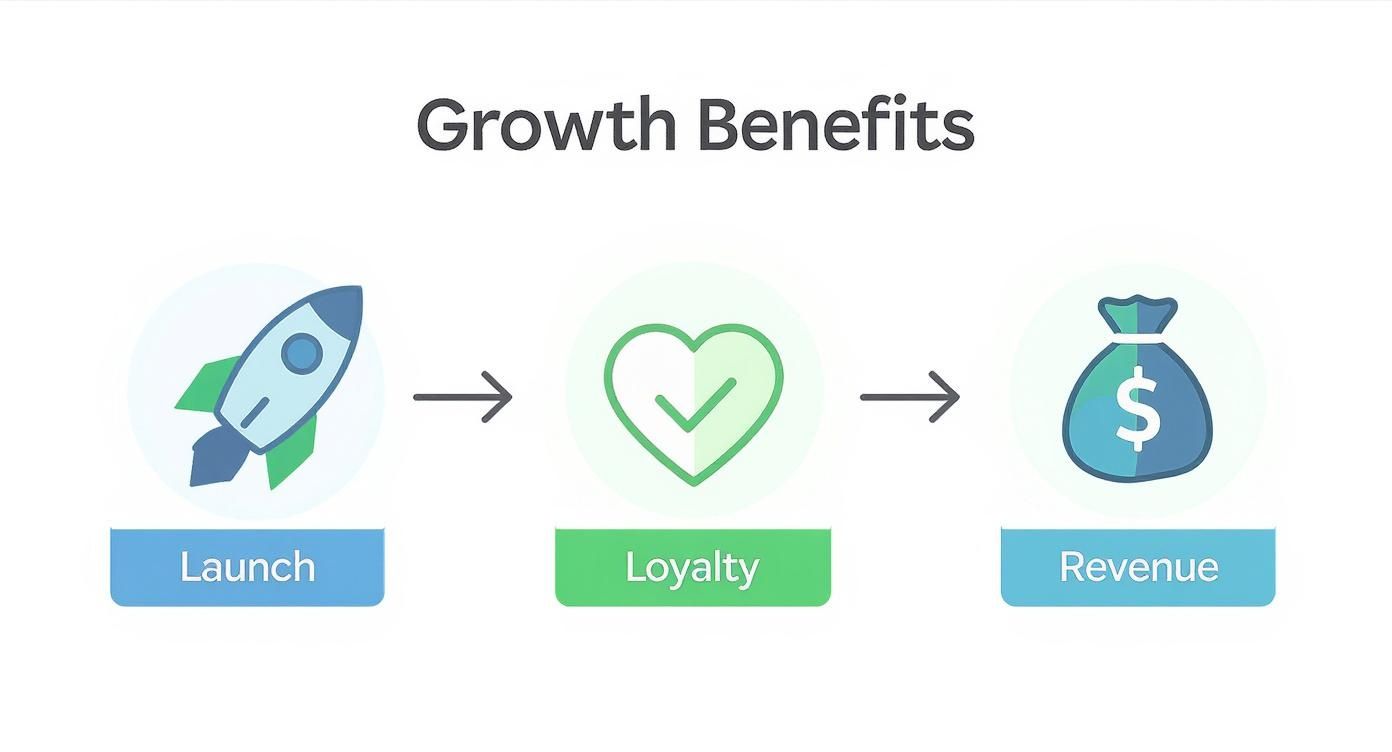
As you can see, getting to market quickly with a reliable payment system builds customer loyalty, which is the engine for generating new and recurring revenue.
Fortifying Transactions with Advanced Security
The real genius of a white-label provider is how they absorb the immense complexity and risk of security and compliance for you. A reputable provider builds their entire system on a foundation of ironclad security, with PCI DSS compliance as the cornerstone.
PCI DSS (Payment Card Industry Data Security Standard) is an exhaustive set of rules for any company that handles credit card information. Achieving and maintaining compliance is a monumental task, demanding constant audits, network scans, and airtight data policies.
When you partner with a compliant provider, you essentially outsource this entire headache. Their certified infrastructure handles all the sensitive data, drastically shrinking your own PCI scope and the costs that come with it. It's like having a world-class cybersecurity team guarding your digital vault around the clock.
With a white-label gateway, you inherit your provider's top-level security posture. They manage the complexities of PCI DSS compliance, so you can focus on building your business with the confidence that customer data is protected by industry-leading standards.
The Digital Armor of Tokenization and Encryption
Two key pieces of technology act as the digital armor for every single transaction: tokenization and end-to-end encryption. They work in tandem to render payment data useless to criminals, even in the rare case of a data breach.
- End-to-End Encryption: This process scrambles payment information the moment it’s typed on your site and keeps it that way until it reaches the secure payment processor. Imagine locking the payment details inside a steel box that only the authorized recipient has the key to.
- Tokenization: Once the initial transaction is approved, the gateway swaps the customer's actual card number for a unique, non-sensitive placeholder called a "token." This token is safe to store for things like subscriptions or one-click checkouts because the real card details are never exposed. To learn more, check out our deep dive into what is payment tokenization and its benefits.
This layered security approach is fundamental to building trust. A secure and seamless checkout is a massive factor in how to reduce shopping cart abandonment. When shoppers feel safe, they don't just complete their purchase—they come back again and again.
Making the Payment Gateway Truly Yours

The real magic of a payment gateway white label solution isn't just the tech—it's the power to make the payment experience an invisible, seamless part of your brand. You're not just processing transactions; you're building trust and reinforcing your brand's professionalism at the most critical point of the customer journey.
This isn't about just slapping your logo on a generic template. A true white-label platform gives you a spectrum of control, letting you fine-tune every visual and functional detail to match your company's identity and what your customers have come to expect from you.
From Simple Branding to Full Customization
How deep you go with customization really depends on what your business needs. The beauty of a white-label model is its flexibility. You can start with some basic, high-impact changes and then dive deeper as your platform evolves.
Even at a surface level, you can make the checkout feel like your own:
- Logo and Color Palette: The quickest win. Applying your logo and brand colors makes the payment page instantly recognizable, reassuring customers they haven't been redirected to some unknown, untrustworthy site.
- Fonts and UI Elements: Matching the typography, button styles, and other small details to your website or app creates a cohesive, professional feel.
But for those who want to go further, the possibilities open up significantly. This is where you move past aesthetics and start reshaping the entire payment flow to create something completely unique to your business.
The ultimate goal of white-label customization is to make the payment gateway disappear. The process should feel so natural and integrated that your customers never even think they're using a third-party service.
Leveraging APIs for a Seamless User Experience
So, how do you achieve that deep, seamless integration? It all comes down to a powerful and well-documented API. Think of an API (Application Programming Interface) as a secure communication channel that lets your platform talk directly to the payment gateway's core engine. This connection is what empowers you to build a completely custom front-end experience from the ground up.
For example, a SaaS platform could use APIs to build the entire merchant onboarding process right into its own dashboard. Instead of sending new users to an external website to get set up, they can handle everything without ever leaving the familiar environment of your software. It’s a game-changer for reducing friction and getting your clients up and running faster. For a closer look at this, our guide on payment gateway API integration breaks it down further.
In the same way, an online marketplace could design a unified checkout that handles complex split payments to multiple vendors behind the scenes. The customer sees one simple transaction, while your platform does the heavy lifting. This kind of control puts you firmly in the driver's seat, allowing you to craft an experience that perfectly serves your users and strengthens your brand.
How to Choose the Right White-Label Partner
Picking a provider for your white-label payment gateway is hands-down the most critical decision you'll make. This isn't just about software; it's about finding a long-term partner who will have a direct hand in your revenue, your customers' trust, and your ability to grow.
Get it right, and your partner becomes a growth engine. Get it wrong, and they become a frustrating bottleneck that bleeds time and money.
You have to be methodical here. Look past the shiny marketing slicks and dig into the real meat of their technical chops, support systems, and the financial models that will shape your relationship for years to come. The goal is to find someone whose tech is rock-solid and whose business philosophy actually clicks with yours.
Your Technical and Security Checklist
Before you even glance at a price sheet, you need to make sure any potential partner clears the non-negotiable technical and security hurdles. A misstep here isn't just an inconvenience—it can be catastrophic, leading to downtime, lost sales, and a black eye for your brand that's hard to recover from.
Start with these must-haves:
- Comprehensive Security Certifications: PCI DSS Level 1 compliance is the absolute baseline. Don’t just take their word for it; ask to see their Attestation of Compliance (AOC). Also, check for other certs like SOC 2 or ISO 27001, which show they're serious about locking things down.
- Guaranteed Uptime and Reliability: What does their Service Level Agreement (SLA) actually promise? A solid partner should be guaranteeing 99.9% uptime or better. They should also be totally transparent about their server infrastructure and how they handle redundancy.
- Scalable Architecture: Will their system crumble when your business takes off? Ask them about their transaction processing capacity and for examples of clients they've successfully scaled with to a size you're aiming for.
- Quality of API and Documentation: A powerful API is completely useless if the documentation is a mess. Your dev team needs to get their hands on it. They’ll be able to tell you pretty quickly if it's logical, well-organized, and flexible enough for what you need to build.
Evaluating Business and Support Compatibility
Once you've confirmed the tech is solid, the lens shifts to how they’ll actually work with you. This is what separates a simple vendor from a true strategic partner—someone who gets your business model and is genuinely invested in seeing you win.
Think through these business-focused points:
- Supported Payment Methods and Currencies: Do they cover the essentials for your target markets? This isn't just about Visa and Mastercard. You need to think about regional payment methods, popular digital wallets, and maybe even crypto if that's your crowd.
- Responsiveness of Technical Support: Don't just believe the sales pitch. Have your tech team throw them some curveball questions during the evaluation process. The speed, clarity, and depth of their answers will tell you everything you need to know about the support you'll get when things go wrong.
- Global Reach and Regional Expertise: If you have international ambitions, you need a partner who has already navigated the tricky regulatory and payment landscapes in those regions. You don't want to be their guinea pig.
The market for white-label gateways is incredibly diverse, with regions like Asia Pacific exploding with growth. You'll see big names like ACI Worldwide, Corefy, and Akurateco all competing for different slices of the pie, from payment service providers (PSPs) to independent software vendors (ISVs). As you do your homework, make sure any potential partner has a strong foothold in the markets that matter most to you. You can discover more insights about these regional market dynamics on Business Research Insights.
Understanding the True Cost
Pricing for these platforms can be a bit of a maze, and the number on the proposal rarely tells the whole story. To figure out the true total cost, you have to dissect every potential fee and map out how those costs will change as your transaction volume scales.
A transparent pricing structure is a sign of a trustworthy partner. Be wary of providers who are vague about fees or reluctant to provide a clear, all-in cost projection based on your business model.
Keep an eye out for these common cost components:
- Setup or Integration Fee: A one-off charge to get you onboarded.
- Monthly or Annual Licensing Fee: The recurring cost just to use the platform.
- Per-Transaction Fees: This is usually a small percentage, a fixed fee, or some combination of the two.
- Hidden Costs: Make sure to ask specifically about fees for things like chargebacks, premium support, currency conversions, or adding new payment methods down the line.
As you move toward a decision, it’s smart to apply some general vendor management best practices to set yourself up for a healthy relationship from day one. And if you want a deeper dive into the different pricing models out there, our complete guide to white-label payment solutions is a great resource.
Finally, don't overlook partners who are experts in a specific niche that aligns with your strategy. For instance, if you're looking to embrace digital assets, a provider like BlockBee offers a specialized solution to integrate cryptocurrency payments seamlessly. It’s a great way to future-proof your platform and appeal to a more tech-forward customer base.
Seeing White-Label Gateways in Action
It’s one thing to talk about benefits in theory, but it’s another to see how a payment gateway white label solution actually solves real problems for real businesses. These platforms aren't just for a specific niche; their adaptability allows them to become a core part of a company's growth strategy in all sorts of industries.
Let's look at a few examples of how this technology really works in the wild. Each scenario tackles a unique business headache and shows how a branded, built-in payment system was the perfect fix.
Vertical SaaS: Unlocking a New Six-Figure Revenue Stream
Picture a SaaS company that builds top-notch management software for fitness studios. For years, their clients had to juggle the main software with a separate payment processor like Stripe or Square just to handle memberships and class fees. This process was clunky for the studio owners and, worse, sent all that valuable transaction revenue straight to another company's pocket.
By embedding a white-label payment gateway, the SaaS provider rolled out "StudioPay," a payment feature that looked and felt like it was part of their own platform all along. The impact was immediate.
- Better Customer Retention: Studio owners loved having everything in one place. It just worked. This convenience alone caused a noticeable drop in customer churn.
- A Brand New Revenue Source: The company tacked on a small processing fee to every transaction, creating a completely new, six-figure revenue stream in the first year alone.
- Stronger Brand Identity: They were no longer just a software tool; they became a complete business solution. This became a huge selling point that set them apart from competitors.
Suddenly, payments went from a simple necessity to a core, profit-generating engine for their entire business.
The Marketplace: Taming Complex Payouts
Now, think about a thriving online marketplace for freelance graphic designers. The platform had a tricky job: collect payments from thousands of clients and then divvy up the money to countless designers, all with different payout schedules and preferences. Trying to manage this by hand was an operational nightmare just waiting to happen, full of potential errors and frustrating delays.
A white-label solution gave them the exact framework they needed to automate the whole thing. The marketplace built a branded payment system that handled complex split payments without breaking a sweat.
By using its white-label gateway, the marketplace built a frictionless financial ecosystem. This move didn't just cut out mind-numbing manual work—it built incredible trust with their designers, who could now count on getting paid on time, every time.
The system automatically takes the platform's commission from each project, then sends the rest directly to the designer’s account. It's a reliable, hands-off process that grew with the marketplace, offering a polished, professional experience for everyone involved.
The ISO: Building a Payments Brand from the Ground Up
Finally, consider an Independent Sales Organization (ISO). An ISO's entire business model is selling merchant services, but the cost and complexity of building the actual payment technology from scratch are staggering. Their real goal is to build a powerful brand and a loyal customer base, not to become a software development shop.
With a payment gateway white label partner, the ISO launched its very own branded payment service right out of the box. They customized everything—the merchant dashboard, the sign-up forms, the reporting tools—with their own logo and color scheme.
This strategy let them enter the market looking like a full-service payment provider, all without writing a single line of code. They could pour all their energy into what they do best—sales and customer support—knowing that a secure, reliable partner was handling all the transaction processing behind the scenes. For anyone looking to build a merchant services business, it's the ultimate fast track.
Frequently Asked Questions
When you're exploring the world of white-label payment gateways, a few key questions always come up around cost, security, and how long it all takes. Getting straight answers is crucial before you dive in. Let's break down the most common queries to give you the clarity you need to make the right call for your business.
How Much Does a White-Label Payment Gateway Cost?
There’s no single price tag for a white-label payment gateway; the cost really depends on the provider and what you need. Think of it in three parts. First, there's usually a one-time setup fee to get everything configured, which can run anywhere from a few thousand to tens of thousands of dollars.
After that, you'll have a recurring licensing fee, either monthly or annually, which covers the software use and ongoing support. And finally, you’ll pay a per-transaction fee for every payment you process. This is often a small percentage plus a fixed amount, something like 2.9% + $0.30. The trick is to look at the total cost and figure out how it will scale as your business grows.
Who Handles Security and PCI Compliance?
This is where the real beauty of a white-label solution comes in. Your provider shoulders almost all of the heavy lifting for PCI DSS compliance. They're the ones who own and maintain the secure, PCI DSS Level 1 certified infrastructure that handles the sensitive payment data.
By partnering with a compliant provider, you essentially offload the massive headache of securing a payment environment. This dramatically shrinks your own PCI scope, saving you a small fortune in time and money that would otherwise be spent on audits and security maintenance.
So, what's left for you? Your main job is to make sure your own website or app handles customer payment details correctly before they're sent to the gateway. Your provider will give you the tools for this, like tokenization, so you never have to see or store raw credit card numbers on your own servers.
How Long Does Implementation Take?
The good news is that implementing a white-label solution is way faster than trying to build a payment gateway from the ground up, a project that could easily take years. A typical white-label setup can be up and running in a matter of weeks, or maybe a few months for more complex projects.
The exact timeline really hinges on a few things:
- Your Integration Plan: A straightforward integration with basic branding is much quicker than a deep, API-heavy integration with custom business logic.
- How Much You Customize: The more you want to tweak the look and feel of the user interface or the merchant dashboard, the more time you'll need for development and testing.
- The Provider's Tools: A provider with a well-documented API and a sharp, responsive support team can make the whole process move a lot faster.
Ready to offer seamless, branded cryptocurrency payments without the development nightmare? BlockBee gives you a secure, non-custodial white-label solution that keeps you in the driver's seat. Check out our powerful features and see how we can help you grow at https://blockbee.io.
Review Us