
What Is an IPN and How Does It Work
Think of an Instant Payment Notification (IPN) as a digital tap on the shoulder from your payment processor. It's an automated message sent directly to your server the moment a transaction happens, letting your systems know that a customer's payment went through.
This simple message is a game-changer. It means you can stop manually checking for payments and start automating what happens next, creating a smooth, hands-off experience for both you and your customers.
How an IPN Actually Works
Let's say you sell digital art online. A customer finds a piece they love and pays for it. How do you get them the download link instantly without lifting a finger?
Without an automated system, you'd be stuck. You'd have to log into your payment account, find their specific transaction, verify it, and then manually email them the file. As your business grows, this becomes a recipe for delays, mistakes, and unhappy customers.
An IPN solves this perfectly. It’s the behind-the-scenes messenger connecting a payment gateway (like BlockBee or PayPal) to your website's backend. The second a payment is confirmed, the gateway pings a special URL on your server—your IPN listener—with all the crucial transaction details.
To get a clearer picture of what an IPN system involves, here's a quick breakdown of its core components.
Instant Payment Notification at a Glance
| Component | Description |
|---|---|
| Payment Gateway | The service processing the customer's payment (e.g., BlockBee). It initiates the IPN. |
| IPN Message (Payload) | A data packet containing transaction details like amount, currency, and customer info. |
| Callback URL | The specific web address on your server that listens for incoming IPN messages. |
| Your Server/Application | The system that receives the IPN and triggers automated actions based on the data. |
This seamless flow of information from the payment gateway to your application is what powers modern e-commerce and digital services.
What an IPN Can Do For You
Once your system "hears" that IPN message, it can kick off a whole chain of events automatically. This is where the magic really happens.
- Fulfill Orders Instantly: Send a download link, generate a software license key, or tell your warehouse to start packing a physical product.
- Keep Records Updated: Mark an invoice as "paid" in your database and adjust your inventory levels in real-time.
- Activate Services: Immediately grant a new user access to their subscription, online course, or membership benefits.
- Communicate with Customers: Automatically send a beautiful confirmation email with a receipt and order summary.
For anyone building payment integrations, understanding IPNs is non-negotiable. It's a fundamental feature you’ll encounter as you explore various payment APIs, including those for stablecoins.
Here's a simple way to think about it: An IPN is like a restaurant's kitchen order ticket system. When you pay at the counter, the cashier doesn't have to run back to the kitchen to tell the cooks what to make. The order is sent instantly and electronically, so they can start working right away. It's faster, more accurate, and keeps the whole operation running smoothly.
By taking these critical post-payment tasks off your plate, an IPN doesn't just save you a ton of administrative time. It delivers the instant gratification that customers now demand, making it a must-have for any online business that wants to scale effectively.
How an IPN Transaction Really Works
So, what actually happens when a customer clicks "buy"? To really get a feel for how an IPN works, let's walk through the entire journey, step-by-step. It's not just one message flying through the internet; it’s a quick, secure back-and-forth that makes automated sales possible.
It all starts the second a payment gateway successfully processes a payment—whether that’s a credit card, a crypto transaction, or something else. As soon as the funds are confirmed, the gateway’s first job is to let your system know the money is there.
The Automated Handshake Begins
This is where the magic happens. Instead of you having to constantly check your admin panel, the gateway’s server sends a small packet of data—the IPN message—directly to a specific URL you've set up on your end. Think of this URL (often called a callback URL or an IPN listener) as a dedicated mailbox that only accepts these payment notifications.
This initial message is a "push" notification. It’s packed with all the crucial info about the transaction: the order ID, the amount paid, the currency used, and a unique transaction ID. Your listener's only job at this point is to catch this incoming message.
But just getting the message isn't enough. You have to be sure it’s legit. This is where the security check comes in. Your listener immediately sends the exact same message it just received straight back to the payment gateway. This is what's known as a verification handshake.
This step is absolutely critical. It’s how you confirm the message actually came from the payment gateway and not from a scammer trying to trick your system into shipping products for free. The gateway gets the message back, sees that it matches what it sent, and replies with a final "VERIFIED" status.
From Verification to Action
Only after getting that "VERIFIED" signal does your system trust the information and kick into gear. This is the moment the automation truly shines, setting off a chain of events you've already defined, like updating inventory, granting access to a digital product, or sending a shipping notification. The best part? This entire round trip, from payment to fulfillment, usually happens in just a few seconds.
This diagram shows just how simple and powerful this automated flow is.
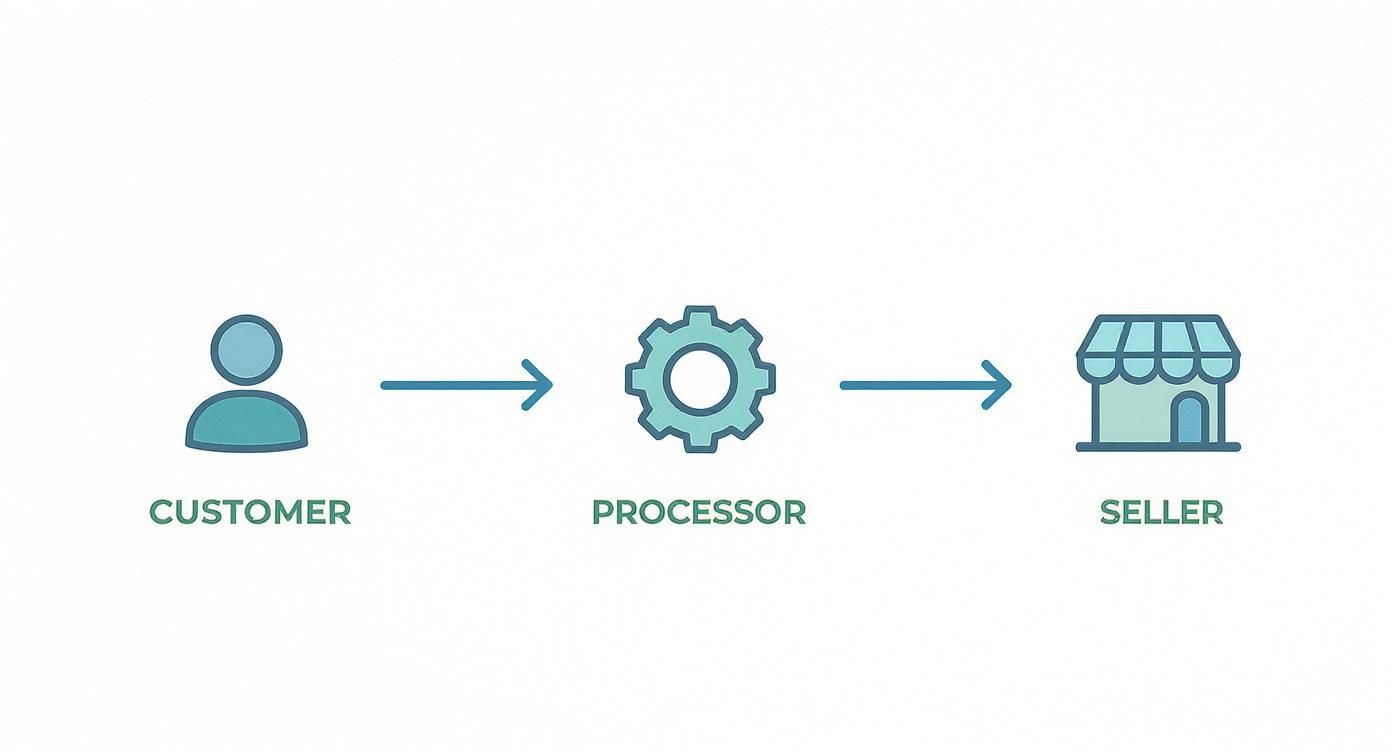
As you can see, the payment processor serves as the essential middleman, completely removing the need for the seller to do anything manually. Systems like these are the backbone of modern e-commerce. In fact, the market for interbank payment networks was valued at $14.3 billion and is projected to hit $29.8 billion by 2033. This growth highlights just how much the world relies on secure, automated transaction systems. You can dive deeper into these numbers in the full interbank payment networks market report.
IPN vs Webhooks: What Sets Them Apart
People often toss around the terms "IPN" and "webhook" as if they're interchangeable. While they're definitely related, the difference is crucial—it’s like comparing a specialized armored truck to a standard delivery van. Both get things from point A to point B, but one is purpose-built for a very specific, high-stakes job.
At its heart, an Instant Payment Notification is a highly specialized type of webhook. It’s engineered for one critical task and one task only: securely communicating events about financial transactions. This sharp focus is what makes it fundamentally different from a general-purpose webhook.
A generic webhook is a more versatile, all-purpose tool. It can be triggered by almost any event you can imagine within an application.
- A new user signs up for your newsletter.
- Someone posts a comment on your blog.
- A file gets uploaded to cloud storage.
- A support ticket is updated.
In each of these scenarios, a webhook can push a notification to another system to kick off a follow-up action. They are fantastic, event-driven communicators that act as the connective tissue between different software.
The Specialization of an IPN
An IPN, on the other hand, is a webhook with a very specific and non-negotiable mission. It only fires for payment-related events, like a successful transaction, a failed payment, a refund, or a subscription renewal. This specialization gives it several key advantages that a generic webhook just doesn't have out of the box.
First, an IPN message—often called a payload—comes with a standardized data structure. You know exactly what financial information to expect every single time, like the transaction ID, payment amount, currency, and customer details. Generic webhooks have no such standard; their data structure is completely dependent on whatever event triggered them.
Key Takeaway: While all IPNs are webhooks, not all webhooks are IPNs. An IPN is a webhook that has been hardened and standardized specifically for the security and reliability required in payment processing.
Second, IPNs have built-in security protocols. A great example is the verification handshake, where your server sends the notification back to the payment gateway just to confirm it's authentic. This security layer is essential for preventing fraud and isn't a standard feature of most generic webhooks. Speaking of other services, you can explore some of the recent updates BlockBee has made to its own checkout, payment, and deposits webhooks.
To make the distinction crystal clear, let's break down the key differences.
IPN vs Webhook: A Feature Comparison
This table highlights where these two powerful tools diverge in their design and application.
| Feature | IPN (Instant Payment Notification) | Generic Webhook |
|---|---|---|
| Primary Use Case | Financial transactions only | Any general application event |
| Data Structure | Standardized for payments | Varies by event type |
| Security | Built-in verification (handshake) | Must be custom-built |
| Purpose | To securely automate post-payment actions | To connect disparate systems |
Ultimately, choosing between them comes down to the job at hand. For notifying a chat app that a new file was uploaded, a generic webhook is perfect. But for the mission-critical task of confirming a customer's payment and triggering an order shipment, the specialized, secure, and reliable nature of an IPN is the only responsible choice.
Best Practices for a Secure IPN Listener

Think of your IPN listener as the digital front door for all your payment data. If you leave that door unlocked, you’re basically inviting trouble, opening yourself up to everything from fake orders to outright data theft. Building a secure and resilient listener isn’t just a good idea; it’s an absolute must for anyone handling online transactions.
When you put solid security measures in place, you’re guaranteeing that every single notification you act on is legitimate, accurate, and processed correctly. This builds a foundation of trust that protects your business, keeps your customers safe, and secures your revenue. Let's walk through the essential strategies for hardening your IPN system against the most common threats.
Always Verify the Sender
If you do only one thing, do this: always confirm that an incoming IPN is actually from your payment gateway. Never, ever trust a notification at face value. It's shockingly easy for a scammer to craft a fake IPN and send it to your listener, trying to trick your system into shipping a product or activating a service they never paid for.
This is where the verification handshake comes into play, and it's non-negotiable. The moment your listener receives an IPN, its first job is to send the entire, untouched payload right back to the payment gateway's verification URL. The gateway will then check it and send back a simple response, usually "VERIFIED" or "INVALID".
Crucial Rule: Your system should only fulfill an order or update a transaction after it gets that "VERIFIED" confirmation. If the response is "INVALID," or if you don't get a response at all, you must discard the notification.
This simple back-and-forth is your number one defense against spoofed messages.
Essential Security Layers
Sender verification is your first line of defense, but it shouldn't be your only one. A few other security layers are essential for protecting your IPN listener and the sensitive data it handles. Think of it as a multi-layered defense—the more obstacles you put in an attacker's way, the safer you'll be.
Enforce HTTPS: Your listener URL must use HTTPS, period. This encrypts the data as it travels between the gateway and your server, making it unreadable to anyone trying to eavesdrop on sensitive details like customer names or order info.
Check Transaction Details: Before you mark an order as paid, double-check the IPN data against what you have in your own database. Does the payment amount actually match the order total? Is the currency correct? This vital step stops attackers from changing the payload—for example, trying to pay $1.00 for a $100.00 item.
Implement Idempotency: The internet isn't perfect. Sometimes, a gateway might send the same IPN message twice due to a network hiccup. Idempotency is just a fancy word for making sure that processing the same notification multiple times has the exact same result as processing it once. You can do this by logging every unique transaction ID you process. If a notification with that same ID comes in again, you just ignore it. This simple log prevents you from shipping the same order twice or giving a customer duplicate credit.
Use Access Controls: Lock down who can even talk to your listener script. One common technique is to check the source IP address to make sure the request is coming from one of the payment gateway's known servers. While IP addresses can be faked, it adds another valuable hurdle for an attacker to overcome.
By layering these strategies together, you build a truly robust security posture. You’re verifying the sender, protecting the data in transit, validating the message contents, and gracefully handling network glitches. The result is a system that’s not just secure, but also incredibly reliable.
Building a Reliable and Error-Proof System
https://www.youtube.com/embed/lxniN4Lt77k
In a perfect world, every message would arrive instantly, just once. But we don't live in a perfect world. Networks get congested, servers need to reboot, and connections drop. A truly solid Instant Payment Notification (IPN) system isn't just built for the good times; it’s designed to handle those inevitable hiccups without breaking a sweat.
Think about it: what happens if your server goes down for maintenance at the exact moment a payment gateway sends a notification? Without a plan B, that transaction data could vanish into thin air. You'd have a customer who paid but an order that was never fulfilled. This is precisely why most payment processors, including BlockBee, build in retry logic.
If your server doesn't respond with a "got it" signal (typically a 200 OK status), the gateway assumes the message failed and will try sending it again. This persistence is a lifesaver, but it creates a new puzzle: what do you do when your server is back online and gets hit with the same notification multiple times?
Handling Duplicates with Idempotency
This is where a concept called idempotency becomes your best friend. In simple terms, it means designing your system so that processing the same notification more than once has the exact same result as processing it just the first time. The goal is to stop duplicate actions in their tracks—no shipping two products for one order or crediting a user's account twice.
The most straightforward way to pull this off is to keep a record of every unique transaction ID you process.
- When an IPN comes in, the first thing you do is check if you've already seen its transaction ID.
- If it's a new ID, go ahead and process the payment, update your database, and then log that transaction ID as completed.
- If you've already logged that ID, you simply send back a
200 OKto let the gateway know you're good, but you don't do anything else.
This simple check ensures that no matter how many times the gateway resends the notification, you only fulfill the order once.
Key Strategy: Think of comprehensive logging as your system’s memory. It’s not just for debugging; it’s the bedrock of an idempotent system that can confidently tell the difference between a new event and a harmless retry.
Monitoring and Alerts
Finally, the most dangerous failure is a silent one. You absolutely need to know when things go wrong. Setting up a solid monitoring system is non-negotiable for a reliable IPN handler. This means tracking every notification—successful or not—and creating automated alerts for repeat failures. For example, if your system keeps erroring out on the same IPN, an alert should ping your team to jump in and investigate.
Since IPNs carry sensitive transaction details, it's crucial to weave strong data breach prevention strategies into your architecture from day one. A fantastic way to put your system through its paces is to use tools that simulate different failure scenarios. You can see how this works in our guide on introducing the Callback Tester.
By combining these strategies—retry logic, idempotency, and smart alerts—you can transform a potentially fragile process into a resilient, error-proof system you can count on.
How to Integrate a BlockBee IPN
Alright, let's move from theory to action. Getting a BlockBee IPN up and running is a pretty straightforward process, and it all starts right in your dashboard.
First things first, you need to tell BlockBee where to send its messages. This destination is your callback URL—the specific endpoint on your server that will listen for these incoming payment notifications. Just pop that URL into your account settings, and you've officially set the delivery address for every transaction update.
With your URL saved, BlockBee gets to work. From that point on, any time a relevant payment event happens, it will automatically send a data payload to your listener. This payload contains all the critical details your system needs to validate the payment and fulfill the order. For a complete list of every parameter included, the official BlockBee API documentation is your best friend.
Safely Testing Your Integration
Before you start handling real customer payments, you absolutely need to make sure your IPN listener is working as expected. This is precisely what BlockBee’s sandbox environment is for. It's a powerful tool that lets you run through all sorts of payment scenarios without touching a single real cent.
Key Advantage: The sandbox gives you the freedom to test how your system reacts to different situations. You can simulate successful payments, underpayments, and even delayed transactions to see if your listener can handle the good, the bad, and the ugly.
This testing phase isn't just a suggestion; it's a crucial step for building a reliable system. By confirming your code responds correctly to every possible event, you can launch with confidence, knowing your automated workflow is solid and ready for real-world business. It’s the best way to guarantee a smooth and secure process right from the start.
Common Questions About IPNs
Even after getting a good handle on how Instant Payment Notifications work, a few practical questions almost always pop up. Let's tackle them head-on, because sorting these out is crucial for building a system you can truly depend on.
What Happens If My Server Is Down When an IPN Is Sent?
This is probably the number one worry for anyone implementing IPNs, but thankfully, payment gateways are designed with this in mind. They don't just send a notification and hope for the best.
If a gateway sends an IPN and doesn't get the expected "OK" response from your server, it won't just give up. The system is built to automatically retry, sending the same notification again and again over a set period. This built-in retry logic is your safety net, making sure a temporary server glitch doesn't lead to a lost transaction.
Is an IPN the Same as an API?
Not at all—in fact, they are fundamentally opposites in how they communicate.
Think of it like this: an API typically uses a "pull" model. Your application has to constantly ask, or "poll," the payment server, "Hey, is there anything new? Has that payment gone through yet?" It's on you to initiate the conversation.
An IPN, on the other hand, uses a "push" model. The payment gateway takes the lead. The moment a payment is confirmed, it actively pushes that information to your server. You don't have to ask; the data just shows up when it's ready, which is far more efficient for real-time updates.
Can IPNs Handle Refunds?
Absolutely. While the most common use is for successful payments, the system is flexible. Most gateways will also send IPN-style notifications for other events like refunds, chargebacks, and even disputes.
The key is to set up your IPN listener to recognize these different event types. Instead of just looking for a "payment_completed" status, you'll need to code it to also handle "refund_processed" or "chargeback_initiated" events and trigger the appropriate actions in your system.
Ready to automate your crypto payments with a reliable, secure IPN system? Get started with BlockBee today and see how easy it is to integrate instant payment notifications into your business.
Review Us