
Your Essential ERC 20 Wallet Guide
An ERC-20 wallet is simply a digital wallet that can hold and manage tokens built on the Ethereum blockchain using the ERC-20 standard. Think of it as a universal bank account, but instead of just holding dollars or euros, it's designed for the huge universe of Ethereum-based assets—from stablecoins like USDT to governance tokens that give you a say in a project's future. It's your personal key to the world of decentralized finance (DeFi).
Your Passport to the Ethereum Economy
To really get what an ERC-20 wallet does, picture the Ethereum network as a massive digital city. In this city, thousands of different "currencies" (tokens) are used for everything, whether you're voting in a decentralized organization or playing a blockchain game. An ERC-20 wallet is your passport and bank account all in one. It doesn't just store your funds; it proves who you are and lets you get involved.
Without a wallet that supports ERC-20 tokens, you're basically stuck on the sidelines. You wouldn't be able to receive a new project's token, trade on a decentralized exchange, or tap into a lending protocol. This makes it an absolutely essential tool for anyone who wants to do more than just hold Ether (ETH), Ethereum's native currency.
Why ERC-20 Compatibility Is Crucial
So, what is "ERC-20"? It's a technical standard—a shared set of rules for creating new tokens on Ethereum. By sticking to this blueprint, developers make sure their tokens play nicely with all the other apps and wallets in the ecosystem.
This standardization is the secret sauce. An ERC-20 wallet is designed to understand and handle any token that follows these rules. That means it can manage a huge range of digital assets right out of the box, including:
- Stablecoins: Tokens like Tether (USDT) and USD Coin (USDC) that are pegged to a real-world asset, usually the US dollar.
- Utility Tokens: Tokens that grant you access to a specific product or service, like Chainlink (LINK).
- Governance Tokens: Tokens that give holders voting power over a project's future, such as Uniswap (UNI).
An ERC-20 wallet acts as a universal key. It doesn’t need a special update for every new token that comes out. As long as a token is built to the ERC-20 standard, your wallet will recognize it, letting you store, send, and receive it without a hitch.
The Scale of the ERC-20 Ecosystem
The need for these wallets has skyrocketed right alongside Ethereum's growth. The sheer number of tokens out there tells the whole story. As of early 2025, a mind-boggling 1.7 million different ERC-20 tokens have been created on the Ethereum blockchain, cementing its status as the world's dominant token standard. This number alone shows just how central these wallets are for anyone managing digital assets.
An ERC-20 wallet is much more than just a place to check your balance; it’s your command center for the decentralized web. To see how these wallets fit into the bigger picture, check out our guide on what a Web-3 wallet is and how it all comes together. At the end of the day, whether you're a developer building the next big thing, a merchant accepting crypto payments, or an investor, an ERC-20 wallet is where it all begins.
How Your ERC-20 Wallet Actually Works
Let's clear up one of the biggest misconceptions right away. Your ERC-20 wallet doesn't actually "hold" your tokens the way your physical wallet holds cash. It's a common mental picture, but it's not quite right.
Your tokens are really just records on the Ethereum blockchain—a massive, public database that everyone can see. Your wallet, then, is more like a specialized keychain. It holds the cryptographic keys that prove you're the true owner of those records and gives you the ability to manage them. Without the keys, your tokens are just numbers on a ledger. With them, they're your assets.
Understanding this difference is the key to grasping how the whole system operates. Your funds live on the blockchain; your wallet is simply the tool you use to access and control them.
The Role of Public and Private Keys
At the heart of every ERC-20 wallet is a pair of powerful, mathematically linked keys: a public key and a private key. Knowing how each one works is absolutely essential for using your wallet securely.
The easiest way to think about it is like a high-tech mailbox:
Your Public Key (Wallet Address): This is your mailing address. You can share it with anyone who wants to send you something—in this case, ERC-20 tokens. It's generated from your public key and is totally safe to give out. It's how people find you.
Your Private Key: This is the actual key to your mailbox. It’s the only thing that can unlock it and access what’s inside. If someone gets their hands on this key, they can open your mailbox and take everything.
Your wallet address, which you'll recognize because it starts with "0x," is what you share to get paid. Your private key, on the other hand, is for your eyes only. It’s the master key that signs off on every single transaction leaving your wallet.
Your ERC-20 wallet address is for receiving funds and is safe to share. Your private key is for sending funds and must be protected at all costs. Losing it is like handing over the keys to your bank vault.
Signing and Broadcasting Transactions
So, what happens when you hit "send"? Your wallet puts your private key to work, creating a unique digital signature for that specific transaction. This is called "signing."
Think of it like writing a check. The transaction details are the recipient's name and the amount. Your handwritten signature is what makes the check legally binding. In crypto, your private key creates a digital signature that's mathematically impossible to fake and is tied directly to that one transaction.
Once signed, your wallet broadcasts the transaction to the entire Ethereum network. From there, computers all over the world (called nodes) do a quick verification. They use your public key to confirm that the signature was made by the matching private key—without ever needing to see the private key itself.
This clever bit of cryptography accomplishes two critical things:
- Authentication: It proves that you, and only you, authorized the transaction.
- Integrity: It ensures that the transaction details weren't changed after you signed them.
If the signature checks out, the nodes approve the transaction, add it to the blockchain, and the token balances are updated for everyone to see. This entire process unfolds in moments, giving us a secure way to transfer value without a middleman. Your ERC-20 wallet handles all this complexity behind a simple user interface, making it all possible with just a click.
Comparing Different Types of ERC-20 Wallets
Choosing the right ERC-20 wallet isn't about finding the single "best" one on the market. It’s about finding the best one for you. Your decision really boils down to a classic balancing act: convenience versus security. How you plan to use your crypto will point you toward the right solution.
To get started, let's break down the two main categories all wallets fall into: hot wallets and cold wallets. Once you grasp the difference, you’ll be in a much better position to pick a wallet that protects your assets and fits your day-to-day needs.
Think of a hot wallet like the cash in your pocket—it’s connected to the internet and ready for immediate use. A cold wallet, on the other hand, is completely offline. It’s more like a secure vault at a bank, designed for holding serious value long-term.
Hot Wallets: Your Everyday Spending Account
Hot wallets are software—desktop apps, mobile apps, or browser extensions like MetaMask or Trust Wallet. Their constant internet connection is what makes them so handy for traders, DeFi enthusiasts, or anyone who needs to make transactions on the fly.
The biggest upside is pure convenience. Sending tokens or interacting with a decentralized app (dApp) takes just a few clicks. But that connectivity is also their greatest vulnerability. Being online 24/7 opens the door to potential remote hacks, phishing scams, and malware.
That’s why the golden rule is to only keep a small amount of "spending money" in a hot wallet. Never your life savings. It's the perfect tool for active use, but not for long-term storage.
Cold Wallets: The Secure Digital Vault
If you're a serious investor or a long-term "hodler," a cold wallet is non-negotiable. These wallets keep your private keys completely offline, creating an "air gap" that makes them virtually immune to online theft.
Cold storage generally comes in two flavors:
- Hardware Wallets: These are small physical devices, often looking like a USB stick. They have one crucial job: to sign transactions internally without ever exposing your private key to an internet-connected computer. The key never leaves the device.
- Paper Wallets: This is a more old-school method where your keys are simply printed onto a piece of paper, often as QR codes. While they can be very secure if stored safely, they're also fragile and clunky to use, which is why they’ve become less common.
The trade-off? Cold wallets aren't built for speed. You need the physical device or paper on hand to access your funds, making them impractical for quick trades or frequent dApp interactions.
Comparison of ERC-20 Wallet Types
To help you visualize the differences, here’s a quick breakdown of how these wallet types stack up against each other.
| Wallet Type | Security Level | Convenience | Cost | Best For |
|---|---|---|---|---|
| Mobile Wallet | Medium | Very High | Free | Daily transactions, on-the-go payments, and dApp access. |
| Web/Browser Wallet | Medium | Very High | Free | Quick dApp interaction and frequent trading on a desktop. |
| Desktop Wallet | Medium-High | High | Free | Regular use from a primary, secure computer. |
| Hardware Wallet | Very High | Low | $50 - $200+ | Long-term holding and securing large amounts of crypto. |
| Paper Wallet | High | Very Low | Free | Deep cold storage, though less practical than hardware wallets. |
Ultimately, each wallet type serves a different purpose. Hot wallets prioritize ease of access for daily activities, while cold wallets offer fortress-like security for your core holdings.
Making the Right Choice for Your Needs
So, which one should you choose? For most people, the answer isn't "one or the other" but "both." A hybrid approach gives you the perfect mix of accessibility and peace of mind.
A smart strategy is to use a hot wallet for your "checking account" to handle daily transactions and a cold hardware wallet for your "savings account" to secure the bulk of your assets.
This two-wallet system compartmentalizes your risk. If your hot wallet were ever compromised, the vast majority of your funds would remain completely untouched and safe in offline storage. At the end of the day, the right setup is one that matches your risk tolerance and how you actually use your crypto.
Essential Security Practices for Your Wallet
In the world of crypto, you really are your own bank. That freedom is powerful, but it comes with a huge responsibility—you are the only one in charge of keeping your assets safe. An ERC-20 wallet is an amazing tool, but its security is only as strong as the habits you build around it.
The absolute number one rule is to protect your seed phrase (sometimes called a recovery phrase). This string of 12 or 24 words is the ultimate master key to your funds. If anyone gets their hands on it, they get complete control of your wallet. It's that simple.
Think of your seed phrase like the deed to your house. You wouldn't post a picture of it online or email it to yourself, right? The same exact logic applies here. Storing it digitally—on your computer, phone, or even in a cloud-based password manager—is just asking for trouble from hackers and malware.
Protecting Your Master Key
The only truly safe place for your seed phrase is offline. This creates a physical gap that digital attackers simply can't cross. The goal is to make it totally immune to online threats while still being accessible to you when you need it.
Here are a few time-tested offline methods:
- Write It Down: Go old-school with pen and paper. Write down the phrase and consider making a couple of copies. Store them in different, secure, private locations, like a safe deposit box and a fireproof safe at home.
- Use Metal Storage: For ultimate protection against things like fire or floods, you can stamp your seed phrase onto a metal plate. There are plenty of products out there designed specifically for this.
- Never Digitize It: I can't say this enough: don't take a photo of it. Don't type it into a notes app. Don't save it as a text file. Any digital version is a vulnerability waiting to happen.
Getting this part right is the single most important security step you can take. To really go deep on this, check out our detailed guide on seed phrase security strategies.
Building a Multi-Layered Defense
Beyond just the seed phrase, strong security is all about creating multiple layers of defense. Putting all your trust in one method is a risky bet. When you combine a few different strategies, you create a much tougher environment for anyone trying to get at your funds.
One of the best moves you can make is to use a two-wallet system. Keep a small amount of crypto in a convenient hot wallet (like a mobile app) for everyday spending, and store the vast majority of your funds in a hardware wallet. This way, your "life savings" are kept completely offline and out of harm's way.
On top of that, you always have to stay sharp and watch out for common threats:
- Phishing Scams: Be incredibly suspicious of random emails, DMs, or links promising free airdrops or telling you to "verify" your wallet. Scammers are experts at creating fake websites that look real, all to trick you into typing in your seed phrase.
- Malicious Smart Contracts: Before you connect your wallet to a new decentralized app (dApp), do your homework. Some smart contracts are cleverly designed to drain your wallet the moment you give them approval.
- Multi-Factor Authentication (MFA): Turn on MFA for every single exchange or service you use. It adds a critical layer of protection that can stop an attacker even if they manage to steal your password.
As threats have grown, so have security solutions. For example, enterprise-grade multi-signature wallets, which need approval from multiple people to send a transaction, have become incredibly popular. In 2025, deployments of these wallets hit 9 million, marking a 47% jump from the previous year. This just shows how much demand there is for better security.
Your diligence is your best defense. If you're looking to learn more, exploring different strategies to enhance fintech app security can offer some great insights that apply directly to crypto.
Accepting ERC-20 Payments with BlockBee
So, you've got your ERC-20 wallet and you're comfortable holding assets. But what about taking the next step and actually accepting tokens as payment? For many business owners, this feels like a huge technical hurdle. The good news is, you don't need to be a blockchain developer to make it happen.
Crypto payment gateways are designed to do all the heavy lifting for you. Think of a service like BlockBee as the bridge between your online store and the blockchain. Instead of getting tangled up in code, you get a simple system that automates everything—from giving your customer a place to send their payment to confirming the transaction and letting your system know it's time to ship the order. It makes accepting crypto feel just as routine as taking a credit card payment.
Streamlining Your Payment Flow
Let’s be honest, the biggest headache with accepting crypto directly is keeping track of who paid for what. If all your customers send tokens to the same public wallet address, you're in for an accounting nightmare. How do you match a dozen different payments of the same amount to a dozen different orders?
This is exactly the problem a dedicated payment gateway solves.
BlockBee tackles this by generating a unique, single-use address for every single invoice. When a customer heads to checkout and chooses to pay with an ERC-20 token, the system creates a brand-new address just for them. As soon as their payment hits that address, the gateway spots it on the blockchain, confirms it, and automatically updates the order status to "paid."
This method gives your business a few immediate advantages:
- Simple Reconciliation: Forget the guesswork. Every payment is tied directly to an order, which keeps your books clean and error-free.
- Better Privacy: Using a fresh address for each transaction is a big win for privacy, both for your business and your customers.
- Automated Workflow: The system does all the payment watching and confirming for you, so your team can focus on what they do best—fulfilling orders and helping customers.
A crypto payment gateway turns your ERC-20 wallet from a simple digital piggy bank into a powerful part of your e-commerce machine. It handles all the messy, technical bits of crypto so you can focus on growing your business.
Thinking about the big picture, managing your assets securely is always priority number one. The flow below breaks down the essential steps of protecting your wallet, from initial setup to ongoing defense.
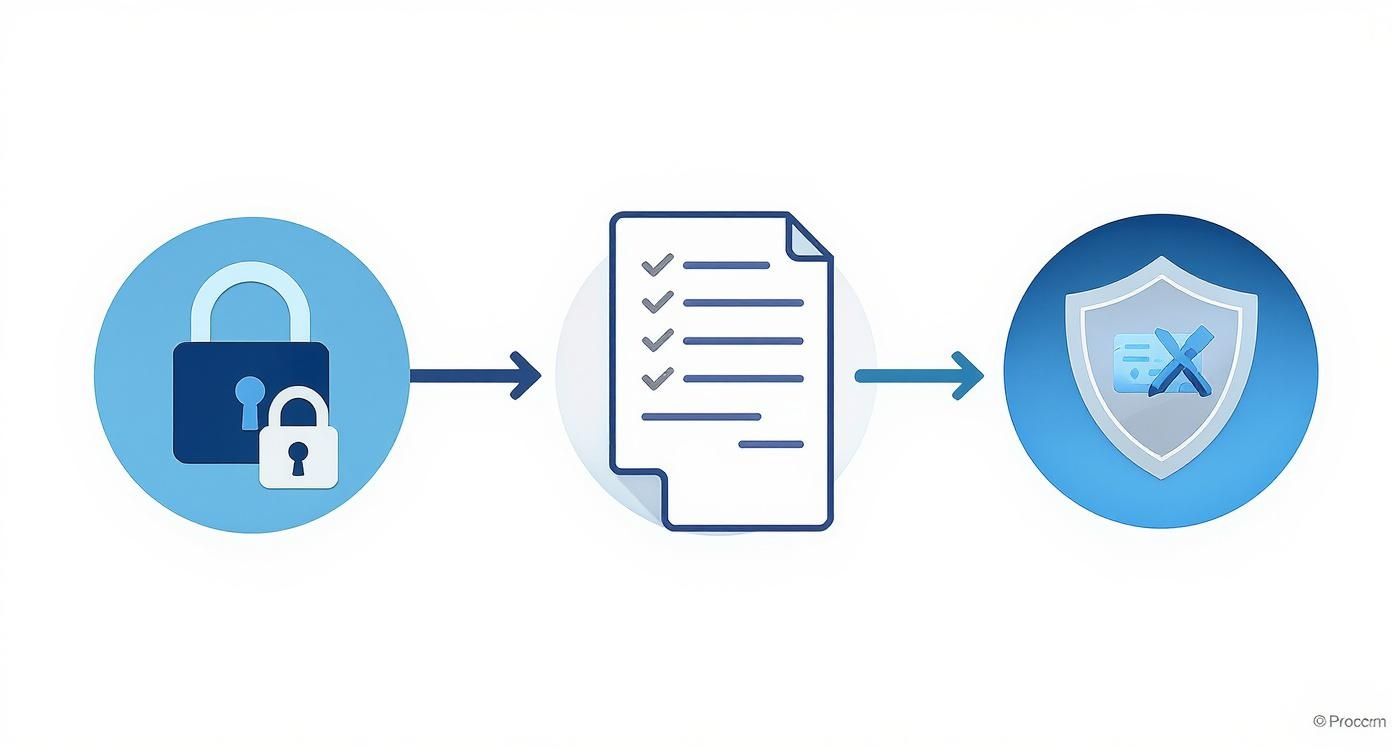
As you can see, a solid security strategy starts long before a transaction ever happens, beginning with how you secure your keys and create reliable backups.
Easy Integration for Any Platform
You don't need a team of developers to get this up and running. Whether you're using a popular e-commerce platform or have a completely custom-built site, there’s an integration path for you. For most merchants, the fastest way to get started is with a pre-built plugin.
BlockBee offers official plugins for some of the biggest names in e-commerce:
- WooCommerce
- Magento
- PrestaShop
- OpenCart
Getting one of these installed is usually just a few clicks. Once it's active, you’ll have a new crypto payment option right on your checkout page. It’s a true plug-and-play solution that can have you accepting ERC-20 tokens in minutes.
If you need something more custom, there's also a powerful API that gives developers the freedom to build unique payment flows from scratch. You can program automatic payouts, create custom notifications, or integrate crypto payments deep into your application's logic. Whether you need a simple payment button or a complex financial system, the API provides all the tools you need. Of course, any setup begins with an address, and you can learn more about the fundamentals in our guide on how to create a wallet address. This level of flexibility ensures that any business, from a small online shop to a large enterprise, can make ERC-20 payments work for them.
Got Questions About ERC-20 Wallets? We’ve Got Answers.
Even after you get the hang of how ERC-20 wallets work, some questions always seem to pop up. Let's tackle some of the most common ones to clear up any lingering confusion and make sure you're managing your Ethereum-based tokens like a pro.
Can I Put My Bitcoin in an ERC-20 Wallet?
The short answer is no, you can't send native Bitcoin (BTC) straight to a standard ERC-20 wallet. This is probably the number one question newcomers ask, and for good reason. It all comes down to the fact that Bitcoin and Ethereum are entirely different blockchains, each with its own language and rules.
Think of it like trying to play a Blu-ray disc in a CD player. They're both discs, but the player just isn't built to read that format. In the same way, an ERC-20 wallet is designed specifically for the Ethereum network and simply can't recognize or interact with the Bitcoin blockchain.
But there’s a clever workaround called Wrapped Bitcoin (WBTC). WBTC is an ERC-20 token whose value is pegged 1:1 to Bitcoin. Because it’s technically an Ethereum token, you can store it in your ERC-20 wallet. This is a game-changer because it lets you use the value of your Bitcoin within Ethereum’s massive world of decentralized finance (DeFi).
What Happens If I Lose My Private Key or Seed Phrase?
If you lose your private key or seed phrase, you lose your crypto. Period. There's no "forgot password" link to click, no support team to call, and no bank manager who can grant you access.
In the world of self-custody, your private key is your ownership. It's the only thing that proves the assets at your address belong to you. Without it, your tokens are still on the blockchain, but they’re locked in a digital vault and you’ve just thrown away the key.
This is the single most important lesson in crypto security. Treat your seed phrase like it's a bar of gold. Don't just save it to your desktop—write it down and store it offline in multiple, secure locations. This isn't just a suggestion; it's absolutely essential.
How Do I See a New or Custom Token in My Wallet?
Most big-name wallets like MetaMask or Trust Wallet are smart enough to automatically show popular tokens like USDT or LINK. But with thousands of new tokens launching all the time, they can't possibly list them all. If you get sent a less common token, you'll probably have to add it manually to see your balance.
Don't worry, it's a simple and safe process. Here’s how it works:
- Find the Token's Contract Address: First things first, you need the token's unique address on the blockchain. The best place to find this is a trusted block explorer like Etherscan. Be very careful—never use a contract address someone sends you in a random DM.
- Find the "Add Token" Button: Open your wallet and look for an option like "Import Tokens" or "Add Custom Token." It's usually at the bottom of your list of assets.
- Paste the Address: Copy the official contract address and paste it into the field.
- Check the Details: Your wallet should automatically fill in the token’s symbol (like WBTC) and its decimal places. Just give it a quick check to make sure it looks right, then confirm.
And that's it! The custom token will now show up in your main asset list with the correct balance, just like all your other coins.
Are Mobile Wallets Safe for Storing a Lot of Crypto?
Mobile wallets are fantastic for everyday use. They make it easy to send a few tokens, interact with dApps, and manage your "walking around" money. That said, they are not the right place to store your life savings.
As "hot wallets," they're always connected to the internet, which exposes them to a wider range of threats like malware, SIM-swapping attacks, or a clever phishing scam. If your phone gets hacked, your wallet is a prime target.
For any amount you’d be devastated to lose, a hardware wallet is the way to go. These devices keep your private keys completely offline, creating a physical barrier—an "air gap"—that hackers can't cross.
A great strategy is to use both:
- A mobile wallet for your daily spending money.
- A hardware wallet for your long-term savings and investments.
This approach splits up your risk. Even if something were to happen to your phone, the vast majority of your assets would remain completely untouched and secure.
Ready to integrate seamless and secure crypto payments into your business? BlockBee provides the tools you need to accept ERC-20 tokens and over 70 other cryptocurrencies with ease. Get started with BlockBee today.
Review Us