
Streamline Global Transactions With Bitcoin Payment Processing
Bitcoin payment processing lets businesses send, confirm, and settle transactions directly on the Bitcoin network. It delivers near-instant confirmations, lower fees, and broad global reach without the delays of traditional banking.
Benefits Of Bitcoin Payment Processing

Routing funds over blockchain rails is a bit like using an express courier instead of standard mail. Payments arrive faster, and you don’t pay hefty intermediary fees.
- Faster settlements with confirmations in 10 minutes on average
- Reduced fees often under 0.5% per transaction
- Borderless transfers without geographic restrictions
This simple switch can shrink cross-border payment times from days down to minutes.
Instant settlement means cash flow that moves as quickly as customers expect.
Here’s a snapshot of Bitcoin payment processing at a glance.
Bitcoin Payment Processing At A Glance
| Aspect | Description |
|---|---|
| Faster Settlements | Confirmations in around 10 minutes |
| Lower Fees | Transaction costs often below 0.5% |
| True Borderless Transfers | No geographic or banking barriers |
Keep this table handy as you dive deeper into workflows, security, and integration options.
Integration Options
Adding bitcoin payments to your checkout is straightforward. You can tap into APIs or drop in plugins designed for popular platforms like WooCommerce and Magento.
How BlockBee Supports Bitcoin Payments
BlockBee provides ready-made developer libraries and modules so you can go live quickly.
- Self-custodial wallet integration keeps control of funds in your hands
- Automatic BTC-to-fiat conversion mitigates volatility risks
- Mass Payouts feature handles affiliate and supplier disbursements seamlessly
Merchants we surveyed saw adoption climb by 15% within just one month. That translates into more sales and smoother checkout experiences.
Next Steps
The next section breaks down the blockchain foundations powering each payment step, from broadcast to final settlement.
Real World Example
One online retailer opened up checkout for customers in 20 additional countries—no extra banking licenses needed. They slashed settlement time from two days to under one hour.
- Sales in emerging markets jumped by 35% after adding crypto rails
- Customer refunds issued on-chain instantly, with zero chargeback risk
Quick Checklist
- Evaluate API or plugin integration based on your platform
- Test transaction flows in a sandbox environment to confirm settlement times and fee displays
- Plan wallet key management and compliance procedures before going live
With these basics in place, you’re ready to explore on-chain and off-chain mechanics in more detail.
Key Takeaways
- Bitcoin rails speed up borderless commerce dramatically
- Transaction fees drop below traditional card and bank charges
- BlockBee integration can add crypto support in under an hour
Start your Bitcoin payment journey today with BlockBee’s sandbox account and see how quickly you can go live.
Understanding Bitcoin Payment Foundations
Blockchain serves as the engine behind every bitcoin payment. It maintains a decentralized ledger where each transaction is recorded like an entry in a public journal—transparent and impossible to alter.
However, not every transfer takes the same path. On-chain transactions post directly to Bitcoin’s network, while off-chain payments settle privately before a final blockchain update.
- On-chain resembles registered mail with publicly visible stamps
- Off-chain feels like a courier bundling multiple letters for a single drop
- Both approaches balance speed, cost, and transparency
This flexibility lets businesses pick the route that fits their priorities.
Imagine sending a $100 payment on-chain like mailing a tracked parcel—you watch it arrive. Off-chain is more like handing a stack of letters to a delivery partner, who tallies them up and settles later.
Exploring Wallets And Addresses
A wallet holds cryptographic keys, just as a secure mailbox safeguards your ability to send or receive mail. Each wallet ties to a public address, the exact spot where funds land.
For instance, a merchant might display a Bitcoin address as a QR code on an invoice. A customer scans it, the tokens move on-chain, and the merchant’s wallet logs the incoming payment.
“Switching to on-chain settlements shaved two days off our cash flow,” shares Carol, founder of a bustling online farmers’ market.
This real-world win shows on-chain transparency builds trust.
Transaction Fees And Confirmations
Think of transaction fees as postage stamps. Paying more generally gets your transaction included faster—like springing for express shipping.
- Fee Size: Fluctuates with network congestion
- Confirmation Time: Roughly 10 minutes per block
- Priority: Higher fees move to the front of the line
Fees can surge during peak times, so merchants often keep an eye on mempool conditions to strike the right balance between cost and speed.
Network Confirmations In Practice
Most businesses wait for 3 confirmations before considering a payment final. Each confirmation equals one more block added to the chain, similar to extra security checks at each shipping hub.
- 1 confirmation: Initial visibility
- 3 confirmations: Standard for low-value goods
- 6 confirmations: Safe for high-value transactions
Case Study
A boutique retailer handled 120 daily orders using on-chain bitcoin payments. They fired off customer notifications after two confirmations, then released goods once the third confirmation landed. The result? Fewer false positives and smoother reconciliation.
Tools like BlockBee’s notification webhook automate this flow, pushing real-time status updates straight into order management systems.
However, zero-confirmation payments carry extra risk since they’re not yet on the blockchain. If you choose this path:
- Use only for small-value orders
- Display clear refund policies
- Monitor network conditions constantly
Mastering these building blocks—distributed ledger, wallets, addresses, fees, and confirmations—gives businesses the confidence to move on to integration workflows, compliance checks, and settlement strategies.
You now have a firm grasp of the fundamentals, removing guesswork from billing and settlement while slashing reconciliation headaches.
Business Benefits And Real World Use Cases
Many businesses struggle with high transaction fees, slow international transfers, and chargeback headaches. It’s like waiting for a container ship when you really need an express courier—funds inch across borders and fees keep piling up.
By switching to bitcoin payment processing, some e-commerce merchants have slashed processing costs by 90%, turning what once drained working capital into direct savings.
The bitcoin payment market ecosystem jumped from $1.32 billion in 2024 to a projected $1.55 billion in 2025, reflecting a robust 17.8% CAGR. Read the full report on The Business Research Company
E-Commerce And Streaming Savings
An online retailer saw its fee burden drop from 3% to 0.3% per transaction, freeing up cash flow almost overnight.
Streaming platforms, meanwhile, can enable instant micropayments under $0.10, paving the way for pay-per-minute models without card network friction.
- Lower Fees: Merchants pay as little as 0.25% per on-chain transaction
- Instant Settlement: Funds settle within minutes, not days
- Chargeback Protection: Irreversible payments remove disputes
BlockBee’s tools slot seamlessly into popular shopping carts, handling volatility and auto-converting to fiat.
A digital art marketplace reported a 20% increase in completed micropayments after adopting bitcoin rails. Transactions under $0.50 became cost-effective, unlocking a fresh wave of buyers.
Global Expansion And Mass Payout Scenarios
A fashion retailer went live in 15 new countries overnight, sidestepping complex banking licenses and local regulations.
Companies running mass payouts—think affiliate commissions or global payroll—can push thousands of payments in a single batch. Compared to traditional wires, bitcoin payout rails deliver:
| Scenario | Wire Transfer | Bitcoin Payout |
|---|---|---|
| Setup Time | 1–3 business days | Minutes |
| Fees Per Transaction | $15 on average | $0.10 or 0.25% fee |
| Geographic Coverage | Limited by correspondent banks | Global via the Bitcoin network |
“Using crypto rails for our global payroll cut costs by 85% and sped up processing tenfold,” says a BlockBee merchant.
These stories prove that bitcoin payment processing isn’t just a niche experiment; it’s a practical upgrade for businesses eager to reduce costs, accelerate cash flow, and scale worldwide.
Integrating with BlockBee brings you:
- Reliable API Support and documentation
- Customizable Checkout Flows to match your branding
- Self-Custodial Control so you hold the keys
Best Practices For Smooth Adoption
- Plan cryptocurrency conversion rules in advance to dodge FX surprises
- Test settlement timing in a sandbox to gauge network congestion
- Use BlockBee’s webhook notifications to automate reconciliation
Follow these steps, and you’ll turn bitcoin payment processing into a genuine competitive advantage.
Start saving today.
Technical Workflows and Stablecoin Integration
Mapping a Bitcoin payment from the moment a customer clicks “Pay” to when funds land in a merchant’s account feels like watching a relay race, with each handoff happening seamlessly.
Behind the scenes, processors swap BTC into local currency almost instantly. This shields merchants from sudden swings in Bitcoin’s market price.
- Automatic Fiat Conversion protects revenue against price jolts
- Near-Instant Settlement means funds clear faster than traditional banking rails
- Scalable Architecture handles spikes in transaction volume without a hitch
Imagine a shopper hits checkout and, in under 50 milliseconds, an API call spins up a fresh wallet address. Even if the blockchain is busy, payments keep flowing without a hitch.
Settlement Flow Diagram
Below is an infographic visualizing the flow of cost, speed, and growth metrics for bitcoin payment processing.
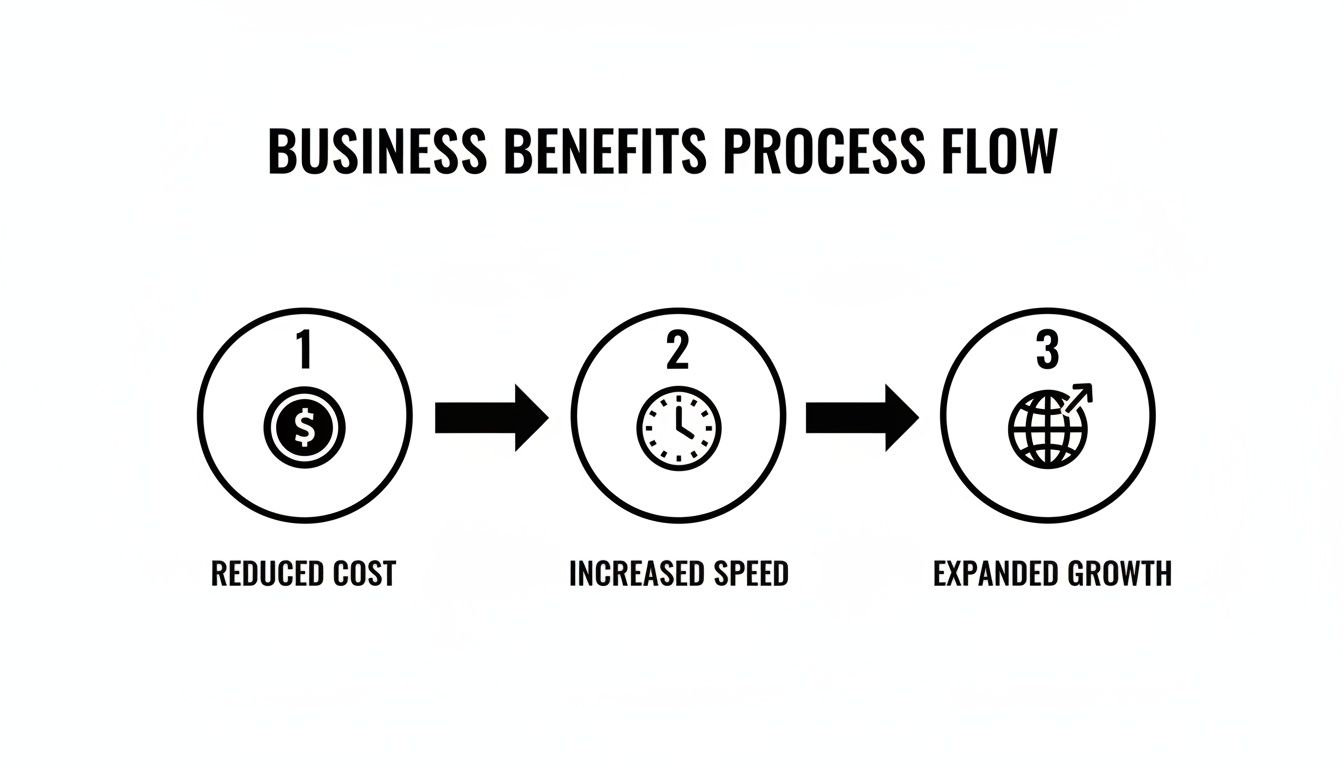
Notice how faster settlements stack up alongside cost efficiency, paving the way for businesses to expand into new markets with confidence.
Stablecoins dominated crypto transactions with over $4 trillion in volume from January to July 2025—a rise of 83% year-over-year—while Bitcoin saw $1.2 trillion in fiat inflows. Discover more insights about stablecoin usage in this report
Check out our guide on stablecoin cross-border rails for more context and examples of integration.
Mini Case Study
A subscription service shifts its monthly billing to USDC rails to dodge Bitcoin’s price swings. Funds roll on-chain into a stablecoin reserve, then convert to fiat at a fixed rate every Monday.
- Predictable Payouts make cash flow forecasts straightforward
- On-Chain Transparency gives customers and accountants a clear audit trail
- Weekly Settlements minimize exposure to currency fluctuations
USDC rails acted like a conveyor belt, moving funds smoothly every cycle.
To sharpen performance further, developers cache wallet generation and batch confirmation checks off-chain before posting to the ledger.
Integration Points
Deciding where to plug in depends on your tech stack and brand needs:
- API Calls for direct invoice creation and payment verification
- E-Commerce Plugins drop into WooCommerce, Magento, PrestaShop in minutes
- Hosted Checkouts via iframe or redirect, trading off some branding control
BlockBee’s RESTful API and official plugins cover all major platforms, smoothing out most headaches. For reliability, set up retry logic on timeouts and trigger alerts for any failed settlement attempts.
Validate transactions off-chain when you can, then confirm them on-chain in the background. Meanwhile, use monitoring dashboards to watch confirmations and send early warnings if something stalls. Keep detailed logs to trace any hiccups in address derivation or network delays.
Mixing Bitcoin with stablecoin rails is like offering express and standard shipping side by side—high-value orders zoom through USDC corridors, while smaller payments ride directly on the Bitcoin network.
Final Takeaways
Technical workflows map out clear checkpoints for checkout, currency conversion, and settlement. Understanding both stablecoin rails and Bitcoin flows guarantees a balance of speed and stability.
Implement these patterns to trim fees, boost throughput, and elevate the merchant experience:
- Track confirmation times for every on-chain transaction
- Schedule stablecoin payouts during periods of low network traffic
- Use BlockBee webhooks to automate reconciliation steps
Run thorough tests on edge scenarios—double spends, invalid UTXOs, network hiccups—to ensure your system holds up under pressure.
Security Compliance And Settlement Models
Security and compliance aren’t just buzzwords in bitcoin payment processing—they’re the foundation you build everything on. From choosing who holds your private keys to settling funds in fiat, each decision shapes how resilient your setup will be.

Custodial And Non Custodial Setups
Think of a custodial model as renting a safe deposit box: the provider stores your keys and handles security upkeep. It’s convenient, but you’re trusting a third party with your funds.
In contrast, non custodial setups hand you the keys to your own vault. You gain full control—along with full responsibility for safeguarding those keys.
Custodial Pros
- Centralized security managed by experts
- Automated updates and monitoring
Custodial Cons
- Exposes you to counterparty risk
- May impose withdrawal or service limits
Non Custodial Pros
- Total ownership of funds
- Supports self-custody best practices
Non Custodial Cons
- Requires rigorous key storage and backup
- Demands in-house security protocols
| Threat | Mitigation |
|---|---|
| Key Loss | Multi-signature wallets, offline backups |
| Unauthorized Access | Hardware security modules, strict access control |
| AML Breach | Automated monitoring, thorough KYC procedures |
Key Management Best Practices
Treat your private keys like gold—secure, rotate, and log every access event. A single slip can cost you dearly.
- Rotate keys on a set schedule using automation
- Store critical keys inside hardware security modules (HSMs)
- Keep detailed logs of every key action for audit trails
AML/KYC rules differ by region, but they share the same DNA: verify identity and monitor transactions. For instance, a US merchant must collect a government-issued ID and screen against sanction lists before finalizing any settlement.
73% of businesses report that robust compliance frameworks reduce fraud incidents by up to 45%.
Fee Structures And Settlement Options
Most processors offer three fee paths: fixed, percentage, or hybrid. Your choice affects both predictability and cost.
- Fixed Fee: Ideal for high-value transfers where forecasting matters
- Percentage Fee: Scales with transaction size, typically 0.25%–1%
- Hybrid Fee: A small flat charge plus a variable slice, balancing fairness
Settlement timing is equally vital:
- Same Day Payouts close liquidity gaps for fast-moving operations
- Next Day Settlements fit regular cash-flow rhythms and simplify accounting
BlockBee, for example, provides next-day fiat conversion to USD or EUR virtual accounts. Other platforms let you pick weekly, daily, or instant tiers—tailor this to your cash-flow needs.
Leading processors also enforce multi-jurisdiction compliance, pairing real-time transaction screening with strong AML workflows. A European provider might insist on two-factor authentication for every payout approval. For instance, XYZ Pay used layered KYC checks and audit logs to breeze through regulatory reviews.
- Map compliance requirements by region before integration
- Align your key management with local regulations
- Automate fee and settlement reconciliation through webhooks
Secure your bitcoin payment processing by combining strong key controls, AML safeguards, and flexible settlement options.
Regular audits help you spot gaps early and keep banks and regulators confident in your setup. A dynamic risk matrix should include emerging threats like phishing, smart contract bugs, and insider mistakes.
- Assess threat likelihood based on transaction volume and geography
- Implement layered defenses—firewalls, monitoring, and checkpoints
- Review settlement logs daily to catch anomalies before they grow
By weaving compliance checks into automated settlement workflows, you create an audit trail regulators appreciate—and build lasting trust in your operations.
Integration Options And Provider Comparison
Getting bitcoin payments up and running can look very different depending on your team’s technical chops and project timeline. You’ve essentially got three routes to choose from:
- API Integration: This gives you end-to-end control through RESTful endpoints and webhook callbacks for payment confirmations. Great if you build custom workflows.
- Platform Plugins: Ready-made modules for WooCommerce, Magento, PrestaShop and more—simply install and configure without writing much code.
- Hosted Checkout: A lightweight iframe or redirect flow that handles everything off your servers, so you stay out of PCI scope.
Each option trades off customization against deployment speed. If you want the tightest fit for a unique storefront, an API is ideal. But for a quick launch, a plugin or hosted checkout can have you accepting bitcoin in under an hour.
Key Integration Criteria
Before you commit to one provider, lock down these essentials:
- Fee Structure: Are you looking at flat rates, percentage-based fees or a hybrid?
- Settlement Currency: Can you get paid in USD, EUR, stablecoins or directly in BTC?
- API Support: How thorough is the documentation? Are there SDKs and helper libraries in your preferred language?
- Geographic Reach: Does the provider operate in the countries you target, and do they hold the necessary licenses?
“Choosing a payment partner with broad API coverage cut our integration time by 50%,” reports a BlockBee merchant.
Even though bitcoin itself doesn’t care about borders, transaction volumes can shift by region. The US share of NOWPayments transactions climbed from 11.36% in 2023 to 18.29% in 2025, while Nigeria stayed in the 9–11% range, underlining how adoption continues to spread. For more on those regional trends, check out this report: Regional Bitcoin Payment Trends
Provider Comparison Table
Below is a side-by-side look at leading bitcoin payment processors so you can weigh their fees, settlement options, API capabilities and global footprint.
| Provider | Fees | Settlement Currency | API Integration | Geographic Reach |
|---|---|---|---|---|
| BlockBee | 0.25% + $0.10 fixed | USD, EUR, BTC, USDC | Yes | 130+ countries |
| Processor A | 0.5% – 1% | USD, BTC | Yes | 80+ markets |
| Processor B | 0.3% + $0.05 | EUR, USDC | Partial | 60+ regions |
| Processor C | 0.4% flat | BTC only | No | Global but unlicensed in US |
This table shows how BlockBee pairs low fees, multiple settlement currencies and robust API support for merchants worldwide.
For a deeper dive into the top crypto payment platforms, see our full guide:
https://blockbee.io/blog/post/best-crypto-payment-processor
Benefits Of BlockBee Integration
BlockBee’s plugin library makes adding bitcoin payments feel like flipping a switch. The setup takes under five minutes and doesn’t touch your theme files.
- WooCommerce: Automatic invoice generation and webhook events keep orders in sync.
- Magento: One-click CLI install with built-in rate locking.
- PrestaShop: On-chain confirmation widget and order synchronization.
- OpenCart: Responsive checkout pop-up with retry logic baked in.
- Odoo: Native ERP integration for invoice creation and reconciliation.
Every plugin handles the heavy lifting—invoice creation, currency conversion and settlement—so you can focus on selling.
Example Hosted Checkout Snippet
Hosted checkout keeps your PCI footprint minimal and lets you accept bitcoin without adding server-side code.
For fully custom flows, BlockBee’s API SDKs cover Node.js, Python, PHP and Java—so you can build a bespoke experience from end to end.
Implementation Checklist And Mass Payout Scenarios
Integrating bitcoin payments demands a clear roadmap—and this checklist is your guide. Think of it as the blueprint that keeps every team member on the same page.
First, gather stakeholders from compliance, finance, and engineering to agree on objectives and timelines. Assign owners for each task before a single API call goes live.
- Onboarding Setup: Collect API keys, designate wallet roles, configure developer accounts.
- Configuration Tasks: Tailor the checkout experience, set up webhooks, define currency conversion rules.
- Testing Phase: Execute sandbox transactions, verify confirmations, simulate refunds, and stress-test error paths.
- Go Live Steps: Flip to production endpoints, deploy monitoring alerts, activate customer notifications.
- Ongoing Monitoring: Watch settlement times, track failed transactions, and keep an eye on network congestion.
Implementation Timeline Template
A visual timeline prevents last-minute surprises. Map out weeks or sprints so the team knows exactly what comes next.
For example, Weeks 1–2 focus on environment setup and sandbox tests. Weeks 3–4 cover pilot transactions and a compliance review. By Week 5, you’re live in production.
A clear timeline stops scope creep and keeps everyone aligned.
Pre Integration FAQs
Before you write any code, tackle these frequent questions to avoid roadblocks later.
- How do I secure private keys? Store them in hardware security modules or use a multi-signature wallet.
- What fees should I expect? Plan for 0.25% of each transaction plus a small flat fee.
- Which currencies are supported? You can settle in BTC, USD, EUR, or USDC.
Test each webhook event in your sandbox to confirm your order system reacts correctly. Breaking tasks into bite-sized chunks builds confidence before launch day.
Mass Payout Scenarios
Handling mass payouts—whether for affiliates, contractors, or payroll—plays out very differently on bitcoin rails. You can slash costs from $15 per wire transfer to about $0.10 per on-chain payout, and move funds in under 30 minutes instead of days.
| Scenario | Traditional Wire | Bitcoin Batch |
|---|---|---|
| Fees | $15 per transaction | $0.10 per payout |
| Settlement | 1–3 business days | Under 30 minutes |
| Geographic Reach | Limited by partner banks | Global via blockchain |
Imagine an affiliate platform that gathers commissions from hundreds of sources, bundles them into one transaction, and distributes payouts instantly. Or picture a global payroll service that pays remote teams within the hour—no forex fees, no banking delays.
“Paying affiliates with on-chain rails cut our cycle time by 80%,” reports a BlockBee client.
For a deeper dive, Learn more about mass-payout solutions and map out your next moves.
Finally, keep an eye on cost per disbursement, on-chain confirmation rates, and failure percentages. Those metrics help you spot bottlenecks and refine your payout process as you scale.
Implementing these steps transforms your payment workflow from a rough draft into a polished, reliable system.
FAQ
You’ve explored bitcoin payment processing. Now let’s tackle the most common questions you’ll face as you move forward.
How Do I Settle Bitcoin Into Local Currency?
When customers pay you in BTC, payment processors can swap funds into USD, EUR, or nearly any fiat currency you choose. BlockBee handles the conversion at settlement, delivering next-day payouts directly into your bank account. This simple step keeps you insulated from sudden price swings.
How Can I Mitigate Volatility Risk?
One easy strategy is to convert payments instantly into stable assets. For instance, you can lock value into USDC or another stablecoin the moment a transaction is confirmed. BlockBee supports real-time transfers to stablecoins so your business never holds volatile BTC overnight.
- Automatic BTC-to-fiat conversion at real-time market rates
- Option to receive USDC or other major stablecoins
- Webhook alerts for significant rate changes
Plugin Vs Custom Integration
Do I Need A Developer For Integration?
If your shop runs on WooCommerce, Magento or PrestaShop, you can install a BlockBee plugin with just a few clicks. No deep coding skills required. However, if your team prefers a bespoke checkout flow, the BlockBee API offers complete control—ideal for custom-built platforms.
How Do Mass Payouts Work?
When you need to send hundreds of payments in one go, batch payouts save time and money. Simply upload a CSV file or call the API and let BlockBee distribute the funds. You’ll notice fees under $0.10 per transaction and a processing speed that’s up to 80% faster than traditional wires.
“Mass payouts run 80% faster and cost under $0.10 per transaction,” says a BlockBee merchant.
Refer back to the Integration Options section for more on advanced payout scenarios.
What Fees Apply To Bitcoin Payment Processing?
Most providers mix a percentage with a small flat fee. BlockBee’s pricing starts at 0.25% plus $0.10 per transaction—with no monthly subscription. As your volume grows, predictability kicks in and fees stay consistent.
- No monthly fees
- Predictable per-transaction costs
Can I Automate Refunds?
Absolutely. BlockBee’s API provides refund endpoints and webhook notifications so you can trigger on-chain returns in seconds. This cuts down manual work and speeds up customer reimbursements.
Ready to simplify your crypto payments? Sign up now for a free account with BlockBee at BlockBee and start accepting bitcoin instantly.
Review Us